
Does Car Insurance Cover Personal Items Stolen From My Car?
Auto insurance covers the car and attached equipment, not belongings inside it — stolen laptops and bags claim under homeowners or renters policies instead.
Why you can trust this guide
- Written by Daniel Reyes, AINS, former licensed P&C agent — independent insurance education publisher.
- Factual accuracy reviewed and signed off by Marcus Hale, CPCU, AINS, licensed P&C agent (Independent insurance reviewer).
- Every factual claim traces to a regulator, statute, or policy document — sources are listed at the bottom of the page.
- Last verified ; time-sensitive guides are re-checked at least twice a year. Read our editorial policy.
On this page
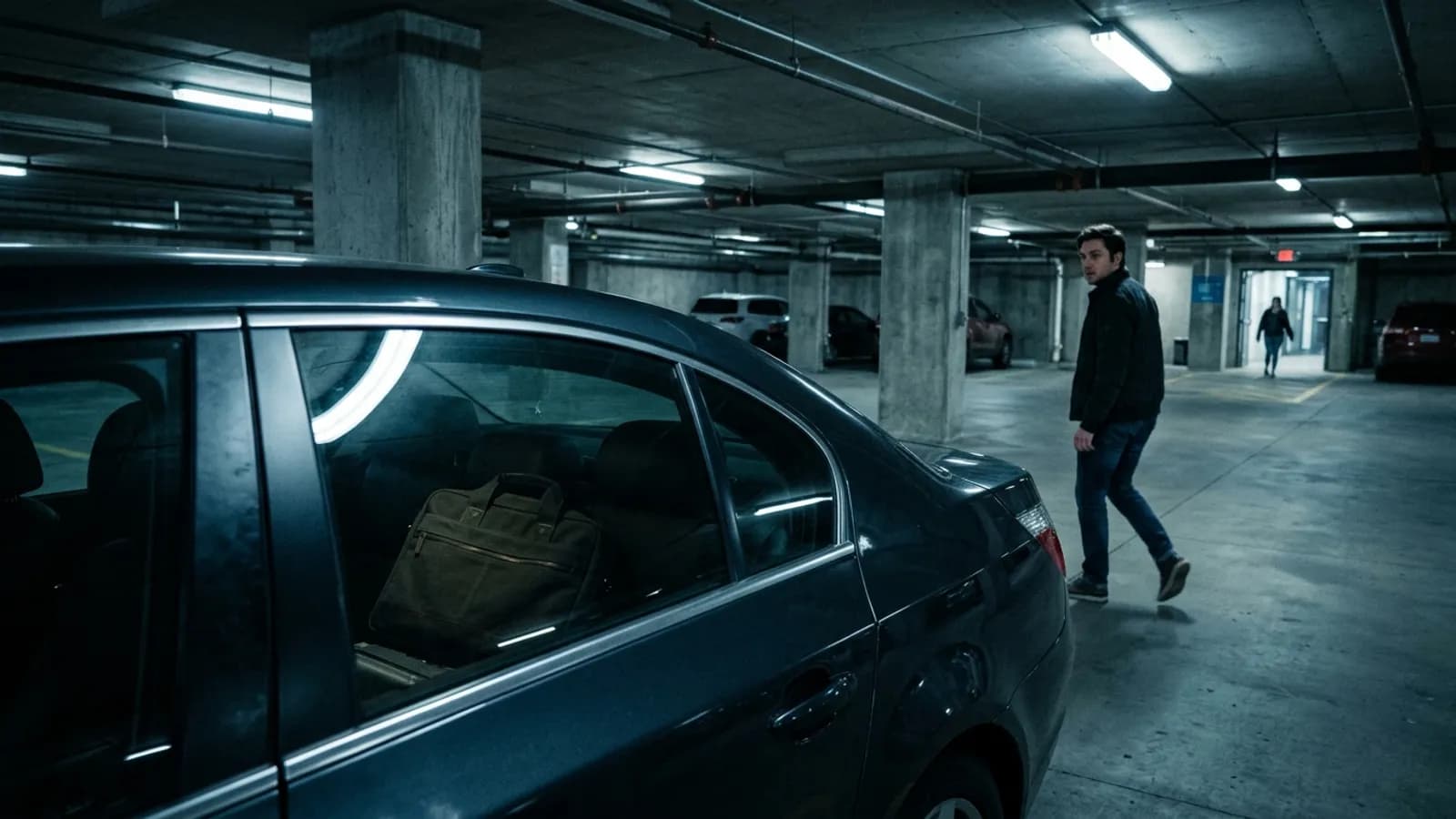
No — auto insurance covers the vehicle and its attached equipment, not personal belongings inside it. The stolen laptop, gym bag, and sunglasses claim against a homeowners or renters policy as personal property away from home. A break-in generates two claims against two policies.
The two-claim scene: a broken window plus a stolen bag
A break-in splits into two claims, and the split surprises everyone the first time. The smashed window is an auto comprehensive claim — glass damage to the vehicle, paid minus the auto deductible, often $0 under full-glass options. The stolen laptop, gym bag, and sunglasses are a homeowners or renters claim — personal property away from home, paid minus the property deductible. The renters insurance hub covers the property side, including the sub-limits below.
The dollar math decides whether the second claim is worth filing: $700 of stolen belongings against a $500 renters deductible nets $200, and the claim still registers in a claims-history file — which is why small thefts are often self-funded. The example that pays: a $2,200 camera bag and laptop stolen with the window smash — the auto claim covers the $380 glass, the renters claim covers $1,700 after deductible, and both file in parallel.
| Item stolen or damaged | The paying policy | The catch | | | --- | --- | | Smashed window | Auto comprehensive | Auto deductible; often $0 glass | | Laptop, bag, sunglasses | Homeowners or renters | Property deductible plus electronics sub-limits | | Factory stereo | Auto comprehensive | Pays at factory-equivalent value | | Aftermarket audio build | Auto custom-equipment endorsement | Only if declared | | Detachable faceplate (in a pocket) | Homeowners or renters | Ordinary personal property | | Work tools in a contractor's truck | Business property line, usually | Home-policy business caps are small, ~$2,500 |
Sub-limits on electronics and jewelry away from home
Standard property policies pay personal-property claims away from home — but with per-category sub-limits that bite on exactly the items stolen from cars. Typical structures: a $1,500–$2,500 cap on electronics away from the residence, lower caps on jewelry — $1,000–$1,500 is common — and separate treatment for business property, where a work laptop may ride a $2,500 cap or need a rider.
The scheduling fix: high-value items such as cameras, instruments, and watches can be scheduled individually with stated values and no deductible, commonly for $10–$60 per year per item — the mechanics are the personal property floater. The claim-day inventory problem: serial numbers, receipts, and a photo inventory are what turn a sub-limit argument into a paid claim, and they live in a cloud folder, not the car.
The prevention rule and the documentation that moves the claim
The cheapest coverage on stolen car contents is a trunk with nothing visible in it — the prevention rule outranks both policies, because the deductibles, sub-limits, and claims-history effects make small thefts bad economics no matter who pays. When a real loss happens, the claim sequence is fixed:
- File the police report first — both insurers want the number.
- Photograph before cleanup — glass, the empty mounting bracket, the point of entry.
- File the auto glass claim and the property claim in parallel, with the same documentation.
- Answer the sub-limit question with model numbers — the inventory list, receipts or bank-statement proof, and serial numbers are the file.
The equipment boundary — the bolted-in subwoofer versus the laptop on the seat — is drawn in the aftermarket parts guide, and the two policies' deductible mechanics sit side by side in the deductible glossary entry. The peril line that pays the glass is the comprehensive guide.
Quick answer: does car insurance cover personal items stolen from the car?
Usually no — the auto policy pays for the car (broken glass, lock damage through comprehensive) but not the belongings inside; stolen personal items fall to your homeowners or renters policy.
- The auto policy insures the vehicle, not its contents — the theft of a laptop or bag from a car is a property-theft claim on the home policy.
- Off-premises coverage is built into home/renters policies — typically up to about 10% of the contents limit, subject to that policy's deductible.
- Comprehensive pays the car's damage: the smashed window and scratched lock are a comprehensive claim on the auto side.
- Exclusions travel with the home policy: firearms, business equipment, and cash have their own special limits.
The trap: filing the laptop on the auto claim. The personal items guide walks the two-policy split; the renters policy at $15–$30 per month is the cheap instrument that actually pays here.
What the theft claim pays, priced
The home/renters claim pays the stolen property's value minus that policy's deductible — a $1,200 laptop against a $500 renters deductible returns $700, and the auto claim covers the glass repair under comprehensive minus the auto deductible. Two policies, two deductibles, one event — the reason the renters insurance hub ranks the pairing as the cheapest contents-plus-liability package available.
Related guides
The neighboring work is the renters policy that pays the belongings, the equipment boundary, and the glass claim from the same break-in.
- What Is Scheduled Personal Property? — the scheduling structure behind the floater.
- Does Car Insurance Cover Windshield Repair? — the glass claim from the same break-in.
- How Long Do Claims Affect Insurance? — the record small theft claims feed.
- What Is Actual Cash Value (ACV)? — how the property claim values the stolen items.
- Car Insurance: The Complete Guide — the hub for coverage structures and state rules.
Sources
Frequently asked questions
Whose policy pays if a friend's laptop is stolen from my car?
The friend's own renters or homeowners policy — their property follows them, not the vehicle. The auto policy covers the car and attached equipment; a property policy covers belongings. A guest's stolen items are their claim to file, with their documentation.
Is my tool chest stolen from a work truck covered?
Business-property caps on home policies are small, commonly around $2,500, and exclude some trade equipment entirely. A contractor or trade professional usually needs a business-policy inland-marine or contractor-equipment line to cover tools properly — price it against the chest's replacement cost.
Should I file a claim for a small theft from my car?
Run the deductible math first: a $600 theft against a $500 deductible returns $100 and adds a claim to the history. Filing makes sense when the loss clears the deductible meaningfully — usually $1,000 or more — or when the glass damage alone justifies the auto claim.
Is my car stereo theft covered?
Factory stereos claim under auto comprehensive. Aftermarket audio claims under a custom-equipment endorsement on the auto policy, if one was declared. The detachable faceplate taken from the pocket is personal property, covered by a homeowners or renters policy like any other belonging.
What is covered away from home on a renters or homeowners policy?
Personal property away from the residence is covered worldwide, subject to the policy's per-category sub-limits — typical structures cap electronics at $1,500–$2,500 away from home and jewelry lower. High-value items such as cameras can be scheduled individually with stated values and no deductible.
How we researched this guide
Car insurance pricing is set per driver, per ZIP code — so our guides anchor on regulator and industry statistics and explain the factors, not a fake exact price.
- Premium ranges are anchored to NAIC statewide average-expenditure data, the most complete public dataset on what drivers actually pay per state.
- State minimum-coverage requirements are checked against each state's motor-vehicle financial-responsibility statute and the state insurance department's consumer pages.
- What a coverage actually pays for is verified against policy declarations and specimen forms, not marketing copy.
- Discount and surcharge rules cite the state DOI consumer bulletin where each state regulates them differently — for example credit-based insurance scores, which most states permit but a few ban.
Where facts vary by state or insurer, we publish the range and the reason for the variation rather than a single misleading average. We do not sell insurance, take money from insurers for coverage, or publish claim amounts we cannot trace to a source.
Sources
The primary sources behind the facts on this page. Last verified November 17, 2026.
- IIHS — Insurance Institute for Highway Safety — crash-test data, vehicle loss statistics, and safety-feature research.
- NHTSA — National Highway Traffic Safety Administration — recalls, crash data, and state traffic-safety requirements.
- FMCSA — Federal Motor Carrier Safety Administration — commercial vehicle and carrier insurance requirements.
- NAIC — National Association of Insurance Commissioners — model regulations, consumer guides, and industry statistics.
- Find your state insurance regulator (NAIC directory) — every state insurance department — the authority for your state's rules and complaint filing.
- Insurance Information Institute (III) — industry statistics and consumer explainers we cross-check against regulator publications.
Rules that vary by state are verified against the state insurance department's consumer pages — find yours via the NAIC directory above.
Keep reading

Renters Insurance: The Complete Guide
Renters insurance covers your belongings, your liability, and your hotel bill when the rental is unlivable — what it pays, what it excludes, and how to pay less.
Read guide
Does Car Insurance Cover Aftermarket Parts?
Standard policies pay factory-equivalent parts and cap or exclude aftermarket mods — a custom parts and equipment endorsement covers declared upgrades.
Read guide
What Is Comprehensive Car Insurance? Coverage and Cost
Comprehensive car insurance pays for non-crash damage — theft, fire, hail, flood, falling objects, vandalism, animal strikes — commonly $100–$300 per year.
Read guideWhat Is a Personal Property Floater?
A floater is a scheduled personal property policy covering specific valuables — jewelry, cameras, bikes — at appraised value, no deductible, with broader perils.
Read guideWhat Is a Deductible? (Insurance, Explained)
A deductible is what you pay out of pocket for covered losses before insurance pays — health resets it yearly; auto and home apply it per claim.
Read guide