
Glossary
What Is a Personal Property Floater?
A floater is a scheduled personal property policy that insures specific high-value items individually — jewelry, cameras, bicycles, musical instruments, fine art — at appraised value, with no deductible and broader perils than the base policy, including mysterious disappearance. It is the standard fix for the contents policy's jewelry and electronics sub-limits.
How it works
Scheduling moves an item from the blanket contents limit to its own line with its own value, backed by an appraisal or receipt in the underwriting file. The scheduled item then pays the appraised value — agreed-value style on most forms — with no depreciation and, on most floaters, no deductible. The perils broaden too: mysterious disappearance, the lost ring that no theft can prove, is covered on scheduled forms but excluded under a blanket policy's theft-only trigger. Coverage is worldwide, so the travel loss pays where the blanket policy's off-premises caps bind — the ring lost on the honeymoon and the camera dropped in Rome both claim the same way a home loss would.
The floaters' real jobs: raising the special limits (jewelry, watches, furs), adding the lost-item peril, and keeping values current through re-appraisal. Carriers want current appraisals for items above roughly $2,500–$5,000, and storage and security conditions matter for art. The scheduled claim is the cleanest in the policy: no depreciation, no deductible, and the appraisal already in the file sets the number — which is why the stale-schedule problem is the floater's main maintenance burden, and why carriers re-request appraisals on their own cycle for high-value items. See scheduled personal property for the full endorsement family and rider for the attachment mechanism.
Typical values
| Attribute | Typical value |
|---|---|
| Premium | $1–$2 per $100 of value per year |
| Example cost | $6,800 ring: about $68–$136 per year |
| Deductible | Commonly $0 |
| Re-appraisal cycle | Every 3–5 years |
| Blanket jewelry sub-limit it replaces | Commonly $1,500 |
Floater vs blanket contents coverage
The blanket policy caps jewelry theft at a special sub-limit — commonly $1,500 — and pays nothing for the lost item, because loss without theft is not a covered peril. The floater removes the cap, pays appraised value, covers the loss, and waives the deductible. The category list keeps growing with the household: bicycles above the sports-equipment cap, drones, musical instruments, and coin or wine collections all schedule on the same mechanism. Households with several collectible categories commonly price better under one collections product than six separate floaters, but a single $6,800 ring prices best alone.
Worked example
A $6,800 engagement ring sits under the homeowners policy's $1,500 jewelry sub-limit. A theft claim pays $1,500 — a $5,300 gap; a drain drop pays nothing. The scheduled floater at $68 per year ($1 per $100 of value) pays the full $6,800 appraised value, covers the disappearance, and applies no deductible. One percent of the item's value per year buys the entire gap.
Related guides
Floaters answer the contents policy's special limits, and the neighboring pages — the scheduling family, the jewelry coverage questions, the high-value market — complete the valuation ladder.
- Actual Cash Value (ACV) — the depreciation math the floater's appraised-value payout avoids.
- Exclusions — the mysterious-disappearance gap the floater closes.
- Does Homeowners Insurance Cover Jewelry? — the sub-limit problem in full.
- Does Renters Insurance Cover Jewelry? — the same problem on renters policies.
- High-Value Home Insurance — where collections-level scheduling lives.
Sources
Frequently asked questions
What does scheduling jewelry actually change?
Three things: the payout (the scheduled appraised value instead of the $1,500 jewelry sub-limit), the perils (mysterious disappearance — a lost ring — becomes covered, where blanket policies pay only for theft), and the cost-sharing (no deductible on most floaters). The scheduled line pays the appraised value with no depreciation.
How much does a floater cost?
Commonly $1–$2 per $100 of value annually. The $6,800 engagement ring runs about $68–$136 per year with no deductible and full appraised-value payment. That is roughly 1–2% of the item's value per year, which is why scheduling beats the blanket sub-limit for anything above a few thousand dollars.
How often should I re-appraise scheduled items?
Every 3–5 years, or after significant market moves for precious metals and art. The policy pays the scheduled value — an item appraised at $6,000 in 2019 and worth $9,000 in 2025 leaves $3,000 unpaid at claim. Some carriers require re-appraisal on their own cycle for high-value items.
What is the difference between a floater and a rider?
Often nothing — the terminology varies by carrier. Both are endorsements attached to a base policy. The floater or scheduled personal articles policy is the specific form that insures named items individually at appraised value, while riders broadly modify a policy in many ways, including adding cash benefits.
Related guides
What Is Scheduled Personal Property?
Scheduled personal property is items listed individually on a policy at appraised value — no deductible, broader perils, full-value payment at loss.
Read guideWhat Is a Rider in Insurance?
A rider is an add-on that modifies an insurance policy — adding coverage such as water backup or jewelry scheduling, or adding benefits — for extra premium.
Read guideWhat Is a Deductible? (Insurance, Explained)
A deductible is what you pay out of pocket for covered losses before insurance pays — health resets it yearly; auto and home apply it per claim.
Read guide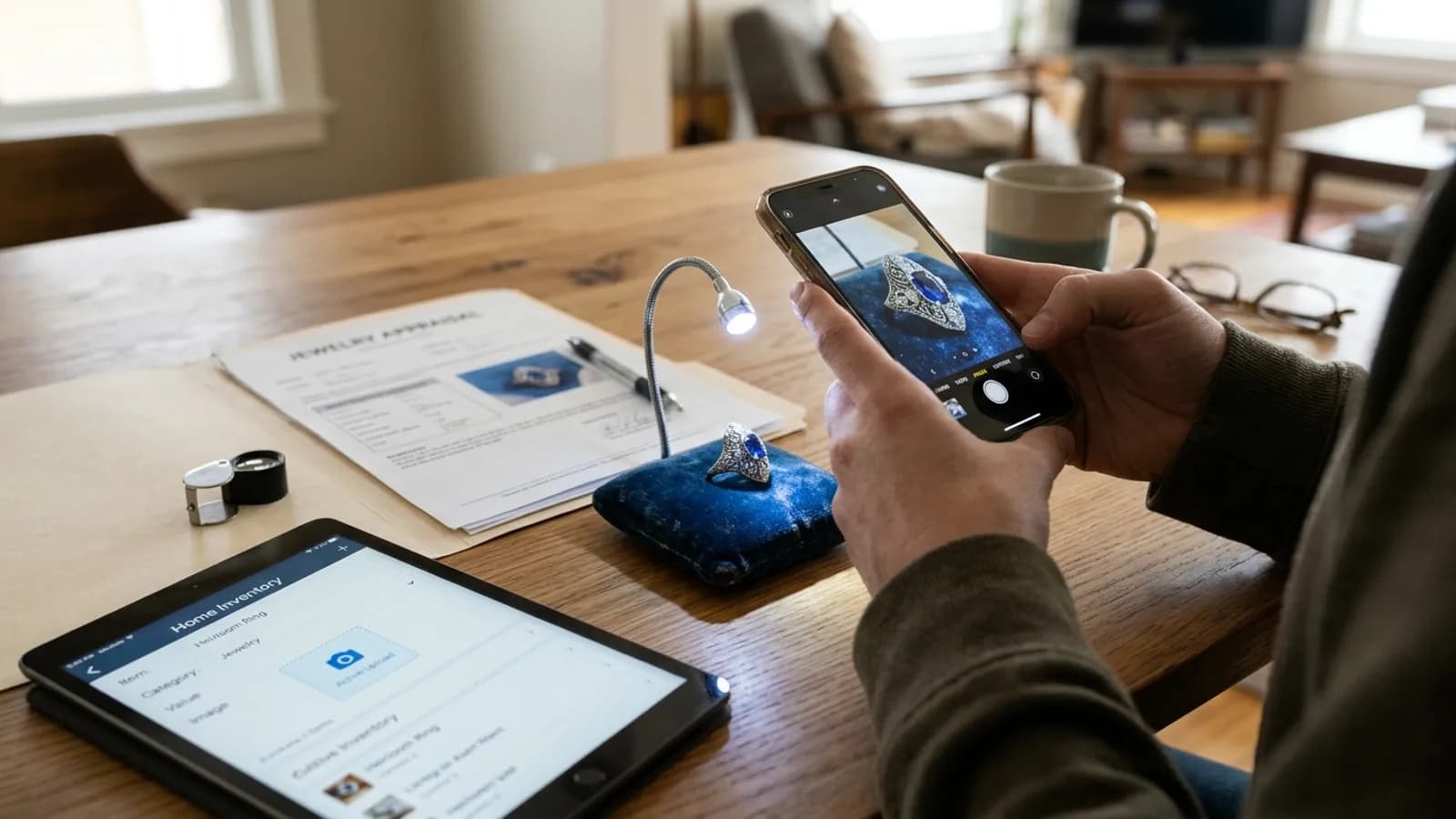
Does Homeowners Insurance Cover Jewelry?
Homeowners insurance covers stolen jewelry up to a small theft sub-limit, commonly $1,000–$2,500; scheduling items above the cap buys full, no-deductible coverage.
Read guide
Does Renters Insurance Cover Jewelry?
Yes up to a sub-limit — renters policies cap stolen jewelry at $1,000–$2,500; pieces above the cap need a scheduling endorsement for full appraised value.
Read guide
High-Value Home Insurance: The $1M+ House Market
Homes above $750k–$1M rebuild cost need the high-net-worth market: agreed-value settlements, cash-baseline claims, broader coverage, and risk consulting.
Read guide← Back to the full insurance glossary
Sources
The primary sources behind the facts on this page. Last verified November 10, 2026.
- HealthCare.gov Glossary — official ACA definitions for health-coverage terms.
- Insurance Information Institute (III) — property & casualty term definitions cross-checked against policy forms.
- NAIC consumer resources — regulator-authored guides and glossaries for each line of insurance.
Rules that vary by state are verified against the state insurance department's consumer pages — find yours via the NAIC directory above.