
Glossary
What Is Scheduled Personal Property?
Scheduled personal property is an item individually listed on a homeowners or renters policy at an appraised value, insured at that full figure with no deductible and broader perils — including mysterious disappearance — than the base contents coverage applies to unscheduled belongings.
How it works
Scheduling moves an item out of the general contents pool and onto its own line: the item appears on the declaration page with its own description and value, backed by an appraisal or receipt and photographs. The scheduled line pays that value at loss, with no deductible applied and without the depreciation haircut that contents claims otherwise take on the way to actual cash value.
The reason scheduling exists is the category sub-limit. Standard policies cap theft of jewelry, watches, and firearms at a few thousand dollars per category regardless of what an individual piece is worth — the structure behind the floater products carriers sell to lift those caps. Scheduled items also pick up perils the base policy narrows: loss and mysterious disappearance are covered, so the ring that goes down the drain is a claim, not a write-off.
Underwriting requirements scale with value: professional appraisals for jewelry and fine art above roughly $2,500–$5,000, receipts for recent purchases, and periodic re-appraisal for items that appreciate. Most carriers also grant newly acquired items 30–60 days of automatic coverage up to a percentage of the existing schedule — the window an engagement ring bought on Friday rides until the endorsement is updated.
Three disputes recur at claim time, and all three are settled by paperwork decisions made before the loss. The under-scheduled item pays the value set years earlier, which is why re-appraisal cycles matter for appreciating pieces. The pair-and-set clause decides what one lost earring of a scheduled pair pays. And the scheduled line carries its own exclusions — scheduling a watch does not cover its manufacturer defect, only the loss perils the endorsement names.
Typical values
| Parameter | Typical value |
|---|---|
| Scheduling cost | $1–$2 per $100 of appraised value per year |
| Jewelry theft sub-limit, standard policy | $1,000–$2,500 (commonly $1,500) |
| Firearms theft sub-limit, standard policy | $2,500 |
| Appraisal requirement | Items above roughly $2,500–$5,000 |
| New-acquisition window | 30–60 days automatic, capped as a share of the schedule |
| Deductible on scheduled items | $0 |
Scheduled property vs a blanket endorsement
Scheduling lists each item separately with its own value; a blanket jewelry endorsement raises the category cap — commonly to $10,000 and up — without per-item appraisals. Scheduling buys the broader perils and the zero deductible per piece; the blanket buys simplicity for many mid-value pieces. Collectible categories (coins, stamps, fine art collections) have their own agreed-value structures on top of both.
Worked example
A $6,800 engagement ring sits inside a $1,500 jewelry sub-limit on a standard homeowners policy. Scheduling it at $1 per $100 of value costs $68 per year. When the ring is lost down the drain — a peril the base policy excludes for jewelry — the scheduled endorsement pays the full $6,800 with no deductible. The unscheduled alternative pays $1,500 under the theft-only sub-limit, minus deductible. The $68 premium spanned $5,300 of claim difference.
Related guides
Scheduling is one rung of the valuation ladder — the sub-limits it lifts, the floater form behind it, and the jewelry rules underneath.
- What Is a Personal Property Floater? — the endorsement form scheduled items ride on.
- What Is Actual Cash Value (ACV)? — the depreciated standard scheduling overrides.
- What Is an Insurance Declaration Page (Dec Page)? — where the scheduled lines appear.
- Does Homeowners Insurance Cover Jewelry? — the sub-limits and theft caps in detail.
- Home Insurance: The Complete Guide — where contents coverage sits in the full policy.
Sources
Frequently asked questions
When should I schedule an item instead of relying on blanket coverage?
Schedule when the item's value exceeds its category sub-limit — commonly $1,500 for jewelry theft and $2,500 for firearms on standard policies — or when you want mysterious-disappearance coverage with no deductible. Items under the sub-limit ride the blanket fine, and scheduling them adds premium without adding protection.
What happens if I lose one earring of a scheduled pair?
The endorsement's pair-and-set clause decides. Some forms pay the full scheduled value and take salvage of the remaining piece; others pay a proportionate single-item value. Read the clause at scheduling, because the decision to schedule a pair as one line or two is made before any loss.
How much does scheduling jewelry cost?
Scheduling typically costs $1–$2 per $100 of appraised value per year. A $6,800 engagement ring runs roughly $68–$136 per year for coverage with no deductible, broader perils, and a payout at full appraised value — versus the category sub-limit a standard policy would apply to the same theft claim.
Related guides
What Is a Personal Property Floater?
A floater is a scheduled personal property policy covering specific valuables — jewelry, cameras, bikes — at appraised value, no deductible, with broader perils.
Read guideWhat Is Actual Cash Value (ACV)?
Actual cash value (ACV) pays replacement cost minus depreciation — used value, not new. The cheaper premium option pays smaller claims on contents, roofs, and cars.
Read guideWhat Is an Insurance Declaration Page (Dec Page)?
The declarations page is the summary at the front of every policy: insureds, limits, deductibles, premium, policy period, and endorsements — the page to read first.
Read guideWhat Is a Deductible? (Insurance, Explained)
A deductible is what you pay out of pocket for covered losses before insurance pays — health resets it yearly; auto and home apply it per claim.
Read guide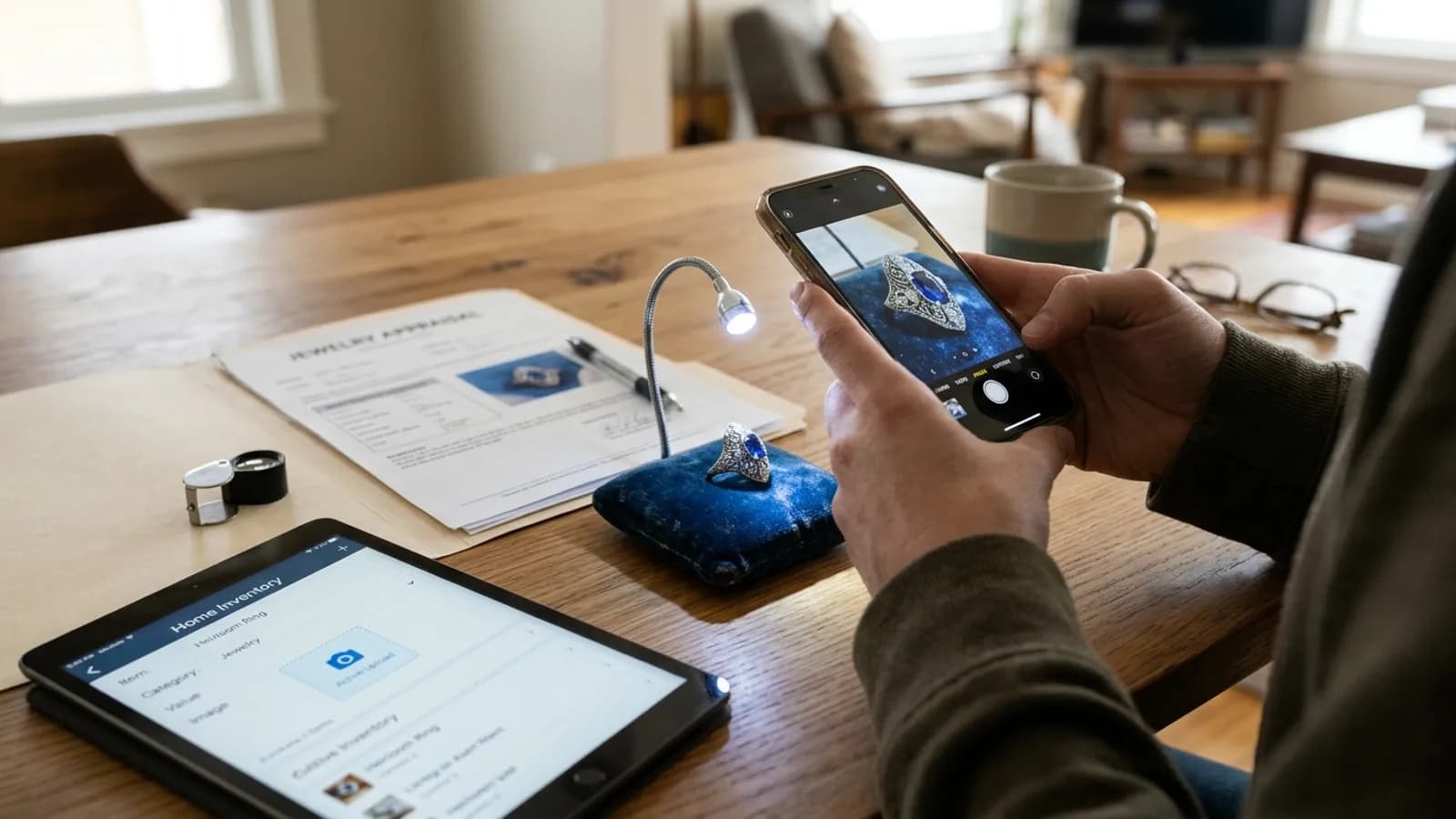
Does Homeowners Insurance Cover Jewelry?
Homeowners insurance covers stolen jewelry up to a small theft sub-limit, commonly $1,000–$2,500; scheduling items above the cap buys full, no-deductible coverage.
Read guide
Home Insurance: The Complete Guide
Homeowners insurance pays to rebuild, replace, and defend after fire, storms, and lawsuits — this guide maps coverage, exclusions, deductibles, and costs by state.
Read guide← Back to the full insurance glossary
Sources
The primary sources behind the facts on this page. Last verified November 10, 2026.
- HealthCare.gov Glossary — official ACA definitions for health-coverage terms.
- Insurance Information Institute (III) — property & casualty term definitions cross-checked against policy forms.
- NAIC consumer resources — regulator-authored guides and glossaries for each line of insurance.
Rules that vary by state are verified against the state insurance department's consumer pages — find yours via the NAIC directory above.