
Does Renters Insurance Cover a Stolen Bike?
Yes — renters insurance covers stolen bikes on and off premises, but bicycle sub-limits of $500–$2,000 cap the payout; pricier bikes need scheduling for full value.
Why you can trust this guide
- Written by Daniel Reyes, AINS, former licensed P&C agent — independent insurance education publisher.
- Factual accuracy reviewed and signed off by Marcus Hale, CPCU, AINS, licensed P&C agent (Independent insurance reviewer).
- Every factual claim traces to a regulator, statute, or policy document — sources are listed at the bottom of the page.
- Last verified ; time-sensitive guides are re-checked at least twice a year. Read our editorial policy.
On this page
Yes — renters insurance covers stolen bikes on and off premises, but most policies cap bicycles at $500–$2,000 through a sub-limit. A $3,000 road bike above the cap needs a scheduled-personal-property endorsement for full value.
What the standard policy pays for a bike
A bicycle is ordinary personal property: theft is covered anywhere, up to your contents limit, subject to your deductible and the valuation basis. The valuation is where claims disappoint. Worked example: an $800 bike stolen from a hallway, $500 deductible. Under replacement cost, the claim pays $300 toward a comparable new bike. Under actual cash value — the default on some carriers' base forms — a four-year-old bike depreciates to perhaps $450, and the claim pays nothing at all.
Scheduling changes the arithmetic. As scheduled personal property, the bike gets its own value, the deductible disappears, and accidental damage joins theft as covered perils, at roughly $1–$2 per $100 of value annually. Bikes above $1,000 are the scheduling candidates; below that, the standard claim is usually sufficient.
The location and evidence questions
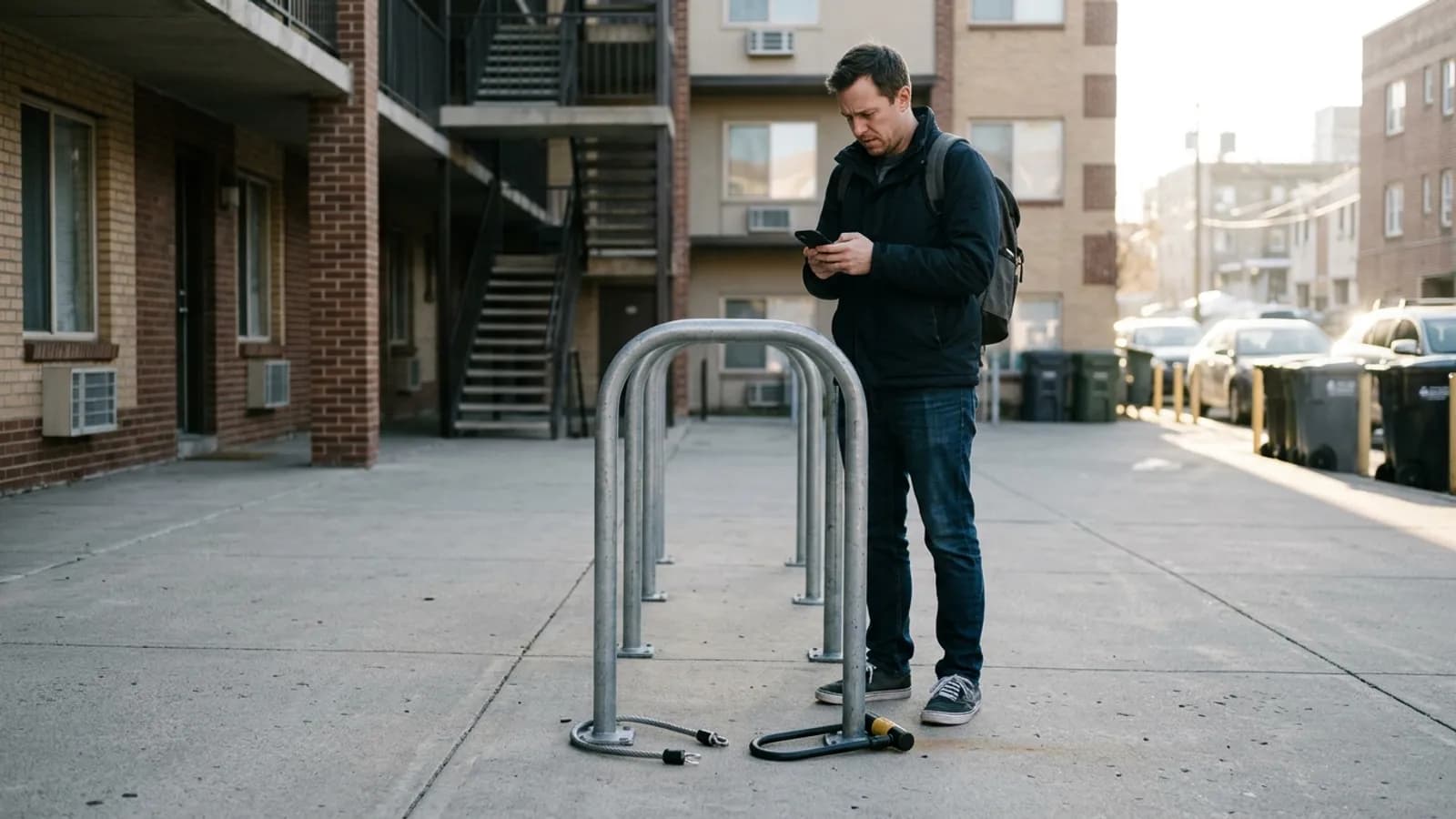
Theft location does not change coverage the way renters fear it does — a bike stolen from a rack downtown, a campus rack, or a car's bike carrier is the same property claim as one stolen from the hallway, because theft is covered everywhere. Two verification points apply. Some forms cap off-premises property at a percentage of the contents limit (10% is common), which shrinks the ceiling for bikes stolen away from home — worth checking before the trip to the trailhead. The car-theft variant has its own split between renters and auto; the theft-from-car question covers it.
Evidence drives the claim speed: the police report (required by most carriers for theft), photos of the scene and the remains of a cut lock, the serial number from the frame or the original receipt. A lock-cut photo is the single most persuasive artifact in a bike claim.
The scheduling decision for real bikes
The scheduling math favors serious bikes more than casual ones. A $1,500 road bike schedules for roughly $15–$30 per year, removes the $500 deductible from every claim, and adds the peril that actually totals bikes: accidental damage — the frame cracked in a crash, the carbon fork shattered in a pileup. E-bikes run the same analysis one layer deeper, because their motor classification can exclude them from standard property coverage entirely before scheduling is even discussed; the e-bike question covers the class map.
The unscheduled path still works for beater and mid-range bikes: theft is covered, the deductible applies, and the claim needs the same police report and serial evidence. The line to draw: if the bike's value exceeds two months of the deductible-plus-depreciation loss, schedule it. The claim process page details the filing sequence once the theft happens.
Filing the bike theft claim
- File the police report first — most carriers require the report number for theft.
- Photograph the scene, the lock remains, and the empty rack or storage spot.
- Send the frame serial number, purchase receipt, and bike photos with the claim.
- Confirm whether the bike was scheduled; if not, verify the sub-limit and valuation basis before accepting the offer.
The pre-theft file that wins the claim
The bike claim's evidence problem is unique: the bike is gone, so the documentation has to predate the theft. The file that works is three photos and one document. A full-bike photo against a neutral background proves the bike existed and shows its condition. A close-up of the frame's serial number — under the bottom bracket on most bikes — proves which bike. A photo of any upgrades (wheels, drivetrain, saddle) proves the value above the stock build. The document is the receipt, or the model's current listing price when the receipt is gone.
Bikes stored in hallways, campus racks, office bike rooms, and gym racks are the same property claim wherever they sit — the location changes the theft odds, not the coverage. Renters with serious bikes keep this file in the same cloud folder as the inventory video, which is the habit the first apartment checklist builds.
Related guides
Bike theft connects to the classification, scheduling, and claim questions:
- Does Renters Insurance Cover E-Bikes? — the class map that decides whether the motorized version is covered at all.
- Does Renters Insurance Cover Jewelry? — the other category that lives under a low sub-limit.
- What Is Renters Insurance and How Much Does It Cost? — the policy the sub-limit sits inside, at $15–$30 per month.
- What Is Replacement Cost Coverage? — the valuation basis that pays new-bike prices instead of depreciated ones.
Sources
Frequently asked questions
Is a bike stolen from a building's shared bike room covered?
Yes — theft from any location is covered under personal property. Photograph the scene and any broken lock or rack; forced-entry evidence strengthens the claim and satisfies carriers that want theft proof before paying. The frame serial number and purchase receipt complete the file.
Is a stolen e-bike covered by renters insurance?
It depends on the motor: pedal-assist bikes under a power threshold are typically covered as bicycles, subject to the sub-limit; throttle-driven and Class 3 e-bikes may be classified as motor vehicles and excluded. Verify the classification with the insurer before buying the e-bike.
What if my bike is stolen from my car or a rack downtown?
Covered — theft is theft, wherever it happens, subject to the sub-limit. The police report and serial number are the claim requirements; your inventory photos prove the bike and its value. Some forms cap away-from-home property at 10% of contents, so check that wording too.
Does renters insurance cover bike rentals?
No. Rented property is not yours to insure. Damage you cause while riding can fall under liability, and rental shops sell damage waivers for the bike itself — the waiver is the property coverage for anything you do not own.
What documentation does a bike theft claim need?
A police report, the frame serial number, purchase receipt or comparable-listing value, and photos of the scene — including a cut lock if there was one. Claims with all four artifacts move in days; claims without them stall. Keep the file in cloud storage so it survives the theft of a phone.
How we researched this guide
Renters coverage is small and simple, but landlord requirements and state rules vary — so we verify both sides of the lease.
- What HO-4 policies cover (and the liability and loss-of-use mechanics) is verified against standard policy forms and DOI consumer guides.
- Landlord-side insurance requirements are framed against HUD tenant-rights resources, since required coverage limits appear in lease terms, not statutes.
- Cost figures are ranges by state and coverage limit, anchored to NAIC statistics.
- Disaster-aid expectations are set from FEMA guidance: federal assistance is not a replacement for coverage, and we explain exactly what it does pay.
Where facts vary by state or insurer, we publish the range and the reason for the variation rather than a single misleading average. We do not sell insurance, take money from insurers for coverage, or publish claim amounts we cannot trace to a source.
Sources
The primary sources behind the facts on this page. Last verified November 10, 2026.
- HUD — tenant rights and responsibilities — state landlord-tenant rules that affect liability requirements.
- FEMA — renters and disaster assistance — what federal disaster aid does and does not cover for tenants.
- NAIC — National Association of Insurance Commissioners — model regulations, consumer guides, and industry statistics.
- Find your state insurance regulator (NAIC directory) — every state insurance department — the authority for your state's rules and complaint filing.
- Insurance Information Institute (III) — industry statistics and consumer explainers we cross-check against regulator publications.
Rules that vary by state are verified against the state insurance department's consumer pages — find yours via the NAIC directory above.
Keep reading
Does Renters Insurance Cover E-Bikes?
Depends on the class — pedal-assist e-bikes under common power thresholds are covered as bicycles, while Class 3 and moped-style models hit motor-vehicle exclusions.
Read guide
Does Renters Insurance Cover Theft From My Car?
Yes — belongings stolen from inside your car are covered by renters insurance as personal property; the car itself and attached equipment belong to auto coverage.
Read guide
The Renters Insurance Claim Process: From Theft to Reimbursement
Renters claims are won by documentation — police report, photos before cleanup, itemized inventory — and most simple claims pay within one to two weeks.
Read guideWhat Is Scheduled Personal Property?
Scheduled personal property is items listed individually on a policy at appraised value — no deductible, broader perils, full-value payment at loss.
Read guideWhat Is Actual Cash Value (ACV)?
Actual cash value (ACV) pays replacement cost minus depreciation — used value, not new. The cheaper premium option pays smaller claims on contents, roofs, and cars.
Read guide