
What Is Gap Insurance and How Does It Work?
Gap insurance pays the loan or lease balance your collision or comprehensive settlement leaves after a total loss — typically $20–$60 per year as an endorsement.
Why you can trust this guide
- Written by Daniel Reyes, AINS, former licensed P&C agent — independent insurance education publisher.
- Factual accuracy reviewed and signed off by Marcus Hale, CPCU, AINS, licensed P&C agent (Independent insurance reviewer).
- Every factual claim traces to a regulator, statute, or policy document — sources are listed at the bottom of the page.
- Last verified ; time-sensitive guides are re-checked at least twice a year. Read our editorial policy.

On this page
Gap insurance pays the difference between your car's actual cash value and what you still owe on the loan or lease after a total loss or theft. Your comprehensive or collision settlement covers the car's market value — not your loan balance. Gap coverage closes that gap so you do not keep paying a loan on a car you no longer have.
Why the gap exists
New cars depreciate fastest in years one and two, while loan balances fall slowly at first because early payments are mostly interest. Combine the two curves and a mismatch appears:
| Point in ownership | Car value (insurer payout) | Loan balance | Out-of-pocket without gap | | | --- | --- | --- | | Day 1 | $30,000 | $32,500 (taxes, fees rolled in) | $2,500 | | End of year 1 | $23,000 | $27,500 | $4,500 | | End of year 2 | $19,000 | $22,000 | $3,000 |
A total loss in year one — a crash, theft, flood — leaves the owner in the table's right column without gap coverage. Leases behave similarly, which is why nearly every lease contract includes gap automatically.
How a gap claim works, step by step
- Your car is declared a total loss or is stolen and not recovered.
- Your insurer pays the actual cash value minus your deductible, typically to the lender or lease company.
- Gap coverage pays the remaining balance up to the policy's cap (commonly 25% of the car's value above the payout).
- Some gap products also cover the deductible and (rarely) a down-payment credit for a replacement car.
You buy gap insurance in three ways: as an endorsement on your auto policy (cheapest), from the dealership at purchase (most expensive), or from a standalone provider after the sale. The endorsement route also means one claim handles everything.
Who needs it — and who doesn't
Buy it if any of these describe you:
- New or nearly new car with less than 20% down
- Loan term of 60+ months
- Negative equity rolled in from a previous trade-in
- Leasing (check — most leases include it)
- A car model that depreciates unusually fast
Skip it if:
- You put 20%+ down on a standard-length loan
- The loan balance is already below the car's value
- The car is older and holds value (or you paid cash)
What it costs
| Source | Typical price | Notes |
|---|---|---|
| Auto insurer endorsement | ~$20–$60 per year | One claim process; cancellable anytime |
| Dealership, financed | $400–$700 one-time | Plus interest once rolled into the loan |
| Standalone provider | $200–$400 one-time | Middle option; shop the terms |
The same protection routinely costs five to ten times more at the dealership desk than as a policy endorsement — and dealer products financed at 7% interest cost even more by the time you finish paying.
Common exclusions to check
- Late or missed payments on the loan (some products void coverage)
- Mechanical repairs, negative equity from the original trade-in (varies by product)
- Cars with altered odometers or salvage titles
- More than one claim per policy term on some standalone products
The 72-month loan math that creates a $3,500 hole
The gap exists because two curves diverge — the car's value falls fast while the loan balance barely moves — and a worked loan shows the size of it. Illustrative numbers: a $28,000 SUV with 10% down ($2,800) financed over 72 months at a typical rate. Early payments are mostly interest, so the balance after one year sits near $25,900. The same car's market value after a year — depreciation heaviest in year one — is commonly $22,400. A total loss in that window (a crash, a theft, a flood) produces a comprehensive or collision settlement of $22,400 minus the deductible, against a payoff of $25,900 — a hole of roughly $3,500 the owner owes on a car they no longer have. Add the rolled-in taxes and fees and a trade-in's negative equity, and the hole grows past $6,000. The gap closes on its own schedule — usually inside two to three years — which is both the case for buying it and the case for cancelling it early.
Lease gap versus loan gap: the wording differences
The gap product behaves differently on a lease than on a loan, and the differences are in the paperwork, not the concept. The lease version: most modern leases build gap into the contract itself, covering the difference between the insurance settlement and the lease payoff at a total loss — check the lease's insurance section before buying a second policy, because the double-purchase is the classic mistake. The loan version: gap is optional, bought as an insurer endorsement ($20–$60 per year), a dealer product ($400–$700 financed), or a standalone policy. The cap differences: insurer endorsements commonly cap the payout at a percentage above the ACV settlement (25% is a common band), while lease-included gap covers the full residual — a heavily rolled-over loan can outrun an endorsement's cap, which is one of the exclusion lines to read. The lender layer: some lenders require gap for high loan-to-value deals as a condition of financing. The lease-specific requirements are detailed in the leased car guide, and the purchase-day pricing is in the new car guide.
The gap-claim edge cases that get disputed
Gap claims are simple until one of five facts complicates them, and every one of them is visible before purchase:
- Missed or late loan payments — several gap products void coverage for delinquent accounts, so the claim that coincides with one is the contested one.
- Negative equity rolled in from the original trade-in — some products cover it, some cap it, some exclude it; the amount and its treatment belong in the policy's fine print, not the sales desk's memory.
- Aftermarket additions — the wrap, wheels, and audio added after purchase ride above the ACV and the gap cap alike; custom parts coverage is a separate question.
- A second claim in the same term — some standalone gap policies cover one total loss per policy period; read the line.
- Late notice after a theft — the comprehensive claim's prompt-notice condition applies to the gap claim behind it.
The dealer-financed versions concentrate these disputes, because the terms were explained at a signing desk and never re-read — the endorsement from your insurer carries the clearest terms and the cheapest price band. The settlement the gap claim sits behind comes from the comprehensive or collision side, and the package those two live in is the full coverage guide.
Quick answers: what gap insurance does and doesn't pay
Gap insurance pays only the difference between a totaled car's actual cash value and the loan or lease balance (minus the policy's deductible). It pays when: a financed or leased car is stolen or totaled early in the loan. It does not pay: the car's repair bills, a trade-in shortfall you negotiated into the next loan, extended warranties rolled into financing beyond the vehicle price, missed payments unrelated to the total loss, or any car you own outright — no loan, no gap. The full trigger and exclusion mechanics are the sections above.
Related guides
Gap insurance sits on top of the total-loss settlement and the loan balance — these pages define the numbers it bridges.
- What Is Actual Cash Value (ACV)? — the depreciated-value formula every physical-damage payout starts from.
- What Is a Total Loss? — when a car is declared total, and how the settlement is set.
- Does Car Insurance Cover Hit-and-Run? — how unidentified-driver claims pay under collision and uninsured-motorist coverage.
- New Car Insurance Checklist — the drive-home steps that configure a new car's policy correctly.
- Car Insurance: The Complete Guide — the coverage structures, state rules, and savings levers every other page builds on.
Sources
Frequently asked questions
When do I need gap insurance?
You need gap coverage when your loan or lease balance can exceed the car's value — typically new cars with little or no down payment, loans longer than 48 months, rolled-over negative equity from a trade-in, and most leases (which usually include gap automatically). Once your loan balance falls below the car's value, gap coverage is no longer useful.
How much does gap insurance cost?
Through a car dealership or rolled into financing, gap coverage commonly costs $400–$700 as a one-time charge. Through your auto insurer as a policy endorsement, the same protection typically costs $20–$60 per year. Always price the insurer version first — the dealer product also adds interest once financed.
Does gap insurance cover my deductible?
Some gap policies cover your collision or comprehensive deductible after a total loss, and some do not — read the terms. Standard gap coverage pays the gap between the insurance settlement and the loan or lease payoff; deductible coverage, if offered, is an additional benefit of specific products.
Can I cancel gap insurance and get a refund?
Yes. Dealer-purchased gap policies can usually be cancelled for a pro-rated refund at any time, and several states require lenders to auto-refund when you pay the loan off early. Insurer endorsements simply drop off the policy. Cancelling after the loan drops below the car's value is one of the easiest wins in car ownership.
Does gap insurance work on a used-car loan?
Yes — gap covers any loan where the balance can exceed the car's value, including used-car loans with low down payments or terms of 60+ months. Older used cars depreciate more slowly, so the gap window is shorter, but a lightly-financed two-year-old car still carries a real gap in year one.
Does gap coverage pay if my stolen car is recovered damaged?
Generally no — gap pays after a total loss or a theft that is never recovered. If the stolen car comes back, the comprehensive claim becomes a repair claim, and gap has nothing to pay because the loan continues on the repaired car. The gap exposure resumes if the car is later totaled.
How we researched this guide
Car insurance pricing is set per driver, per ZIP code — so our guides anchor on regulator and industry statistics and explain the factors, not a fake exact price.
- Premium ranges are anchored to NAIC statewide average-expenditure data, the most complete public dataset on what drivers actually pay per state.
- State minimum-coverage requirements are checked against each state's motor-vehicle financial-responsibility statute and the state insurance department's consumer pages.
- What a coverage actually pays for is verified against policy declarations and specimen forms, not marketing copy.
- Discount and surcharge rules cite the state DOI consumer bulletin where each state regulates them differently — for example credit-based insurance scores, which most states permit but a few ban.
Where facts vary by state or insurer, we publish the range and the reason for the variation rather than a single misleading average. We do not sell insurance, take money from insurers for coverage, or publish claim amounts we cannot trace to a source.
Sources
The primary sources behind the facts on this page. Last verified November 17, 2026.
- IIHS — Insurance Institute for Highway Safety — crash-test data, vehicle loss statistics, and safety-feature research.
- NHTSA — National Highway Traffic Safety Administration — recalls, crash data, and state traffic-safety requirements.
- FMCSA — Federal Motor Carrier Safety Administration — commercial vehicle and carrier insurance requirements.
- NAIC — National Association of Insurance Commissioners — model regulations, consumer guides, and industry statistics.
- Find your state insurance regulator (NAIC directory) — every state insurance department — the authority for your state's rules and complaint filing.
- Insurance Information Institute (III) — industry statistics and consumer explainers we cross-check against regulator publications.
Rules that vary by state are verified against the state insurance department's consumer pages — find yours via the NAIC directory above.
Keep reading
What Is Actual Cash Value (ACV)?
Actual cash value (ACV) pays replacement cost minus depreciation — used value, not new. The cheaper premium option pays smaller claims on contents, roofs, and cars.
Read guideWhat Is a Total Loss?
A total loss is declared when repair costs plus salvage approach the car's actual cash value — thresholds run 70–100% — and the insurer pays ACV minus deductible.
Read guide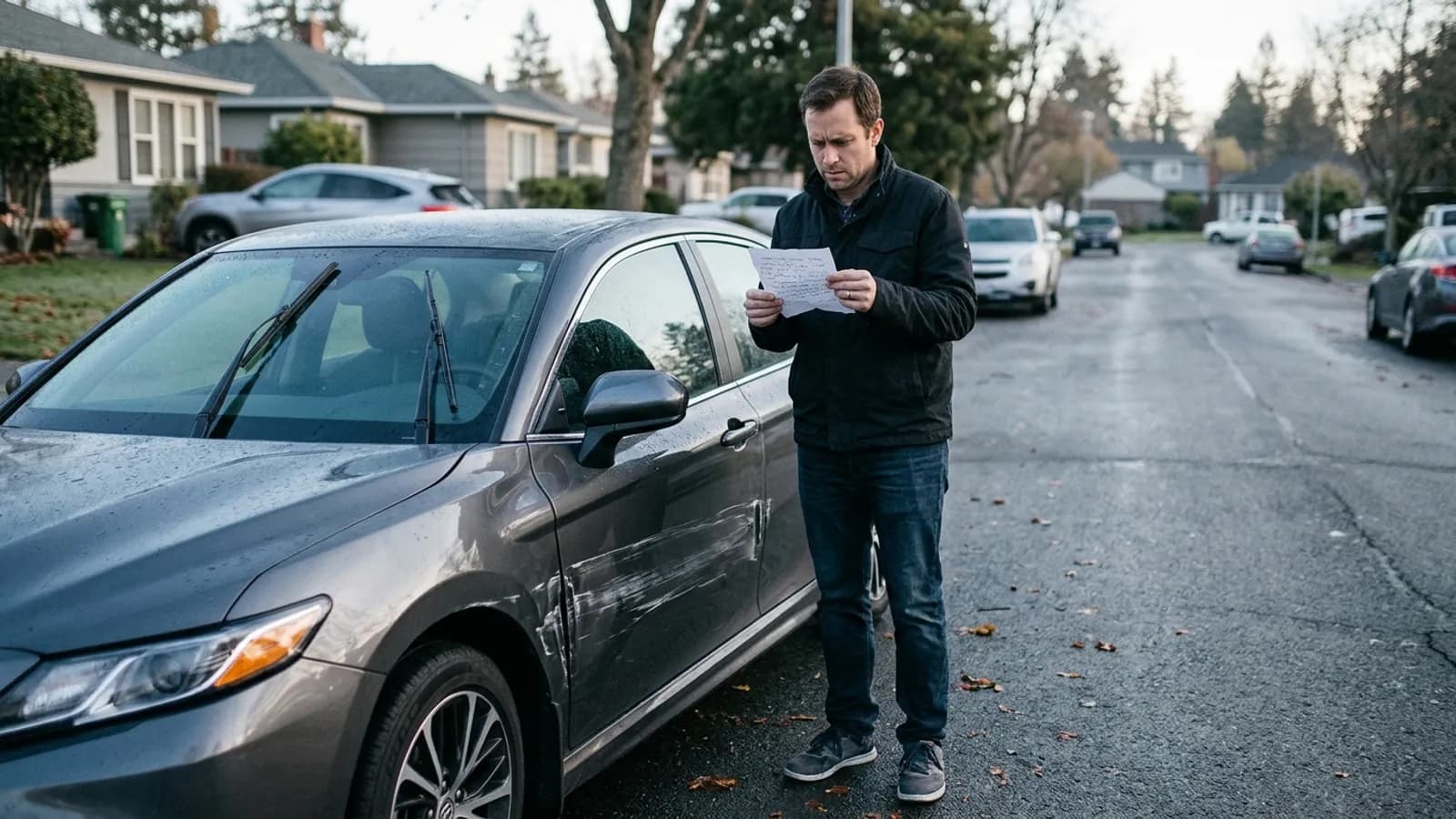
Does Car Insurance Cover Hit-and-Run?
Hit-and-run damage claims under collision and injuries under uninsured motorist — the unidentified driver counts as uninsured. The claim protocol and refund path.
Read guide
New Car Insurance Checklist
The new car insurance checklist: the dealership-day call, the grace window, gap coverage, liability limits, endorsements worth pricing, and the first-30-days audit.
Read guide
Car Insurance: The Complete Guide
Car insurance bundles liability, collision, comprehensive, and medical coverage — this guide explains state minimums, full coverage, and how to lower the premium.
Read guide