
What Is Collision Car Insurance? Coverage, Deductibles, and Cost
Collision insurance pays to repair or replace your car after a crash with a vehicle or object, regardless of fault — commonly $300–$900 per year.
Why you can trust this guide
- Written by Daniel Reyes, AINS, former licensed P&C agent — independent insurance education publisher.
- Factual accuracy reviewed and signed off by Marcus Hale, CPCU, AINS, licensed P&C agent (Independent insurance reviewer).
- Every factual claim traces to a regulator, statute, or policy document — sources are listed at the bottom of the page.
- Last verified ; time-sensitive guides are re-checked at least twice a year. Read our editorial policy.
On this page
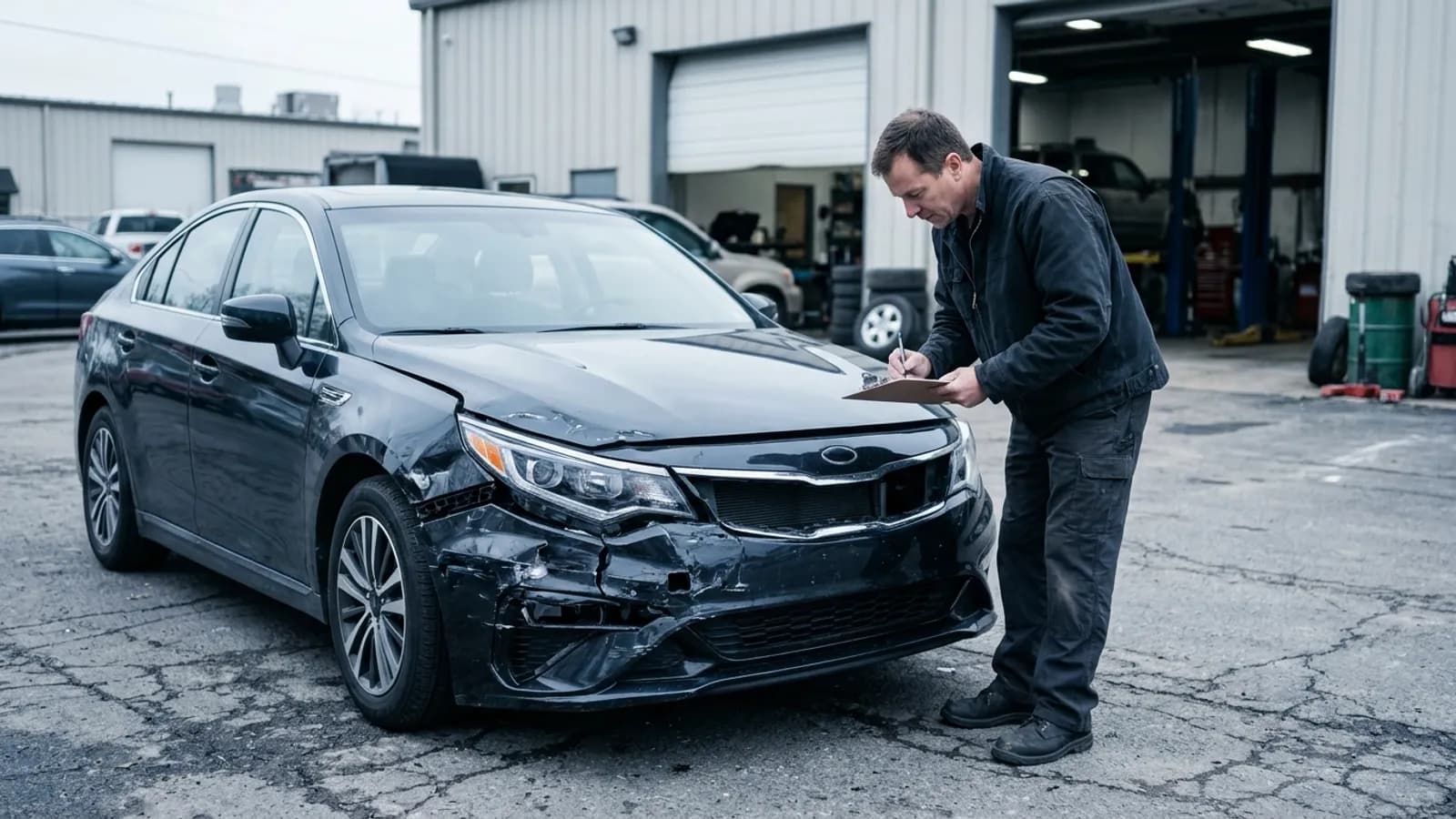
Collision insurance pays to repair or replace your own car after a crash — with another vehicle, or with an object like a pole, guardrail, or tree — no matter who was at fault. It pays the car's actual cash value minus your collision deductible. Like comprehensive, it is optional under state law and required by lenders on financed cars.
What collision covers
- Rear-end, side-impact, and head-on crashes with another vehicle
- Single-car crashes into stationary objects (poles, fences, buildings, guardrails)
- Rollovers
- Hit-and-run damage where no other driver is identified (in most states)
- Pothole damage under some policies
What it does not cover
- Non-crash damage — theft, weather, glass, animals — which is comprehensive
- Injuries to you or others (medical payments/PIP and liability handle those)
- Damage to the other driver's car (liability pays them, or their collision pays them)
- Mechanical failures, normal wear, and depreciation
How collision interacts with liability
| Situation | Your car | Their car | Your medical | | | --- | --- | --- | | You cause the crash | Collision (minus deductible) | Your liability pays them | Your MedPay/PIP | | They cause the crash | Their liability — or your collision pays now | Their problem | Their liability or your MedPay | | Hit-and-run / uninsured driver | Collision — or uninsured motorist property damage where offered | Nobody's | Uninsured motorist bodily injury |
The "they were at fault" column is where collision earns its premium: your insurer pays immediately, pursues reimbursement (subrogation) later, and often refunds your deductible if they recover from the other side.
What it costs
Collision is the priciest physical-damage coverage — commonly $300–$900 per year ($25–$75 per month), scaled to your car's value, repair costs, and your driving record. A new $50,000 SUV costs far more to cover than a ten-year-old sedan. Deductible choices ($250–$1,000) move the premium meaningfully; see our guide to lowering car insurance.
The drop decision: the ten-times rule
Collision's value falls with your car's book value, so the premium eventually outgrows the protection:
- Find your car's current private-party value.
- Multiply your annual collision premium by ten.
- If the value is lower, price the policy without collision and compare.
Example: a car worth $2,500 with $500 per year in collision premium and a $500 deductible — a worst-case claim pays about $2,000, while three years of premium costs $1,500. Self-insuring via a repair fund often wins at that point. Keep collision if you could not replace the car, or if the numbers are close and you sleep better with it.
Filing a collision claim
- Document the scene: photos of both cars, plate numbers, position, and witnesses before anything is moved.
- Report promptly — most policies require prompt notice even for single-car damage.
- Get the adjuster's estimate, or use a shop you trust; you can generally choose the repair shop.
- Pay your deductible to the shop; the insurer pays the rest of the repair cost, or pays actual cash value (minus deductible) on a total loss.
Deductible math on a real repair bill
The deductible is the only dial on collision that changes both the premium and the claim day, so it deserves real numbers. Take a common single-car claim: a low-speed impact into a pole, repair estimate $3,400. With a $500 deductible, the insurer pays $2,900 and you pay $500. With a $1,000 deductible, the insurer pays $2,400 and you pay $1,000. On the premium side, raising the deductible from $500 to $1,000 commonly cuts the collision line by $150–$200 per year. The breakeven: paying $175 per year to carry $500 more risk per claim only wins if you file a collision claim less than roughly once every three years. Drivers with a decade of claim-free years have, statistically, been overpaying for the low deductible; drivers with a recent claim or a long, high-traffic commute have not. Match the number to the emergency fund first — the deductible guide covers the mechanics across coverages.
Subrogation: how not-at-fault collision claims get money back
When the other driver was at fault, your collision coverage is a cash-flow tool, not a concession of fault. The sequence: your insurer pays the repair or total loss immediately (minus your deductible), then pursues the at-fault driver's carrier for reimbursement through subrogation — and when it recovers, your deductible comes back to you, commonly within weeks to a few months after the recovery closes. This is why the documentation at the scene decides the money: photos, the police report number, and the other driver's insurance card are the subrogation file. The same machinery explains the hit-and-run structure — no identified driver means nobody to subrogate against, which is covered in the hit-and-run guide. One timing note: never wait for the other carrier to "do the right thing" — your own collision policy exists to pay now and fight later.
The total-loss fork at the end of a collision claim
Every significant collision claim reaches a fork: repair or declare a total loss. The trigger is economic — when the repair estimate approaches or exceeds the car's actual cash value (thresholds vary by state and carrier, commonly in the 70–100% of ACV range), the claim converts to a total-loss settlement: ACV minus your deductible, paid to you or to the lender if the car is financed. The two money questions at the fork: whether the ACV offer reflects real local comparables (counter it with listings and maintenance records), and whether the loan balance exceeds the payout — in which case gap coverage is the difference-maker, with the full mechanics in the gap insurance guide. Rental reimbursement typically ends when the settlement is made, not when the check clears, so the last week of the claim is the week to arrange the replacement car.
Related guides
Collision sits in a coverage pair and a claim path — these pages carry the other halves.
- What Does Full Coverage Car Insurance Cover? — what the liability-plus-comp-plus-collision package includes, excludes, and costs.
- Average Cost of Car Insurance in 2026 — the national and state baselines your quote should beat, with the factor table.
- What to Do After a Car Accident: The 10-Step Claim Checklist — the scene-to-settlement sequence that protects the claim.
- Does Car Insurance Cover Rental Cars? — how rental reimbursement and rental-car coverage interact.
- Car Insurance: The Complete Guide — the coverage structures, state rules, and savings levers every other page builds on.
Sources
Frequently asked questions
What does collision insurance cover?
Collision pays to repair or replace your own car after it hits another vehicle, or after a single-car crash with an object — a pole, guardrail, tree, or pothole damage in some policies. It applies regardless of who was at fault, and pays the car's actual cash value minus your collision deductible.
Do I need collision insurance if the other driver was at fault?
The other driver's liability insurance pays for your damage when they are clearly at fault — but claims can take weeks, disputed-fault cases can drag on, and uninsured drivers may pay nothing. Collision gets your car fixed now and lets the insurers settle fault afterward. That speed is the main reason at-fault-proof drivers still carry it.
How much is collision coverage per month?
Collision commonly costs $25–$75 per month ($300–$900 per year), more for new, expensive, or high-repair-cost vehicles and for drivers with recent at-fault crashes. The premium tracks the car's value and repair cost, which is why it falls as the car ages.
What deductible should I choose for collision?
Choose the highest deductible you could pay from savings the day after a crash. Moving from $250 to $500 or $1,000 typically cuts the collision premium by 15–30%. A deductible you cannot afford turns a covered accident into a debt problem.
Can I choose my own repair shop after a collision claim?
Yes — in every state, the choice of repair shop is yours. Insurer direct-repair programs offer convenience and workmanship guarantees, and are entirely optional. For major damage, an independent estimate alongside the insurer's scope is the standard consumer protection.
Does a not-at-fault collision claim raise my premium?
Much less than an at-fault claim, and several states prohibit not-fault surcharges outright. Some carriers still weigh claim frequency at renewal. The practical move: ask whether the claim was surcharged, then re-shop — competitors price not-fault history more gently than incumbents.
How we researched this guide
Car insurance pricing is set per driver, per ZIP code — so our guides anchor on regulator and industry statistics and explain the factors, not a fake exact price.
- Premium ranges are anchored to NAIC statewide average-expenditure data, the most complete public dataset on what drivers actually pay per state.
- State minimum-coverage requirements are checked against each state's motor-vehicle financial-responsibility statute and the state insurance department's consumer pages.
- What a coverage actually pays for is verified against policy declarations and specimen forms, not marketing copy.
- Discount and surcharge rules cite the state DOI consumer bulletin where each state regulates them differently — for example credit-based insurance scores, which most states permit but a few ban.
Where facts vary by state or insurer, we publish the range and the reason for the variation rather than a single misleading average. We do not sell insurance, take money from insurers for coverage, or publish claim amounts we cannot trace to a source.
Sources
The primary sources behind the facts on this page. Last verified November 10, 2026.
- IIHS — Insurance Institute for Highway Safety — crash-test data, vehicle loss statistics, and safety-feature research.
- NHTSA — National Highway Traffic Safety Administration — recalls, crash data, and state traffic-safety requirements.
- FMCSA — Federal Motor Carrier Safety Administration — commercial vehicle and carrier insurance requirements.
- NAIC — National Association of Insurance Commissioners — model regulations, consumer guides, and industry statistics.
- Find your state insurance regulator (NAIC directory) — every state insurance department — the authority for your state's rules and complaint filing.
- Insurance Information Institute (III) — industry statistics and consumer explainers we cross-check against regulator publications.
Rules that vary by state are verified against the state insurance department's consumer pages — find yours via the NAIC directory above.
Keep reading

What Does Full Coverage Car Insurance Cover?
Full coverage car insurance is liability plus comprehensive and collision — what each part pays, what it excludes, what it costs, and when liability-only wins.
Read guide
Average Cost of Car Insurance in 2026
Full coverage car insurance averages roughly $1,500–$2,500 per year and minimum liability $400–$900 per year nationally — age, state, and record swing the number.
Read guide
What to Do After a Car Accident: The 10-Step Claim Checklist
The post-accident sequence that protects your claim: scene safety, documentation, prompt insurer notice, the adjuster process, and the statements that cost money.
Read guide
Does Car Insurance Cover Rental Cars?
Most auto policies extend liability and often comprehensive and collision to U.S. rental cars at your own limits — loss-of-use fees and foreign rentals are the gaps.
Read guide
Car Insurance: The Complete Guide
Car insurance bundles liability, collision, comprehensive, and medical coverage — this guide explains state minimums, full coverage, and how to lower the premium.
Read guide