
Does Renters Insurance Cover Drones?
Sometimes — drones are claimable as personal property for theft and covered perils; the liability a flying drone creates is excluded by most personal policies.
Why you can trust this guide
- Written by Daniel Reyes, AINS, former licensed P&C agent — independent insurance education publisher.
- Factual accuracy reviewed and signed off by Marcus Hale, CPCU, AINS, licensed P&C agent (Independent insurance reviewer).
- Every factual claim traces to a regulator, statute, or policy document — sources are listed at the bottom of the page.
- Last verified ; time-sensitive guides are re-checked at least twice a year. Read our editorial policy.
On this page
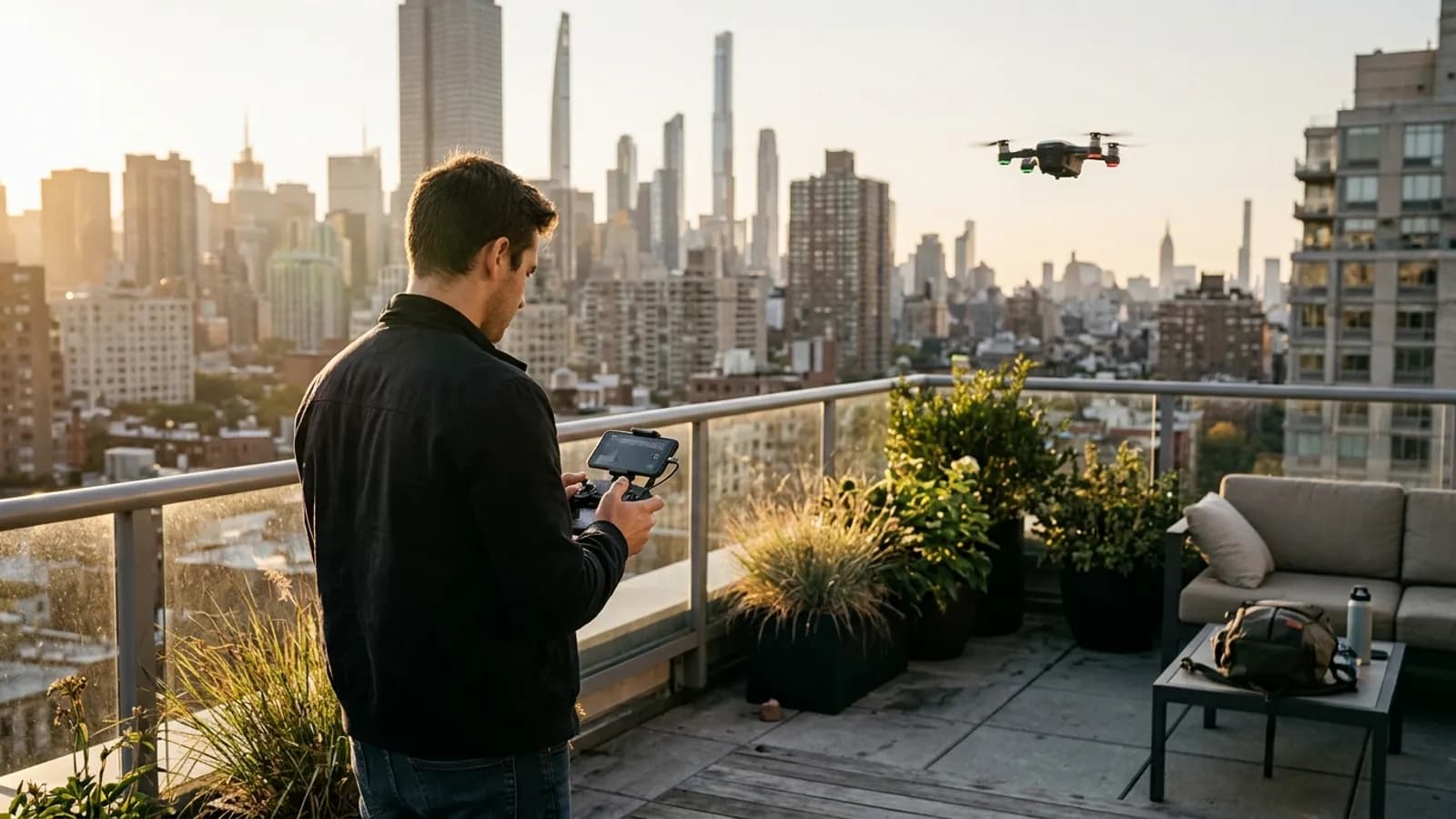
Sometimes — renters insurance covers a stolen or fire-damaged drone as personal property, but the liability a flying drone creates is commonly excluded, and any commercial use needs a separate policy.
How a drone claim gets paid
A drone loss resolves through one of two coverages, and the aircraft wording decides which. The drone itself is personal property: theft, fire, and other named perils pay up to your contents limit, subject to your deductible and any electronics sub-limits. What the drone damages — a neighbor's car, a window — is a liability claim, paid under personal liability up to that limit, when the form does not exclude aircraft operations.
The gate between the two lanes is the aircraft wording: consumer camera drones under common weight thresholds are generally treated as personal property on standard forms, while larger aircraft and commercial operations can trip the aircraft exclusion entirely. The FAA registration rule (drones over 250 grams must be registered) is unrelated to insurance, but it is the first fact an adjuster checks for commercial-use signals.
What your policy will not do for a drone
- Accidental crash damage to your own drone — not a named peril; policies pay theft and sudden perils, not breakage you caused.
- A flyaway drone that never returns — a disappearance loss, rarely claimable on an unscheduled item.
- Commercial work — paid footage, real-estate shoots, inspections — business use, excluded for both property and liability; Part 107 operators need dedicated aviation or drone-specific policies.
- Heavier platforms — large aircraft can trip the aircraft exclusion before any question of money arises.
The pattern to remember: the policy insures the drone as a possession, not as an aircraft. The moment the drone behaves like an aircraft — commercial operations, heavier platforms — a different product takes over.
The scheduling and specialty options
Two upgrades change the drone math. Scheduling the drone as scheduled personal property lists it at its own value, removes the deductible, and adds accidental-damage coverage at some carriers — the difference between a $1,200 drone stolen from a car (standard claim, $500 deductible, pays $700) and the same drone dropped on concrete (scheduled with accidental damage, pays the repair or replacement). Carriers without scheduling sometimes accept a personal-property floater instead; some refuse drones outright.
Drone-specific insurers fill the remaining gap for both hull and liability, priced by weight and use, with commercial Part 107 policies running roughly $500–$1,000 per year. For hobbyists, scheduling is worth it above roughly $1,000 of airframe; for anyone earning from flights, the specialty policy is not optional — a personal policy will deny the liability claim that matters most.
Filing a drone theft claim
- File the police report — most carriers require it for theft.
- Photograph the scene and any damaged packaging or storage case.
- Submit the serial number, purchase receipt, and controller/aircraft photos with the claim.
- Confirm whether the drone was scheduled, and ask the adjuster to apply the correct limit.
The same documentation standard governs theft claims anywhere; the full claim process walks the sequence from report to reimbursement.
The regulatory lines that show up in claims
The FAA rules do not set insurance requirements, but they mark the lines adjusters look across. Drones over 250 grams must be registered, and the registration category (recreational or Part 107) states the intended use — a recreational registration attached to paid footage is exactly the commercial-use signal a claim investigation flags. Remote ID broadcast applies to most drones flown in US airspace, and recreational flights are restricted from overflying people and from controlled airspace without authorization.
None of that makes a flight insured or uninsured by itself — the form's aircraft and business wording does that. The overlap is practical: a flight that breaks the commercial-use boundary usually also breaks the policy's business-activity boundary, so the same facts that trigger an FAA problem trigger the exclusion. Flying legally by the FAA's recreational rules keeps the claim on the personal-property lane, where the coverage actually lives.
Related guides
Drone losses sit next to the other classified-equipment and away-from-home questions:
- Does Renters Insurance Cover E-Bikes? — the other popular purchase that turns on a classification line.
- Does Renters Insurance Cover Theft From My Car? — where drones and cameras are actually stolen most often.
- What Is Renters Insurance and How Much Does It Cost? — the three policy parts and the $15–$30 per month band behind them.
- What Is a Rider in Insurance? — how scheduling endorsements attach and price against the base form.
- Videographer and Drone Operator Insurance: Coverage for Motion Work — the commercial stack for paid drone work.
Sources
Frequently asked questions
Is a drone stolen from my apartment covered?
Yes — theft is a covered peril and a consumer drone is personal property. The claim pays up to your contents limit minus your deductible, subject to any electronics sub-limits. A serial number and purchase receipt move the claim quickly, and the police report is required by most carriers.
Does renters insurance cover a drone I crash myself?
Usually not. Accidental damage to your own property is not a named peril on standard forms. Some carriers offer scheduling with accidental-damage coverage, and drone-specific policies cover hull damage as a core feature — that is the fix if the crash risk matters to you.
Do I need separate insurance for paid drone work?
Yes. Commercial operations are business use, excluded from personal renters policies for both the aircraft and the liability. Part 107 operators commonly carry dedicated drone or aviation liability policies, typically $500–$1,000 per year, because clients and venues also require proof.
Does renters insurance cover drone crash damage to someone's car?
Probably not. Drone-operations liability is excluded or restricted by many personal policies, especially once money changes hands. Drone-specific liability coverage is the clean answer for anything beyond casual backyard flying at low weight, and the aircraft wording on your form settles the question before you fly near roads, cars, or neighbors.
Does the FAA registration rule affect my insurance?
Registration is a legal requirement, not an insurance one — drones over 250 grams must be registered with the FAA. It matters to claims indirectly: adjusters look for commercial-use signals, and paid work discovered after a loss gives the carrier a business-exclusion defense.
How we researched this guide
Renters coverage is small and simple, but landlord requirements and state rules vary — so we verify both sides of the lease.
- What HO-4 policies cover (and the liability and loss-of-use mechanics) is verified against standard policy forms and DOI consumer guides.
- Landlord-side insurance requirements are framed against HUD tenant-rights resources, since required coverage limits appear in lease terms, not statutes.
- Cost figures are ranges by state and coverage limit, anchored to NAIC statistics.
- Disaster-aid expectations are set from FEMA guidance: federal assistance is not a replacement for coverage, and we explain exactly what it does pay.
Where facts vary by state or insurer, we publish the range and the reason for the variation rather than a single misleading average. We do not sell insurance, take money from insurers for coverage, or publish claim amounts we cannot trace to a source.
Sources
The primary sources behind the facts on this page. Last verified November 10, 2026.
- HUD — tenant rights and responsibilities — state landlord-tenant rules that affect liability requirements.
- FEMA — renters and disaster assistance — what federal disaster aid does and does not cover for tenants.
- NAIC — National Association of Insurance Commissioners — model regulations, consumer guides, and industry statistics.
- Find your state insurance regulator (NAIC directory) — every state insurance department — the authority for your state's rules and complaint filing.
- Insurance Information Institute (III) — industry statistics and consumer explainers we cross-check against regulator publications.
Rules that vary by state are verified against the state insurance department's consumer pages — find yours via the NAIC directory above.
Keep reading
Does Renters Insurance Cover E-Bikes?
Depends on the class — pedal-assist e-bikes under common power thresholds are covered as bicycles, while Class 3 and moped-style models hit motor-vehicle exclusions.
Read guide
Does Renters Insurance Cover Theft From My Car?
Yes — belongings stolen from inside your car are covered by renters insurance as personal property; the car itself and attached equipment belong to auto coverage.
Read guide
The Renters Insurance Claim Process: From Theft to Reimbursement
Renters claims are won by documentation — police report, photos before cleanup, itemized inventory — and most simple claims pay within one to two weeks.
Read guideWhat Is Scheduled Personal Property?
Scheduled personal property is items listed individually on a policy at appraised value — no deductible, broader perils, full-value payment at loss.
Read guideWhat Is a Personal Property Floater?
A floater is a scheduled personal property policy covering specific valuables — jewelry, cameras, bikes — at appraised value, no deductible, with broader perils.
Read guide