
Does Homeowners Insurance Cover Water Damage?
Homeowners insurance covers sudden water damage from burst pipes, appliance failures, and storm-driven rain, excluding gradual leaks, sewer backup, and floods.
Why you can trust this guide
- Written by Daniel Reyes, AINS, former licensed P&C agent — independent insurance education publisher.
- Factual accuracy reviewed and signed off by Marcus Hale, CPCU, AINS, licensed P&C agent (Independent insurance reviewer).
- Every factual claim traces to a regulator, statute, or policy document — sources are listed at the bottom of the page.
- Last verified ; time-sensitive guides are re-checked at least twice a year. Read our editorial policy.

On this page
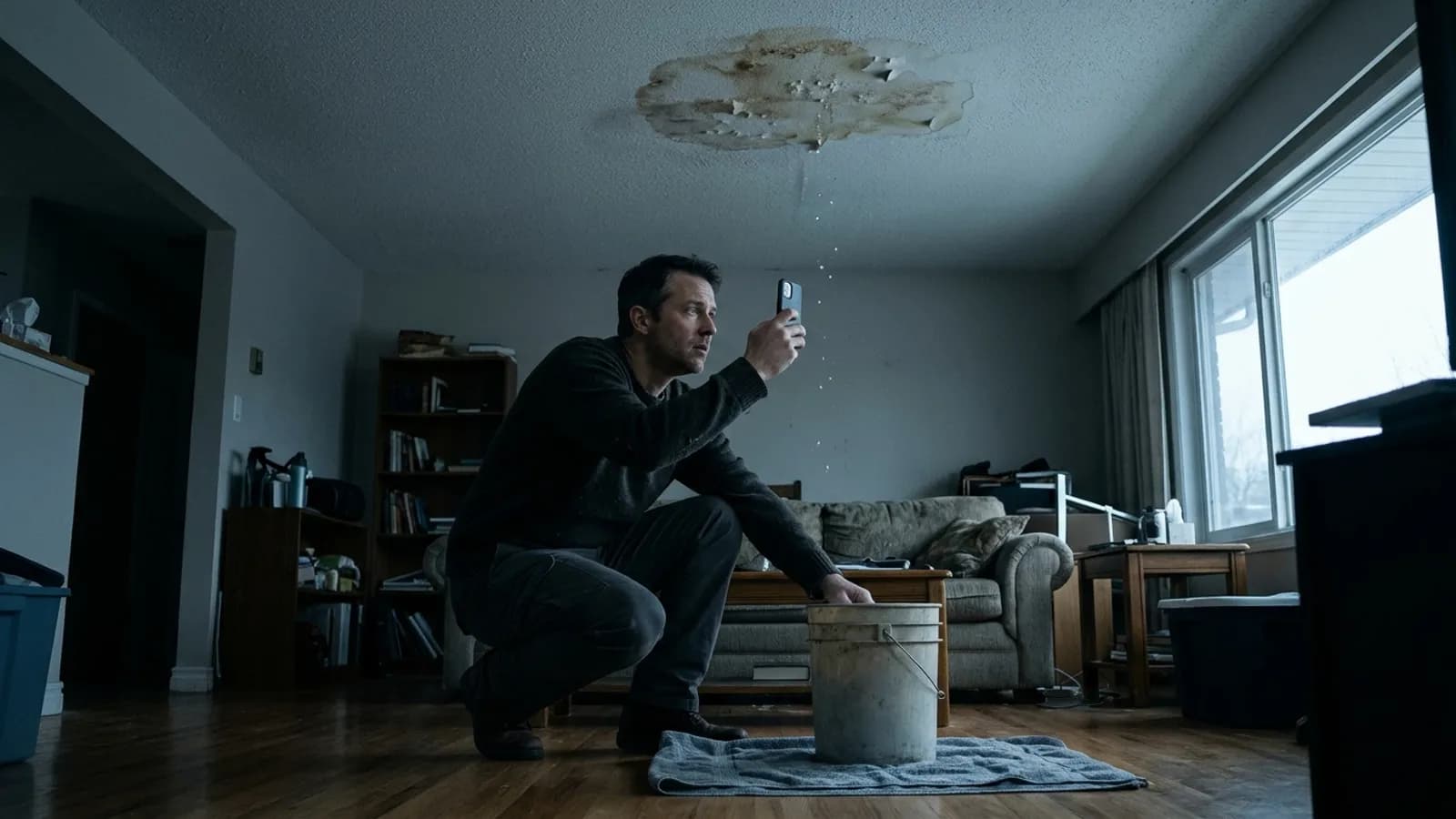
Water damage from sudden, accidental causes — burst pipes, appliance failures, ice dams, storm-driven rain through a damaged roof — is covered. Gradual leaks, long-term seepage, sewer backup without the endorsement, and all rising water (floods) are excluded.
The claim-split anatomy of a burst pipe
A representative burst-pipe claim shows how the money actually moves. Scenario: a supply line fails overnight while you are asleep. The insurer's scope typically includes emergency mitigation — extraction and dryout, commonly $2,000–$4,500 for a single-room event — the plumber's repair of the failed line (the pipe repair itself is often excluded as the failed item's cost, though some forms pay access-and-repair, meaning opening and restoring the wall), reconstruction of damaged drywall, flooring, and cabinets — the largest line item, commonly $8,000–$20,000 depending on finishes — and content cleaning or replacement for rugs, furniture, and boxes in contact with water. Against a $1,000 deductible, a $14,000 total loss pays $13,000. The two details that shift real money: whether the policy pays access-and-repair of the pipe, and whether contents are paid at replacement cost or ACV — a $2,000 rug at ACV pays a few hundred dollars, which is why contents RCV coverage is the highest-leverage water-damage upgrade.
The four water sources and their coverage map
Water claims sort by source, and each source has its own coverage answer. Supply-line failures — burst pipes, failed hoses, appliance leaks — are covered as sudden and accidental: the core water-damage coverage. Drain-side events — sewer and drain backup, sump pump overflow — are excluded by the base policy and covered by the sewer-backup endorsement, commonly $50–$250 per year for meaningful limits, as the sewer backup guide details. Ground and rising water — storms, overflowing creeks, storm surge — is excluded entirely, and flood insurance is the only path; one inch of water in a 2,000-square-foot home commonly produces five-figure damage. The gradual category — chronic seepage, slow leaks, condensation — is excluded everywhere as maintenance, with the mold that follows excluded for the same reason. The practical stack for a typical home is three lines: the base policy's water coverage, the backup endorsement, and a flood policy where geography justifies it — each covering a source the other two exclude.
| Water scenario | Which coverage answers | Watch for |
|---|---|---|
| Supply line bursts overnight | Base homeowners policy | Sudden accidental discharge; standard deductible |
| Sewer backs up through the floor drains | Sewer-backup endorsement | Excluded from the base policy |
| Rising creek water enters the living room | Flood policy | Excluded from homeowners entirely |
| Slow leak under the sink, undetected for months | Nothing | Gradual-damage exclusion, including the mold it breeds |
The table's last row is the expensive one, because it fails silently: no claim exists until the damage is discovered, and by then the gradual-damage argument is automatic. The remedy is detection hardware rather than coverage — point sensors under every sink and behind the water heater, plus an automatic shutoff on the main line, convert the silent failure into an attended one. One coverage line the water claim quietly consumes: loss of use, when dryout and reconstruction force the household into temporary housing — confirm the ALE limit before the loss, not during it.
The leak-detection leverage and the claims file that settles fast
Two modern habits change water-claim outcomes. Leak-detection devices — point sensors at water heaters and washing machines, automatic shutoffs on the main line — commonly earn insurance discounts, and the automatic shutoff converts a $15,000 loss into a $2,000 one by closing the valve in minutes; the insurer's claim-time question, "how long did it run," has a different answer with a shutoff installed, and the discount list that includes it sits in the premium-lowering guide. The claims file that settles fast has five artifacts: photos before cleanup, the mitigation company's moisture log (IICRC-standard dryout documentation), the plumber's failure diagnosis naming the failed part, the reconstruction estimate, and the content inventory with receipts for the big items. File the claim the day of the loss even when the scope is uncertain — the claim date protects the sudden-loss characterization, and a claim amended upward is routine, while a claim filed three weeks late invites the gradual-damage argument. The roof-leak version of this map is covered in the roof leaks guide.
Related guides
Water damage is the hub of the water-coverage family, because every other water question inherits its sudden-versus-gradual line.
- Does Homeowners Insurance Cover Sewer Backup? — the drain-side exclusion and the $50–$250-per-year endorsement that fixes it.
- Does Homeowners Insurance Cover Roof Leaks? — the opening-peril rule and the two-payment structure of a leak claim.
- Does Homeowners Insurance Cover Mold? — the caps and exclusions when water becomes a moisture event.
- ACV vs Replacement Cost — the contents settlement basis that decides what your soggy rug pays.
- What Does Homeowners Insurance Cover? — the full covered-versus-never-covered water map.
Sources
Frequently asked questions
What water damage is most commonly denied?
The gradual category: slow leaks under sinks, long-running seepage, condensation damage, and the mold that develops from chronic moisture — all excluded as maintenance-related. The second most common denial is late notice, when a sudden loss is reported weeks after it happened and the insurer argues gradual damage. Same-day reporting plus photos and a moisture log defeats both patterns.
Does homeowners insurance cover the cost to repair the pipe itself?
It depends on the form. Many policies exclude the failed pipe's own replacement but cover the resulting water damage and sometimes the cost to access the pipe — opening and restoring the wall. Some carriers sell access-and-repair endorsements. The answer changes the plumber-scenario economics on every future leak claim, so it is a five-minute question worth asking the carrier directly.
Should I install a leak detection system?
Yes — the economics favor it strongly. Point sensors cost tens of dollars; an automatic whole-house shutoff commonly runs $1,000–$2,500 installed, prevents most of the damage from unattended leaks, and earns insurance discounts with many carriers. The claims benefit compounds: losses caught by a shutoff are often small enough to self-fund below the deductible, protecting your claims history.
Is a burst pipe covered by homeowners insurance?
Yes. Sudden, accidental pipe bursts are core covered water damage, including the resulting property damage and the water's cleanup, subject to the deductible. Two nuances apply: the failed pipe's own replacement may be excluded under your form, and the freeze-prevention duty applies — a pipe that bursts in a home left unheated for weeks can face a maintenance argument. Report the loss the day it is discovered.
Does homeowners insurance cover water damage from rain?
Rain entering through a storm-damaged roof or broken window is covered, because the wind or hail peril created the opening and the water that followed is a resulting loss. Rain that rises from the ground or overwhelms drains is flood territory, excluded from the homeowners policy entirely. The source — sky versus ground — decides which policy answers the claim.
How we researched this guide
Home policies are forms-driven: the peril list in the form decides what gets paid, so our guides follow the policy form structure.
- Coverage explanations track the standard HO-3/HO-5 form structure — Coverage A through E — because that's the contract language adjusters apply.
- Flood facts come from FEMA's National Flood Insurance Program (floodsmart.gov), since standard home policies exclude flood.
- Regional cost ranges are built from NAIC home-owners insurance statistics, with the drivers of variation (construction, age, wind/hail exposure) named explicitly.
- Mitigation and eligibility claims cite IBHS research and state fair-plan rules where standard market access is an issue.
Where facts vary by state or insurer, we publish the range and the reason for the variation rather than a single misleading average. We do not sell insurance, take money from insurers for coverage, or publish claim amounts we cannot trace to a source.
Sources
The primary sources behind the facts on this page. Last verified November 10, 2026.
- FEMA — National Flood Insurance Program (FloodSmart) — flood coverage, which standard homeowners policies exclude.
- Insurance Institute for Business & Home Safety (IBHS) — property-loss research and mitigation standards that affect eligibility and discounts.
- U.S. Department of Housing and Urban Development (HUD) — FHA-insured property requirements and disaster assistance programs.
- NAIC — National Association of Insurance Commissioners — model regulations, consumer guides, and industry statistics.
- Find your state insurance regulator (NAIC directory) — every state insurance department — the authority for your state's rules and complaint filing.
- Insurance Information Institute (III) — industry statistics and consumer explainers we cross-check against regulator publications.
Rules that vary by state are verified against the state insurance department's consumer pages — find yours via the NAIC directory above.
Keep reading
Does Homeowners Insurance Cover Roof Leaks?
Homeowners insurance covers leaks caused by a covered peril — storm hail, wind, a fallen tree — while leaks from age, wear, or deferred maintenance are excluded.
Read guide
What Does Homeowners Insurance Cover? (And What It Never Covers)
A standard HO-3 covers fire, wind, hail, theft, and burst pipes — and never floods, earthquakes, or gradual damage. The coverage buckets, exclusions, and fixes.
Read guide
ACV vs Replacement Cost: The Claim-Payout Difference
Replacement cost pays today's price to rebuild; ACV pays that price minus depreciation. Learn which settlement basis your policy names before a claim arrives.
Read guide
How to Lower Homeowners Insurance: 10 Moves Ranked by Impact (2026)
Ten moves lower homeowners insurance: the deductible, the roof, bundling, claims discipline, and the annual re-shop, with the traps that cost more than they save.
Read guideWhat Is Replacement Cost Coverage?
Replacement cost pays today's price to repair or replace damaged property with no depreciation subtracted; actual cash value subtracts depreciation.
Read guide