
Does Homeowners Insurance Cover Roof Leaks?
Homeowners insurance covers leaks caused by a covered peril — storm hail, wind, a fallen tree — while leaks from age, wear, or deferred maintenance are excluded.
Why you can trust this guide
- Written by Daniel Reyes, AINS, former licensed P&C agent — independent insurance education publisher.
- Factual accuracy reviewed and signed off by Marcus Hale, CPCU, AINS, licensed P&C agent (Independent insurance reviewer).
- Every factual claim traces to a regulator, statute, or policy document — sources are listed at the bottom of the page.
- Last verified ; time-sensitive guides are re-checked at least twice a year. Read our editorial policy.
On this page
A roof leak is covered when a covered peril caused it — storm hail, wind-lifted shingles, a fallen tree. Leaks from age, wear, deferred maintenance, or installation defects are excluded, and the roof's age and settlement basis decide what the roof repair itself pays.
The two-payment structure of a leak claim
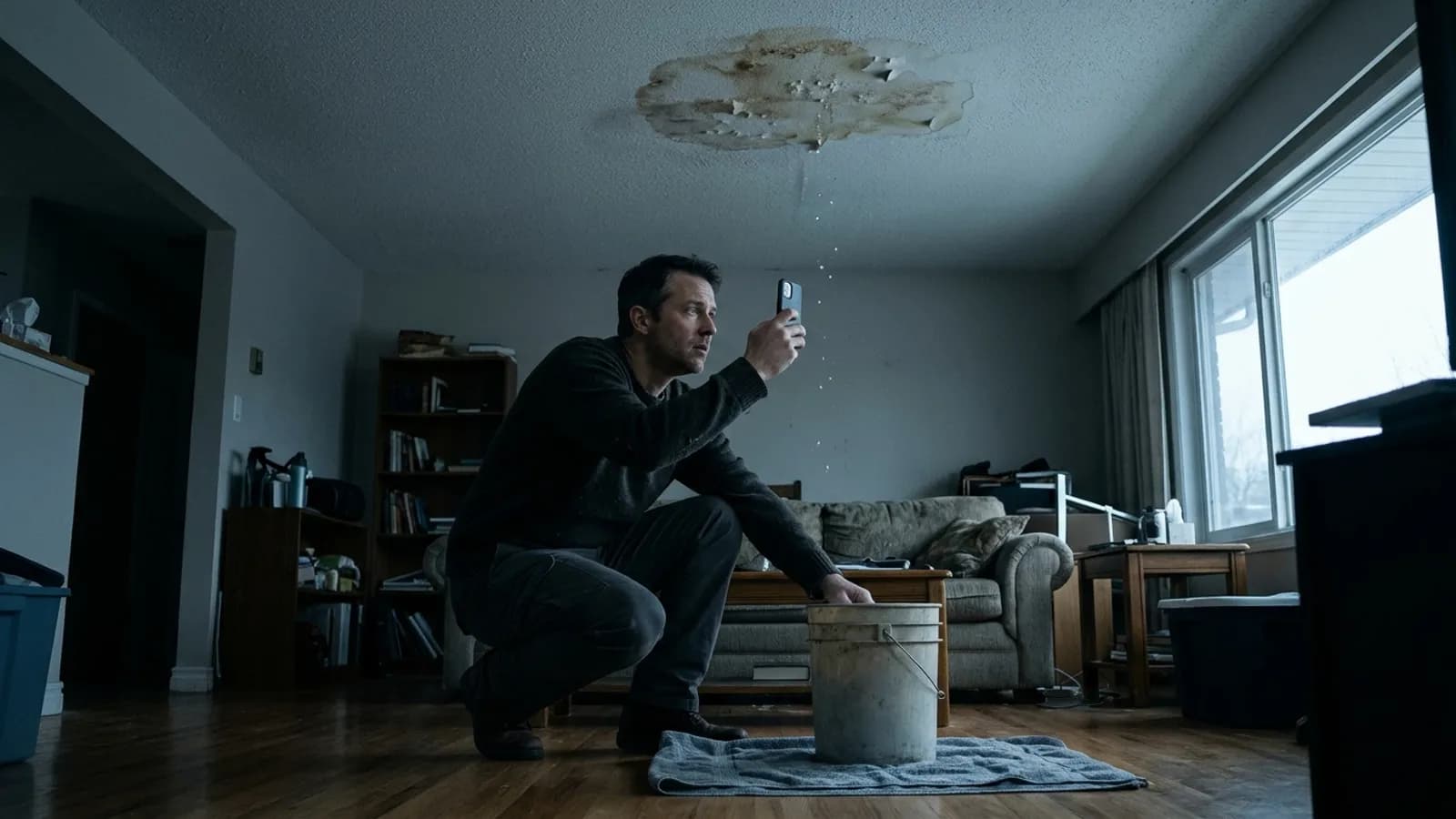
Roof-leak claims pay in two separate parts, and knowing the split explains most settlement surprises. Part one is the interior damage — soaked insulation, stained drywall, damaged flooring — paid under dwelling and contents sections regardless of roof age, because the water inside is the covered consequence. Part two is the roof repair itself, and here age and settlement basis decide everything. A 6-year-old roof on a replacement-cost policy gets a repair at current prices minus the deductible; a 19-year-old roof on an ACV schedule gets depreciated value — a 20-year-life architectural shingle at year 19 pays roughly 5% of replacement cost, often less than the deductible, which effectively transfers the roof repair to the homeowner. The same logic explains why a ceiling stain and a shingle repair can arrive as two checks months apart — the interior payment settles first while the roof scope waits for the supplement round. The ACV versus replacement cost comparison works the settlement mechanics, and the dwelling coverage limit anchors both parts.
The opening-peril rule and the leak that started last spring
The peril that opened the roof decides the claim. Wind or hail tears shingles and rain follows: covered — the storm created the opening, and the subsequent water damage is a resulting loss. A flashing seam that has seeped for three rains: wear and tear, excluded, including the interior damage in many forms because the deterioration is the proximate cause. The tricky middle is timing: a storm damaged the flashing in March and the stain appeared in June. Carriers investigate the loss date with weather data — hail and wind reports for your coordinates on specific dates are standard claim tools — which is why reporting a leak claim promptly, even before the interior damage is assessed, protects the claim date. Waiting to bundle small leaks into a bigger future claim is the pattern that converts covered sudden damage into denied gradual damage.
| Leak scenario | Roof repair paid? | Interior damage paid? |
|---|---|---|
| Storm-torn shingles, replacement-cost schedule | Yes, minus the deductible | Yes |
| Storm leak on a 19-year-old ACV roof | Depreciated — roughly 5% at year 19 of a 20-year life | Yes |
| Flashing that has seeped for three rainy seasons | No | Often no — deterioration is the proximate cause |
| Storm damage in March, stain discovered in June | Yes, with weather-data proof of the loss date | Yes |
The roof-schedule row deserves its own check at renewal. Carriers sell replacement-cost roof endorsements up to a stated age, and a few states restrict how sharply ACV schedules can be applied, so the payout basis is a negotiable line rather than a fixed fact. Run the arithmetic before a storm ever hits: the roof's replacement cost minus your deductible, against the depreciated payout the current form would produce, tells you whether the schedule is a $500 problem or a $12,000 problem at the next hail event.
The mitigation duties and the tarp question
- Tarp the damaged section within 24–48 hours if weather allows — professional tarping commonly costs a few hundred dollars and is payable as emergency mitigation in most claims.
- Photograph the interior damage before tarping and the roof damage before any repair.
- Keep every receipt — the wet-vac, the fans, the tarp, the roofer's emergency patch — because mitigation costs are reimbursable under most forms even when the roof itself is depreciated.
- Report the claim the day the leak is discovered, before the scope is known.
- Schedule the permanent repair promptly and submit completion documents inside the policy's window, commonly 180 days from loss, to protect the replacement-cost holdback.
The tarping step prevents the carrier's least-favorite scenario: a one-day leak turned into a three-week moisture event with mold caps and a weakened claim. Where the leak traces to storm damage, the percentage-deductible and roof-schedule mechanics are worked in the hail damage guide. Completion documents submitted inside the stated window also release the replacement-cost holdback that ACV forms apply to roof settlements — the check the insurer mails only after the work is done.
Related guides
Roof-leak claims sit beside the water-damage and hail pages, because the same sudden-versus-gradual line and the same roof schedules decide all of them.
- Does Homeowners Insurance Cover Water Damage? — the coverage map for the water that came through the opening.
- Does Homeowners Insurance Cover Hail Damage? — percentage wind/hail deductibles and age-based roof payout schedules.
- What Does Homeowners Insurance Cover? — where roof perils and wear-and-tear exclusions sit in the standard form.
- Annual Insurance Audit Checklist — the 30-minute review that catches a stale roof schedule before a claim.
- Does Homeowners Insurance Cover Mold? — the caps and exclusions when a leak becomes a mold event.
Sources
Frequently asked questions
Will insurance pay for a full roof replacement from one leak?
Only when the damage justifies it: a storm leak that compromises most slopes, a discontinued shingle with no matching product where state law or policy terms support it, or code-required upgrades under an ordinance-or-law endorsement. A single-source leak on a healthy roof is a repair claim, not a replacement claim. Contractors who start every estimate at full replacement invite adjuster pushback that slows the whole claim.
Does the deductible apply to just the roof or the whole claim?
One deductible applies per claim, not per damaged item — a $15,000 claim with a $9,000 roof repair plus $6,000 of interior damage pays $14,000 after a $1,000 deductible in one combined settlement. The exception is percentage wind/hail deductibles in some states, which can be calculated on the roof portion or on dwelling items depending on the form. Ask how your policy applies its storm deductible.
Is the ceiling stain covered if the roof repair is not?
In many policies yes — resulting interior water damage from a leak that suddenly worsened is paid even when the aged roof itself is depreciated below the deductible, though some forms tie interior coverage to the covered-peril question more tightly. This split is one of the most misunderstood areas of roof claims, so document the interior damage as thoroughly as the roof itself.
Does homeowners insurance cover an old roof leaking?
If a covered peril damaged it, yes — likely at actual cash value for older roofs, meaning depreciated payment under an age-based schedule. If the roof is failing from age alone, the leak is excluded wear and tear. The storm-versus-age line is the adjuster's first question, and weather data for your address on specific dates is the standard tool carriers use to answer it.
Do insurers inspect the roof before writing a policy?
Commonly yes for roofs past 15–20 years, and carriers increasingly photograph roofs at renewal through aerial imagery. An aging roof can bring a surcharge, an ACV roof schedule, or a decline. The remedies are documentation — installation invoices, inspection reports — and where the roof still has serviceable life, a roof certification that supports standard-market terms.
How we researched this guide
Home policies are forms-driven: the peril list in the form decides what gets paid, so our guides follow the policy form structure.
- Coverage explanations track the standard HO-3/HO-5 form structure — Coverage A through E — because that's the contract language adjusters apply.
- Flood facts come from FEMA's National Flood Insurance Program (floodsmart.gov), since standard home policies exclude flood.
- Regional cost ranges are built from NAIC home-owners insurance statistics, with the drivers of variation (construction, age, wind/hail exposure) named explicitly.
- Mitigation and eligibility claims cite IBHS research and state fair-plan rules where standard market access is an issue.
Where facts vary by state or insurer, we publish the range and the reason for the variation rather than a single misleading average. We do not sell insurance, take money from insurers for coverage, or publish claim amounts we cannot trace to a source.
Sources
The primary sources behind the facts on this page. Last verified November 10, 2026.
- FEMA — National Flood Insurance Program (FloodSmart) — flood coverage, which standard homeowners policies exclude.
- Insurance Institute for Business & Home Safety (IBHS) — property-loss research and mitigation standards that affect eligibility and discounts.
- U.S. Department of Housing and Urban Development (HUD) — FHA-insured property requirements and disaster assistance programs.
- NAIC — National Association of Insurance Commissioners — model regulations, consumer guides, and industry statistics.
- Find your state insurance regulator (NAIC directory) — every state insurance department — the authority for your state's rules and complaint filing.
- Insurance Information Institute (III) — industry statistics and consumer explainers we cross-check against regulator publications.
Rules that vary by state are verified against the state insurance department's consumer pages — find yours via the NAIC directory above.
Keep reading

Does Homeowners Insurance Cover Water Damage?
Homeowners insurance covers sudden water damage from burst pipes, appliance failures, and storm-driven rain, excluding gradual leaks, sewer backup, and floods.
Read guide
Does Homeowners Insurance Cover Mold?
Homeowners insurance covers mold only when it results from a covered sudden peril, and even then often capped at $5,000–$10,000; chronic-moisture mold is excluded.
Read guide
What Does Homeowners Insurance Cover? (And What It Never Covers)
A standard HO-3 covers fire, wind, hail, theft, and burst pipes — and never floods, earthquakes, or gradual damage. The coverage buckets, exclusions, and fixes.
Read guide
Annual Insurance Audit Checklist (30 Minutes)
A 30-minute annual audit: verify dwelling limits against rebuild cost, pull the CLUE report, sweep endorsements and beneficiaries, and re-shop both policies.
Read guideWhat Is Dwelling Coverage (Coverage A)?
Dwelling coverage (Coverage A) insures your home's structure at rebuild cost — not market value — and anchors the policy: other limits are percentages of it.
Read guide