
Does Homeowners Insurance Cover Hail Damage?
Homeowners insurance covers hail damage to roofs, siding, and contents, and hail-belt states price it with percentage wind/hail deductibles and ACV roof schedules.
Why you can trust this guide
- Written by Daniel Reyes, AINS, former licensed P&C agent — independent insurance education publisher.
- Factual accuracy reviewed and signed off by Marcus Hale, CPCU, AINS, licensed P&C agent (Independent insurance reviewer).
- Every factual claim traces to a regulator, statute, or policy document — sources are listed at the bottom of the page.
- Last verified ; time-sensitive guides are re-checked at least twice a year. Read our editorial policy.
On this page
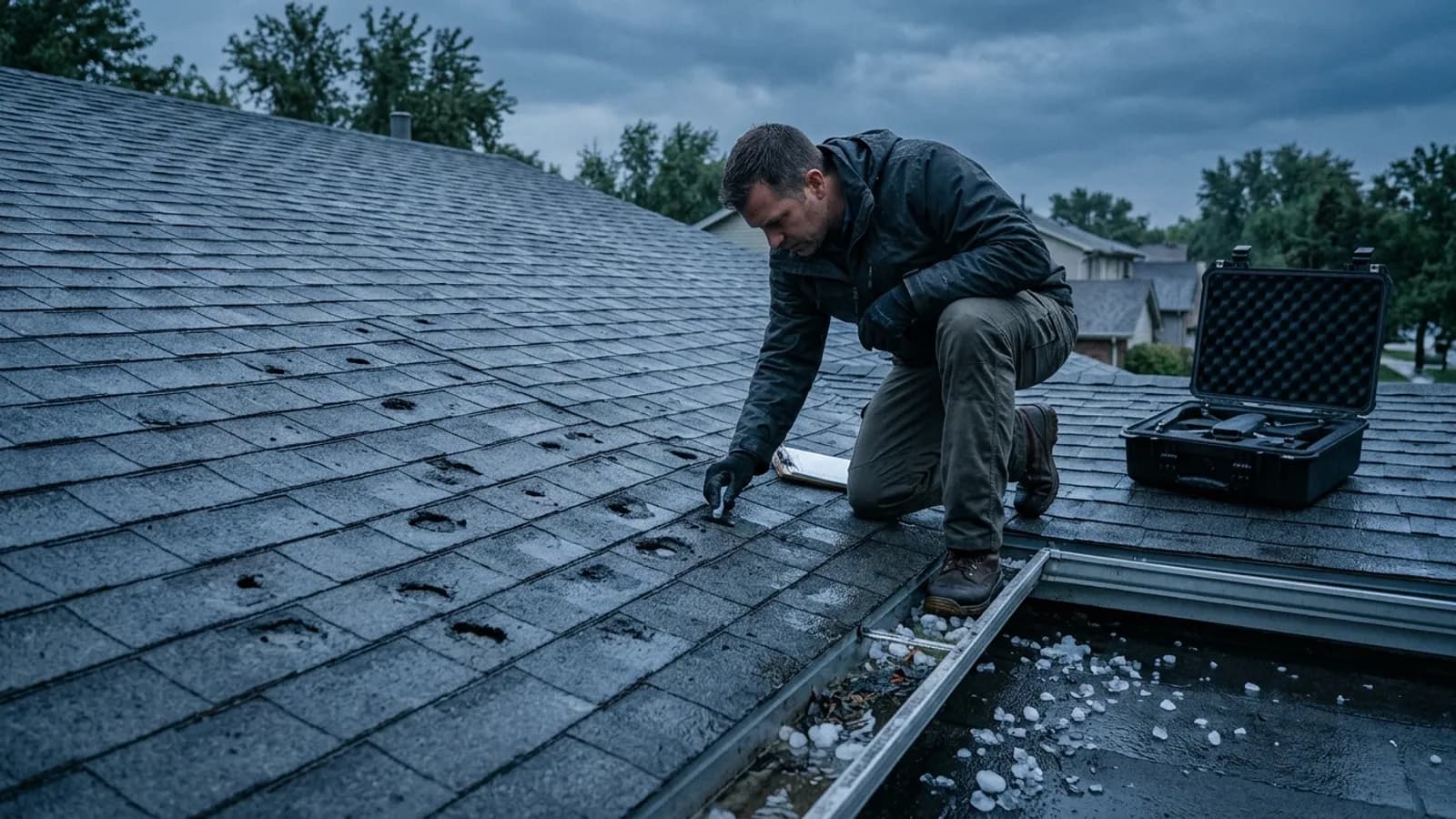
Hail damage to roofs, siding, and contents is covered — the claim type that defines hail-belt states (TX, CO, KS, NE, OK). The catch is the deductible: wind/hail deductibles are usually percentage-based (1–5% of dwelling coverage) and separate from your flat deductible.
What a hail policy actually pays
Hail is a covered peril in standard homeowners forms, and a hail claim pays the damaged roof, siding, and contents per the policy's settlement basis. The payout mechanics, not the peril, decide real money: replacement-cost roof schedules pay current repair prices, while ACV schedules pay depreciated value for older roofs. A 5-year-old roof on a 20-year life schedule pays about 75% of replacement cost; a 14-year-old roof pays about 30%. The wind/hail deductible is calculated on dwelling coverage and applies before the insurer pays anything, which is why claim economics in hail states differ from every other peril.
What hail covers, scenario by scenario
| Scenario | Covered? | The catch |
|---|---|---|
| Hail cracks shingles on a 5-year-old roof (RCV schedule) | Yes | Percentage wind/hail deductible applies first |
| Hail damages an older roof on an ACV schedule | Yes, depreciated | A 14-year-old roof may pay ~30% of replacement cost |
| Hail breaks windows and dents siding | Yes | Dwelling and contents sections pay at their settlement basis |
| Hail dents a detached garage | Yes | Other structures coverage, commonly 10% of dwelling |
| Hail dents the car in the driveway | No | Auto comprehensive covers the car; home policy excludes vehicles |
| Cosmetic dents below the deductible | Self-funded | Claim pays $0 and adds a 5–7-year loss entry |
The percentage deductible, worked on real numbers
A 2% wind/hail deductible on a $400,000 dwelling is $8,000 — the homeowner pays that before the insurer contributes to a $15,000 roof. At 1% the threshold is $4,000; at 3% it is $12,000. Two consequences follow. Minor hail claims — dented gutters, a few shingle tabs — are almost always self-funded, because the damage sits under the deductible. And the deductible moves with Coverage A: a homeowner who raised dwelling coverage after a rebuild-cost update also raised the storm deductible without noticing. The spread between carriers in the same ZIP code can run 1% to 3%, so the deductible percentage is a renewal-negotiation item, not a fixed fact.
Roof-age schedules: how older roofs get paid
Many carriers in hail states pay older roofs on an ACV table: shingle type sets a useful life (20–30 years is common for architectural asphalt), and the payout is replacement cost minus age-proportional depreciation. Some carriers sell an RCV roof endorsement up to a stated age, and a few states restrict how sharply age schedules can be applied — one of the most state-variable rules in home insurance. The pre-storm moves: know the roof's current settlement basis, photograph the roof annually, and keep the last replacement invoice. The date on that invoice is the single most valuable line in a hail claim, and the ACV versus replacement cost comparison works the settlement mechanics in full.
The post-storm protocol
- Photograph the damage before any repair, from the ground and of each affected slope.
- Get the roof inspected by a licensed local contractor you choose — not the door-knocker who arrived the next morning.
- Confirm your wind/hail deductible amount from the declarations page before deciding to file.
- Get two or three estimates, attach one to the claim, and file promptly — hail claims carry prompt-notice requirements, and the claims process guide walks the sequence.
- Expect a supplements round: adjusters' initial scopes commonly miss code-required items such as ice-and-water shield and ridge venting, which contractors justify line by line.
Refuse three deals that surface after every hail event: an assignment-of-benefits signature that hands claim rights to the contractor, an invoice engineered to "cover the deductible" (insurance fraud, and it voids the RCV holdback), and repair work started before the adjuster's inspection unless it is emergency mitigation. Carriers track hail claims on the CLUE report for 5–7 years, which is the second reason sub-deductible damage stays off the claim.
Related guides
Hail claims sit beside the roof-leak and cost questions, because the same deductibles, roof schedules, and claim files run through all of them.
- Does Homeowners Insurance Cover Roof Leaks? — the two-payment structure of a leak claim and the storm-versus-age line.
- How Much Is Homeowners Insurance? — the annual cost bands hail states sit at the top of, with the levers that move them.
- What Does Homeowners Insurance Cover? — where wind and hail sit in the standard covered-peril list.
- The Home Insurance Claim Process — documentation, adjuster visits, and supplements from first notice to settlement.
- Homeowners Insurance in Colorado — annual costs in one of the most hail-exposed markets in the country.
Sources
Frequently asked questions
Will filing hail claims get my policy non-renewed?
Multiple hail claims in a short window are a common non-renewal trigger in hail states, because carriers track both claim frequency and the roof's age. One documented storm claim with a repaired roof is usually survivable; three claims in five years on an aging roof rarely is. The practical rule in hail country: self-fund damage below your deductible and reserve the claim for the event that actually requires it.
Do I need matching shingles if only one slope is damaged?
Standard policies pay to repair the damaged slope; matching an obsolete or discontinued shingle across the whole roof is not automatically covered unless state law requires it or the policy includes a matching endorsement. Some states have case law supporting full-roof payment for mismatched repairs, so check your state's position before accepting a slope-only settlement.
Is a car damaged by hail covered on the home policy?
No. Vehicles are excluded from homeowners coverage entirely, so hail damage to a car runs through the auto policy's comprehensive coverage wherever the car was parked. Items inside the car follow the home policy as personal property, but the car's own panels follow auto comprehensive. File the hail claim on the auto side and expect a comprehensive deductible.
How do I find my wind/hail deductible amount?
Check the declarations page, which lists a separate wind/hail line when the policy uses one. Percentage deductibles are calculated on dwelling coverage, not on the roof: 1% of a $400,000 dwelling is $4,000, 2% is $8,000, and 3% is $12,000. Confirm which perils carry the percentage deductible — usually wind and hail only, while fire keeps a flat dollar deductible.
Should I file a claim for minor hail damage?
Run the math first: the wind/hail deductible, often $4,000–$8,000 or more in hail states, against the repair quote, plus the claims-history record that follows the property for 5–7 years. Sub-deductible cosmetic damage usually self-funds better, because a small claim pays nothing now and adds a loss entry that can surcharge renewals or complicate a future sale.
How we researched this guide
Home policies are forms-driven: the peril list in the form decides what gets paid, so our guides follow the policy form structure.
- Coverage explanations track the standard HO-3/HO-5 form structure — Coverage A through E — because that's the contract language adjusters apply.
- Flood facts come from FEMA's National Flood Insurance Program (floodsmart.gov), since standard home policies exclude flood.
- Regional cost ranges are built from NAIC home-owners insurance statistics, with the drivers of variation (construction, age, wind/hail exposure) named explicitly.
- Mitigation and eligibility claims cite IBHS research and state fair-plan rules where standard market access is an issue.
Where facts vary by state or insurer, we publish the range and the reason for the variation rather than a single misleading average. We do not sell insurance, take money from insurers for coverage, or publish claim amounts we cannot trace to a source.
Sources
The primary sources behind the facts on this page. Last verified November 10, 2026.
- FEMA — National Flood Insurance Program (FloodSmart) — flood coverage, which standard homeowners policies exclude.
- Insurance Institute for Business & Home Safety (IBHS) — property-loss research and mitigation standards that affect eligibility and discounts.
- U.S. Department of Housing and Urban Development (HUD) — FHA-insured property requirements and disaster assistance programs.
- NAIC — National Association of Insurance Commissioners — model regulations, consumer guides, and industry statistics.
- Find your state insurance regulator (NAIC directory) — every state insurance department — the authority for your state's rules and complaint filing.
- Insurance Information Institute (III) — industry statistics and consumer explainers we cross-check against regulator publications.
Rules that vary by state are verified against the state insurance department's consumer pages — find yours via the NAIC directory above.
Keep reading

Does Homeowners Insurance Cover Roof Leaks?
Homeowners insurance covers leaks caused by a covered peril — storm hail, wind, a fallen tree — while leaks from age, wear, or deferred maintenance are excluded.
Read guide
How Much Is Homeowners Insurance?
Homeowners insurance costs $1,500–$3,000 per year for typical coverage, and state risk, roof age, and your deductible choices decide where you land.
Read guide
What Does Homeowners Insurance Cover? (And What It Never Covers)
A standard HO-3 covers fire, wind, hail, theft, and burst pipes — and never floods, earthquakes, or gradual damage. The coverage buckets, exclusions, and fixes.
Read guide
The Home Insurance Claim Process: From Damage to Settlement
How a homeowners claim actually works: mitigation, documentation before cleanup, the adjuster visit, the two-check payout, supplements, and common mistakes.
Read guide
Homeowners Insurance in Colorado: Costs and What to Know (2026)
Homeowners insurance in Colorado costs $2,400–$3,800 per year, with Front Range hail, wildfire losses, and roof-shrinkage rules shaping what each ZIP pays.
Read guide