
Does Homeowners Insurance Cover Mold?
Homeowners insurance covers mold only when it results from a covered sudden peril, and even then often capped at $5,000–$10,000; chronic-moisture mold is excluded.
Why you can trust this guide
- Written by Daniel Reyes, AINS, former licensed P&C agent — independent insurance education publisher.
- Factual accuracy reviewed and signed off by Marcus Hale, CPCU, AINS, licensed P&C agent (Independent insurance reviewer).
- Every factual claim traces to a regulator, statute, or policy document — sources are listed at the bottom of the page.
- Last verified ; time-sensitive guides are re-checked at least twice a year. Read our editorial policy.
On this page
Homeowners insurance covers mold only when it results from a covered sudden peril — mold after a burst pipe is claimable, often capped at $5,000–$10,000. Mold from humidity, chronic leaks, or neglect is excluded as maintenance.
The covered-peril chain: mold from sudden water
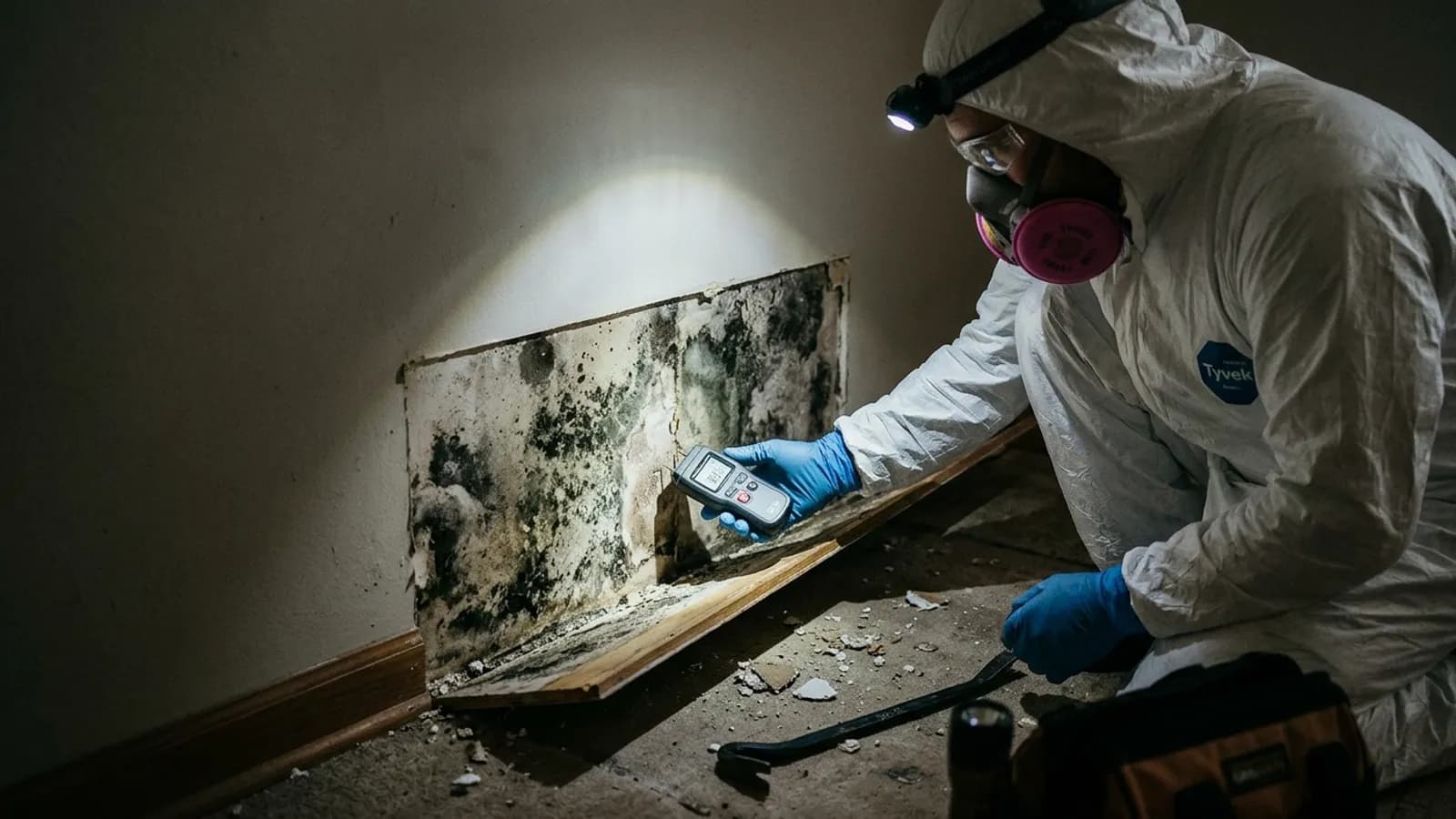
Mold coverage exists only as the tail of a covered water loss. The chain the policy follows: a burst supply line floods the bathroom on a Tuesday, the insurer pays the water mitigation — dryout and removal of wet materials — and mold that develops from that specific event is a resulting-damage claim, commonly paid with a cap. The caps are the number to know: many policies limit mold remediation to $5,000–$10,000 even when the water loss itself is fully covered, and some carriers sell a mold endorsement raising the cap for a modest premium. What defeats the chain is the alternative history: a slow leak under the sink running for months, a chronic crawlspace moisture problem, condensation from inadequate ventilation. These fall under the maintenance and seepage exclusions, and mold growing from them is not the result of a covered peril. The claim framing is always the same: identify the sudden event, its date, and the dryout steps taken.
What is and is not covered, scenario by scenario
| Scenario | Covered? | Why |
|---|---|---|
| Mold after a burst pipe, dryout started within 48 hours | Yes, capped | Resulting damage from a covered sudden peril |
| Mold from a sink leak that ran for months | No | Gradual seepage and maintenance exclusions |
| Mold after a flood, prompt dryout | Flood-policy rules | The NFIP pays mold only where the homeowner dried promptly |
| Mold from chronic humidity and condensation | No | Maintenance category in every standard form |
| Mold the homeowner knew about and left unaddressed | No | The most common mold denial |
Two reads make the table actionable. The dryout clock is evidence, not advice: moisture logs and psychrometric readings dated inside 48 hours are what converts the first row from a discretionary payment into a defensible one. And the fourth row's fix is hardware, not coverage — a dehumidifier in a humid basement does more for mold risk than any endorsement, because endorsements raise caps on covered claims without touching the chronic-moisture exclusions. Where the carrier disputes the moisture's origin after a documented sudden event, the dispute is factual rather than interpretive, which is why the dryout file, not the mold itself, wins these claims.
The 48-hour protocol that preserves the claim
Mold claims are won or lost in the first two days.
- Shut off the water source and photograph everything before moving anything.
- Begin mechanical drying within 24–48 hours — fans, dehumidifiers, wet-vac. Insurer-approved mitigation is expected, not optional.
- Call a water-damage restoration firm if the wet area exceeds a couple of square feet or any wall cavity is involved, and keep its moisture readings and drying logs.
- Notify the insurer the same day, even when you intend to handle the drying yourself — late notice is the denial that costs the most for the least reason.
The mitigation company's moisture readings and psychrometric logs are the evidence that drying was prompt and complete, which is precisely the evidence that defeats a later carrier argument that mold resulted from homeowner neglect. The water-loss side of the chain — the sudden-versus-gradual decision tree — is covered in the water damage guide, and the rising-water exclusion in the flood insurance guide.
Buying mold coverage where it can be bought
Mold endorsements raising the remediation cap exist from a meaningful set of carriers, commonly priced from $200–$500 per year for meaningful additional limits. Read the exclusions before buying: mold from floods is flood-policy territory — the NFIP does not pay mold damage after the homeowner had a reasonable chance to dry out, while mold from covered flood water you promptly addressed is treated differently from deferred maintenance; mold from long-term seepage is excluded by design; and mold in homes with known humidity defects invites a pre-existing-condition argument. Two structural facts frame expectations: mold from an unaddressed leak the homeowner knew about is the most common mold denial, and landlord-tenant mold duty is a habitability matter governed by state law — tenants document and notify, owners remediate. When a mold denial misreads the moisture's origin, the claim denial playbook is the escalation path.
Related guides
Mold claims trace back to the water-loss pages, because the mold answer is always inherited from the water answer.
- Does Homeowners Insurance Cover Water Damage? — the sudden-versus-gradual decision tree behind every mold-adjacent claim.
- Does Homeowners Insurance Cover Roof Leaks? — the slow-leak pattern that produces the most mold denials.
- Flood Insurance — the rising-water exclusion and NFIP dryout duties that govern post-flood mold.
- What Does Homeowners Insurance Cover? — where mold caps and maintenance exclusions sit in the standard form.
- The Home Insurance Claim Process — mitigation documentation from first notice to settlement.
- Does Homeowners Insurance Cover Termite Damage? — the pest exclusion and what it leaves you paying.
Sources
Frequently asked questions
Is mold remediation capped even when the water loss is covered?
Frequently yes. Policies commonly include a mold-specific sub-limit, often $5,000–$10,000, applied to remediation that follows a covered water loss, separate from the water-damage payment itself. Some carriers sell endorsements raising the cap. Ask your carrier for the policy's mold limitation in writing, because the number is not on the declarations page in many forms.
Does homeowners insurance cover mold after a flood?
Flood water itself is excluded from homeowners policies, so mold that follows a flood runs through flood insurance rules — and even there, mold from flood water is typically paid only when the policyholder took reasonable steps to dry the home after the water receded. Mold that develops from neglect after the flood is excluded under NFIP as well. Prompt dryout is the entire coverage difference.
Can I test for mold myself before filing a claim?
You can, but a claim should not start with a mold test — it should start with the water event. Identify and stop the source, document the sudden loss with photos and dates, and notify the insurer; the carrier typically arranges its own inspection and hygienist if needed. Independent mold testing, commonly $300–$700, is most useful for non-claim decisions such as confirming a remediation was complete before closing a wall.
Is there an endorsement that raises the mold cap?
Yes. Mold buy-back endorsements raise or remove the mold cap on covered claims, commonly priced at $200–$500 per year depending on carrier and state. The endorsement does not cover gradual-growth mold from chronic moisture; it raises the ceiling on the sudden-peril cases. Availability varies by state, so the question goes to the carrier at quote or renewal time.
Does homeowners insurance cover mold from humidity?
No. Condensation, chronic humidity, and long-term seepage are maintenance categories, and mold growing from them is excluded in every standard form regardless of severity. Ventilation fixes, dehumidification, and prompt leak repair are the prevention the exclusion assumes. Mold claims succeed only when the moisture traces to a sudden, documented, covered water event.
How we researched this guide
Home policies are forms-driven: the peril list in the form decides what gets paid, so our guides follow the policy form structure.
- Coverage explanations track the standard HO-3/HO-5 form structure — Coverage A through E — because that's the contract language adjusters apply.
- Flood facts come from FEMA's National Flood Insurance Program (floodsmart.gov), since standard home policies exclude flood.
- Regional cost ranges are built from NAIC home-owners insurance statistics, with the drivers of variation (construction, age, wind/hail exposure) named explicitly.
- Mitigation and eligibility claims cite IBHS research and state fair-plan rules where standard market access is an issue.
Where facts vary by state or insurer, we publish the range and the reason for the variation rather than a single misleading average. We do not sell insurance, take money from insurers for coverage, or publish claim amounts we cannot trace to a source.
Sources
The primary sources behind the facts on this page. Last verified November 10, 2026.
- FEMA — National Flood Insurance Program (FloodSmart) — flood coverage, which standard homeowners policies exclude.
- Insurance Institute for Business & Home Safety (IBHS) — property-loss research and mitigation standards that affect eligibility and discounts.
- U.S. Department of Housing and Urban Development (HUD) — FHA-insured property requirements and disaster assistance programs.
- NAIC — National Association of Insurance Commissioners — model regulations, consumer guides, and industry statistics.
- Find your state insurance regulator (NAIC directory) — every state insurance department — the authority for your state's rules and complaint filing.
- Insurance Information Institute (III) — industry statistics and consumer explainers we cross-check against regulator publications.
Rules that vary by state are verified against the state insurance department's consumer pages — find yours via the NAIC directory above.
Keep reading

Does Homeowners Insurance Cover Water Damage?
Homeowners insurance covers sudden water damage from burst pipes, appliance failures, and storm-driven rain, excluding gradual leaks, sewer backup, and floods.
Read guide
Flood Insurance: What It Covers, What It Costs, and Who Needs It
Flood insurance is never part of a standard home policy. Costs per year, the 30-day waiting period, NFIP limits, and why most claims come from outside flood zones.
Read guide
The Home Insurance Claim Process: From Damage to Settlement
How a homeowners claim actually works: mitigation, documentation before cleanup, the adjuster visit, the two-check payout, supplements, and common mistakes.
Read guide
What Does Homeowners Insurance Cover? (And What It Never Covers)
A standard HO-3 covers fire, wind, hail, theft, and burst pipes — and never floods, earthquakes, or gradual damage. The coverage buckets, exclusions, and fixes.
Read guideWhat Is an Exclusion in Insurance?
An exclusion is a peril, property type, or situation a policy does not cover — floods, earthquakes, wear and tear — marking exactly where your protection ends.
Read guide