
Renters Insurance for Students: Dorms, Off-Campus, and the Fine Print
Dorm belongings ride on parents' homeowners policies at 10% of contents; off-campus apartments need the student's own policy at roughly $12–$18 per month.
Why you can trust this guide
- Written by Daniel Reyes, AINS, former licensed P&C agent — independent insurance education publisher.
- Factual accuracy reviewed and signed off by Marcus Hale, CPCU, AINS, licensed P&C agent (Independent insurance reviewer).
- Every factual claim traces to a regulator, statute, or policy document — sources are listed at the bottom of the page.
- Last verified ; time-sensitive guides are re-checked at least twice a year. Read our editorial policy.
On this page
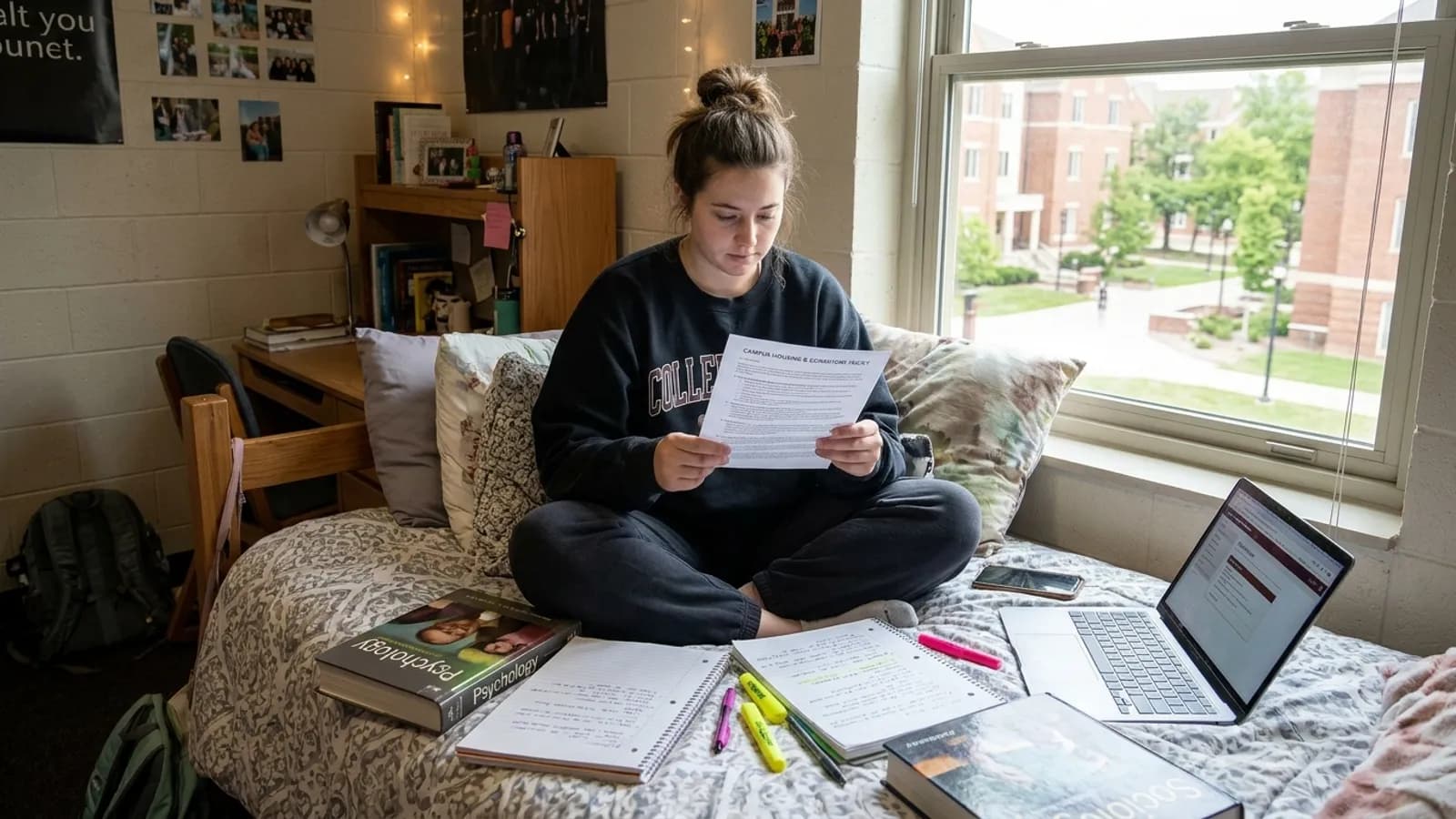
Dorm belongings ride on parents' homeowners policies through the student-away clause, capped at 10% of the parents' contents limit; off-campus apartments need the student's own renters policy — $12–$18 per month, and most leases require it. The student-specific rules are few but decisive.
Dorms vs off-campus
| Living situation | Coverage source | Watch for |
|---|---|---|
| Dorm (on-campus) | Parents' homeowners — 10% off-premises clause | The $2,500–$3,000 cap; electronics sub-limits |
| Off-campus apartment | Own renters policy | The lease requirement; full limits needed |
| Sorority/fraternity housing | Varies — some are covered as chapter property | Ask the chapter and verify in writing |
| Summer sublets | Own policy follows the student | The vacancy clause at the parents' home |
The row that decides most cases is the second one: once a lease exists, the student needs their own policy — the first apartment checklist runs the same setup for students and non-students alike.
The dorm claim (the parent-policy mechanics)
The stolen laptop from a dorm room claims against the parents' homeowners policy — the off-premises personal-property clause pays 10% of contents limits, subject to electronics sub-limits. The claim's cost consideration: a parent-policy deductible ($1,000–$2,500) against a $1,500 laptop — the math often says self-fund, because the claim nets little and adds a loss to the parents' history.
The dorm lane works for exactly that class of small loss, and fails for the apartment class: a one-bedroom's contents outrun the 10% cap by thousands of dollars.
The off-campus answer
The apartment changes everything: the lease requires coverage, the contents are worth a full policy, and the $12–$18 per month product is the same renters insurance everyone else buys — $25,000–$30,000 property, $300,000 liability, replacement cost. Choosing among carriers follows the same evaluation criteria as any other renter: replacement-cost standards, claim channel, complaint index, endorsement menu.
The certificate goes to the landlord before move-in, and the policy stays month-to-month for the lease's length. One policy per adult — unrelated roommates are never covered as a household.
The student-specific checks
- The university requirement — schools requiring health insurance waive for other coverage; some require renters proof too, and the waiver paperwork precedes move-in.
- The roommate split — each tenant buys their own policy; a roommate's certificate satisfies only their own lease obligation.
- The summer gap — sublets and going-home summers test the vacancy clause at the parents' home and the storage cap at the destination.
- The electronics sub-limits — the gaming rig and camera gear get scheduled while the receipts exist.
- The study-abroad territory — most forms cover personal-property theft worldwide, but liability follows the coverage territory wording, and programs sometimes demand proof the parent policy cannot provide.
The tech-load math for a dorm room
The dorm inventory is heavier than its square footage suggests. Worked example: laptop $1,200, tablet $400, phone $900, headphones $300, bike $500, clothing and bedding $700 — a $4,000 room on a typical tech-heavy load. Against the 10% cap of a $30,000 parent policy, coverage lands at $3,000 — close enough to matter on a theft of everything, comfortably under it for a laptop-only claim.
A student's own policy reframes the math: $15,000–$20,000 of contents at roughly $10–$15 per month, no cap question, and liability of their own for the roommate-damage and guest-injury scenarios a parent's liability may not reach across the named-insured boundary. The own-policy decision is cleanest for off-campus leases, where the landlord certificate requirement settles it anyway.
The summer and study-abroad gaps
Two calendar gaps catch students. The summer gap: between-lease storage moves property into the off-premises lane — the storage units question covers the 10% cap students hit there — and a student living at home again re-qualifies as a household member, so verify rather than assume.
The study-abroad gap: most forms cover personal-property theft worldwide, but the liability piece follows the territory wording, and program or visa requirements sometimes demand proof of insurance the parent policy cannot provide. The operational checklist: before summer storage, confirm the cap; before a semester abroad, confirm territory and any certificate the program needs; before any new lease, order the student's own certificate. When a claim does happen at school, the claim process runs the same documentation sequence as any other loss.
The parents'-policy call script
The two-minute verification call to the parents' carrier asks three questions and ends with one request. Question one: does the student-away clause apply to a full-time student living in a dorm — and to what age? Question two: what is the away-from-home property cap as a percentage of the contents limit? Question three: does the form's electronics or jewelry sub-limit shrink the dorm coverage further? The request: put the three answers in writing, because the dorm claim will be measured against the written form, not the phone summary. The same script asks the fourth question only when a lease exists: whether an off-campus leased unit qualifies at all — the signed lease usually answers no on its own.
Related guides
Student coverage connects to the household rule, the storage gap, and the setup checklist:
- Renters Insurance: The Complete Guide — the silo hub with state pricing from $11–$16 per month in the cheapest states.
- Does Renters Insurance Cover Roommates? — why each roommate in a shared apartment needs their own policy.
- Does Renters Insurance Cover a Stolen Bike? — the campus-rack theft claim and its sub-limit.
- Does Renters Insurance Cover E-Bikes? — the campus e-bike's classification problem, before purchase.
- The 8 Renters Insurance Mistakes That Cost Tenants Money — the student version: stale limits and skipped certificates.
Sources
Frequently asked questions
Do students need renters insurance in dorms?
Dorm belongings are typically covered under parents' homeowners policies at 10% of the contents limit (the off-premises clause) — $2,500–$3,000 of dorm coverage. Theft from dorms claims there. Check the electronics sub-limits and whether the university requires its own proof of coverage.
Do students need renters insurance in off-campus apartments?
Yes — the lease requires it (most complexes do), and the parent-policy off-premises cap is too thin for an apartment's contents. A student policy runs $12–$18 per month with full limits and the student's own liability. The certificate names the landlord before keys are handed over.
How much is renters insurance for students?
$12–$18 per month for standard coverage — among the cheapest policies in insurance. Bundle discounts apply if the student carries auto coverage, and some insurers price student profiles favorably for low-claims ZIP codes. Standard settings match any other renter's: $25,000–$30,000 contents, $300,000 liability, replacement cost.
Does my parents' renters insurance cover me at college?
Often, for dorms, under the student-away clause — typically full-time students under about age 26, with away-from-home property commonly capped at 10% of the parents' limit. Off-campus leases usually need the student's own policy because the signed lease reads as a separate household.
Is a student's policy different from a standard one?
It is the same product at lower limits and lower prices. The practical difference is operational: off-campus leases require a certificate naming the landlord, which the student's own policy provides and a parent's policy does not. Limits should come from the student's own inventory, not the household's.
Does renters insurance cover a laptop stolen from the library?
Yes — theft away from the residence is covered, subject to any off-premises cap. A police report and the serial number or receipt are the claim's core evidence, and claims with all three artifacts move in days rather than weeks.
How we researched this guide
Renters coverage is small and simple, but landlord requirements and state rules vary — so we verify both sides of the lease.
- What HO-4 policies cover (and the liability and loss-of-use mechanics) is verified against standard policy forms and DOI consumer guides.
- Landlord-side insurance requirements are framed against HUD tenant-rights resources, since required coverage limits appear in lease terms, not statutes.
- Cost figures are ranges by state and coverage limit, anchored to NAIC statistics.
- Disaster-aid expectations are set from FEMA guidance: federal assistance is not a replacement for coverage, and we explain exactly what it does pay.
Where facts vary by state or insurer, we publish the range and the reason for the variation rather than a single misleading average. We do not sell insurance, take money from insurers for coverage, or publish claim amounts we cannot trace to a source.
Sources
The primary sources behind the facts on this page. Last verified November 10, 2026.
- HUD — tenant rights and responsibilities — state landlord-tenant rules that affect liability requirements.
- FEMA — renters and disaster assistance — what federal disaster aid does and does not cover for tenants.
- NAIC — National Association of Insurance Commissioners — model regulations, consumer guides, and industry statistics.
- Find your state insurance regulator (NAIC directory) — every state insurance department — the authority for your state's rules and complaint filing.
- Insurance Information Institute (III) — industry statistics and consumer explainers we cross-check against regulator publications.
Rules that vary by state are verified against the state insurance department's consumer pages — find yours via the NAIC directory above.
Keep reading

Renters Insurance: The Complete Guide
Renters insurance covers your belongings, your liability, and your hotel bill when the rental is unlivable — what it pays, what it excludes, and how to pay less.
Read guide
What Is Renters Insurance and How Much Does It Cost?
Renters insurance covers your belongings, liability, and hotel costs when the rental is unlivable, for about $15–$30 per month — what it pays and what it excludes.
Read guide
Does Renters Insurance Cover Roommates?
No — renters policies cover the named insured and resident relatives, not unrelated adults; each roommate needs their own policy for belongings and liability.
Read guide
Does Renters Insurance Cover Storage Units?
Usually — renters insurance follows belongings into storage, but an off-premises cap of 10% of your property limit bounds the payout; scheduling bypasses the cap.
Read guide
First Apartment Insurance Checklist (20 Minutes to Covered)
The first-apartment renters checklist: a 20-minute sequence of inventory, limits, replacement cost, endorsements, and the landlord certificate before move-in.
Read guide