
Buying a Used Car: Insurance Checklist
The used-car insurance checklist: quote the VIN before buying, run the ten-times rule on comp and collision, check title brands, and configure coverage day one.
Why you can trust this guide
- Written by Daniel Reyes, AINS, former licensed P&C agent — independent insurance education publisher.
- Factual accuracy reviewed and signed off by Marcus Hale, CPCU, AINS, licensed P&C agent (Independent insurance reviewer).
- Every factual claim traces to a regulator, statute, or policy document — sources are listed at the bottom of the page.
- Last verified ; time-sensitive guides are re-checked at least twice a year. Read our editorial policy.
On this page
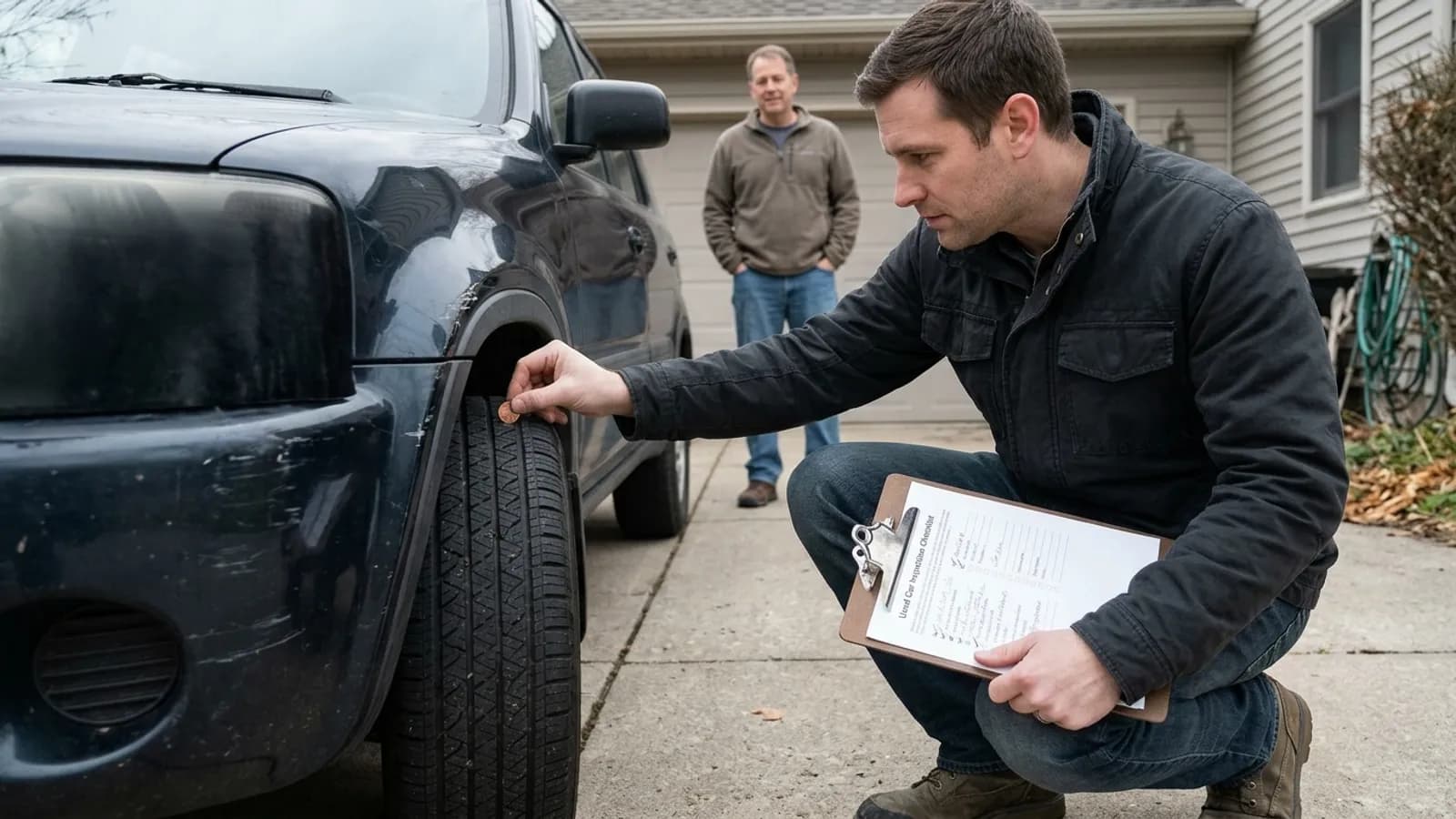
The used-car purchase has its own insurance math: quote the VIN before you buy, run the ten-times rule on physical damage, check the title brands that reshape coverage, and configure the policy the same day you take ownership. The checklist below is the sequence.
The checklist
- Quote the VIN before buying — used cars price wildly by model; a sport trim or high-theft model can carry an $800-per-year penalty over the equivalent base trim.
- Run the ten-times rule — the comprehensive/collision decision; see full coverage for the math.
- Check the title history (NMVTIS) — flood and salvage brands change both the price and the possibility of coverage.
- Verify liability limits stay high — the car's age does not lower liability needs; keep 100/300/100 as the floor.
- Drop comp/collision if justified — the savings fund a repair account; the ten-times rule decides when.
- Confirm the loan (if financed) — the lender requires full coverage regardless of the car's age, and gap if the balance can outrun the value.
- Update the policy same-day — the grace window (commonly 2–30 days) applies the old car's coverage levels; call anyway.
- Check for open recalls — safety, not insurance — but it prices the claim file too.
- Re-shop at renewal with the new car — the ownership change is a repricing event at every carrier.
The VIN quote that catches title brands before you pay
Insure the VIN before you sign, not after — the title history changes both the price and the possibility of coverage. A quick NMVTIS report surfaces the brands that reshape the deal: salvage (repaired total loss), flood (storm-damaged and re-titled), rebuilt, and odometer discrepancies. Carriers treat these differently: most will write liability on a rebuilt-title car at a reduced insured value, many decline comprehensive and collision on it entirely, and a flood-brand car can be nearly uninsurable for physical damage — the flood-claim mechanics are in the flood damage guide. The same VIN quote catches the mundane money too — a sport trim or high-theft model can carry an $800-per-year penalty over the equivalent base trim. The sequence that works: run the title report, pull a quote on the exact VIN, then negotiate the purchase price with the insurance number in hand — see the average cost guide for the baseline your quote should beat.
Insurance math across three used-car price tiers
The coverage decision on a used car is a ratio, not an opinion — the car's value against the cost of insuring it. Three illustrative tiers:
| Car | Value | Comp/collision (typical) | The math | Structure |
|---|---|---|---|---|
| 2009 beater | $3,500 | ~$420 per year | Value is ~8× premium | Liability-only, self-fund repairs |
| 2017 commuter | $9,000 | ~$520 per year | Value is ~17× premium | Keep full coverage |
| 2022 certified used | $19,000 | ~$900 per year | Financed — lender requires it | Full coverage + gap if upside-down |
The ratio is the ten-times rule from the full coverage guide: when the car's value falls under roughly ten times the annual physical-damage premium, the coverage is pre-insuring a payout that keeps shrinking. The middle tier is where used-car buyers most often overpay — keeping a $1,000 deductible on a car that would total at $8,400 anyway. A financed used car adds the gap question: the loan-versus-value mechanics are in the gap insurance guide, and the same VIN-level quote discipline the new-car buyers use applies at the used desk.
Ownership-day mistakes that strand or void coverage
The first 48 hours of used-car ownership are where claims go wrong later. The avoidable versions:
- Assuming the grace window carries full coverage — the automatic extension for a replacement car commonly runs 2–30 days and applies the old car's coverage levels, so a liability-only trade-in briefly insures a liability-only purchase.
- Leaving the seller's policy in force on the drive home while yours lapsed — a gap day on your record prices every future quote.
- Forgetting the lender's proof of insurance — financed deals need the lienholder listed and the binder sent, sometimes within days of signing.
- Delaying the VIN update — the policy technically insures the car you traded, and the mismatch surfaces at claim time.
- Reusing last year's quote instead of re-shopping with the new car on the policy — the ownership change is a repricing event at every carrier.
Related guides
The used-car purchase connects to its new-car counterpart and the valuation rules that decide coverage on an older car.
- Insuring a New Car: What Coverage You Actually Need — what lenders require on a new car, and the dealer-desk products to decline.
- New Car Insurance Checklist — the drive-home steps that configure a new car's policy correctly.
- What Is Actual Cash Value (ACV)? — the depreciated-value formula every physical-damage payout starts from.
- What Is a Total Loss? — when a car is declared total, and how the settlement is set.
- Car Insurance: The Complete Guide — the coverage structures, state rules, and savings levers every other page builds on.
Sources
Frequently asked questions
Does insurance transfer automatically to a used car I just bought?
Usually through a grace window — many policies automatically extend coverage to a replacement vehicle for roughly 2–30 days, but with the coverage levels of the car it replaced. Call the insurer with the VIN the same day to configure the new car properly; the window is a safety net, not a plan.
Is car insurance cheaper on a used car than a new car?
The comprehensive and collision portion is cheaper, because it scales with the car's value; liability costs the same either way. A five-year-old car can price $400–$800 per year below an equivalent new model — the bigger savings come from dropping physical damage entirely on older cars.
Can I insure a rebuilt or salvage-title car?
Usually yes for liability, often at a reduced insured value that reflects the branded title. Many carriers decline comprehensive and collision on rebuilt vehicles or require an inspection first. Always disclose the brand — an undisclosed salvage title is a denial waiting to happen.
Do I need gap insurance on a used car loan?
Sometimes — gap covers any loan where the balance can exceed the car's value, including used-car loans with low down payments or terms of 60+ months. Older used cars depreciate slowly, so the gap window is shorter, but a lightly financed two-year-old car still carries a real gap in year one.
Will my current policy cover a test drive before I buy?
Typically yes for a permissive-use drive in a car you do not own — your liability follows you, and the seller's policy covers the car. The clean rule: keep test drives short, verify the seller has active insurance, and bind your own coverage before the ownership transfer, not after.
How we researched this guide
Car insurance pricing is set per driver, per ZIP code — so our guides anchor on regulator and industry statistics and explain the factors, not a fake exact price.
- Premium ranges are anchored to NAIC statewide average-expenditure data, the most complete public dataset on what drivers actually pay per state.
- State minimum-coverage requirements are checked against each state's motor-vehicle financial-responsibility statute and the state insurance department's consumer pages.
- What a coverage actually pays for is verified against policy declarations and specimen forms, not marketing copy.
- Discount and surcharge rules cite the state DOI consumer bulletin where each state regulates them differently — for example credit-based insurance scores, which most states permit but a few ban.
Where facts vary by state or insurer, we publish the range and the reason for the variation rather than a single misleading average. We do not sell insurance, take money from insurers for coverage, or publish claim amounts we cannot trace to a source.
Sources
The primary sources behind the facts on this page. Last verified November 10, 2026.
- IIHS — Insurance Institute for Highway Safety — crash-test data, vehicle loss statistics, and safety-feature research.
- NHTSA — National Highway Traffic Safety Administration — recalls, crash data, and state traffic-safety requirements.
- FMCSA — Federal Motor Carrier Safety Administration — commercial vehicle and carrier insurance requirements.
- NAIC — National Association of Insurance Commissioners — model regulations, consumer guides, and industry statistics.
- Find your state insurance regulator (NAIC directory) — every state insurance department — the authority for your state's rules and complaint filing.
- Insurance Information Institute (III) — industry statistics and consumer explainers we cross-check against regulator publications.
Rules that vary by state are verified against the state insurance department's consumer pages — find yours via the NAIC directory above.
Keep reading
Insuring a New Car: What Coverage You Actually Need (and What the Dealer Pushes)
A new car needs full coverage, usually gap insurance, and two dealer-desk rejections — what lenders require and which endorsements are worth pricing.
Read guide
New Car Insurance Checklist
The new car insurance checklist: the dealership-day call, the grace window, gap coverage, liability limits, endorsements worth pricing, and the first-30-days audit.
Read guideWhat Is Actual Cash Value (ACV)?
Actual cash value (ACV) pays replacement cost minus depreciation — used value, not new. The cheaper premium option pays smaller claims on contents, roofs, and cars.
Read guideWhat Is a Total Loss?
A total loss is declared when repair costs plus salvage approach the car's actual cash value — thresholds run 70–100% — and the insurer pays ACV minus deductible.
Read guide
Car Insurance: The Complete Guide
Car insurance bundles liability, collision, comprehensive, and medical coverage — this guide explains state minimums, full coverage, and how to lower the premium.
Read guide