
Car Insurance in Iowa: Minimums, Costs, and How to Save (2026)
Car insurance in Iowa costs roughly $1,400–$2,100 per year for full coverage. Hail, derecho winds, river flooding, and rural miles keep Iowa among the cheapest.
Why you can trust this guide
- Written by Daniel Reyes, AINS, former licensed P&C agent — independent insurance education publisher.
- Factual accuracy reviewed and signed off by Marcus Hale, CPCU, AINS, licensed P&C agent (Independent insurance reviewer).
- Every factual claim traces to a regulator, statute, or policy document — sources are listed at the bottom of the page.
- Last verified ; time-sensitive guides are re-checked at least twice a year. Read our editorial policy.
On this page
Car insurance in Iowa commonly costs $1,400–$2,100 per year for full coverage — among the nation's cheapest — with a minimum-liability policy running roughly 30–40% of that. Iowa's pricing signature is a low-claims-density, rural-heavy market offset by a real weather file: hail, straight-line derecho winds, river flooding, and deer-dense two-lane highways.
What Iowa drivers pay
| Profile | Typical annual premium |
|---|---|
| Full coverage, clean record, statewide | $1,400–$2,100 |
| Minimum liability only (20/40/15) | Roughly 30–40% of the full-coverage figure |
| Des Moines metro | Above the rural band, still below national averages |
| Cedar Rapids / Iowa City corridor | Mid-range |
| One at-fault crash | +25–50% |
| Teen driver added to the household | +$2,000–$5,000 |
Iowa's urban-rural spread is real but narrow — no metro zip code prices anywhere near the coasts. See how to lower car insurance for the levers; in Iowa, carrier choice moves the number more than geography does.
What Iowa law requires
- Minimum liability is 20/40/15 — $20,000 bodily injury per person, $40,000 per accident, $15,000 property damage, under Iowa Code chapter 321.
- The system is tort (at-fault). The driver who causes the crash pays the other side's injury and property claims; Iowa requires no PIP.
- UM/UIM is required unless rejected in writing. Iowa Code § 516A puts uninsured, underinsured, and hit-and-run coverage in every policy at liability minimums; a signed written rejection removes it — see what uninsured motorist coverage is before signing one.
- Insurance is verified electronically through the state's database at registration and traffic stops, and a lapse can suspend registration.
- The Iowa Insurance Division (formerly the Iowa Insurance and Financial Services Division) licenses carriers, publishes consumer guides, and takes written complaints when claims stall.
The Iowa claim landscape
- Hail and severe convective storms — Iowa's spring storm season drops large hail across the state, feeding windshield and body-panel claims into comprehensive at some of the highest Midwest frequencies.
- Derecho wind damage — the August 2020 derecho that crossed Cedar Rapids and Iowa City with hurricane-force straight-line winds is Iowa's reference catastrophe; wind-thrown trees and debris totaled vehicles across the Corridor, all under comprehensive.
- River flooding — Cedar Rapids (2008) and the Missouri River floods (2011, 2019) put neighborhoods and parked vehicles underwater; rising-water damage is a comprehensive peril.
- Deer strikes — Iowa's deer population and farm two-lane network produce a heavy fall animal-collision season; Iowa regularly ranks among the national leaders in animal-strike claim frequency.
- Winter driving claims — ice, blizzard closures on I-80 and I-35, and visibility pileups feed the winter collision load.
- Farm-equipment and rural-road collisions — Iowa's harvest seasons put slow-moving implements on rural two-lanes at dusk, and uncontrolled rural intersections produce the state's most severe liability claims — a severity pattern that survives despite the state's low frequency.
Coverage setup that fits Iowa
- Liability at 100/300/100. Iowa's 20/40/15 floor is among the nation's lowest — one hospital stay exhausts the per-person cap, and the excess is personally owed.
- Uninsured/underinsured motorist matched to liability limits. Iowa requires it unless you reject in writing; keeping it at full limits is the cheap hedge against the state's rural uninsured share.
- Comprehensive for hail, wind, and flood. In Iowa this line does more work than in most states — storm season is the state's dominant claim pattern.
- Collision sized to the vehicle's value. The ten-times rule applies: on an older vehicle, compare the annual physical-damage premium with the car's actual cash value (see what full coverage covers).
- Bundle and collect discounts. Telematics, low-mileage, and paid-in-full discounts all apply; Iowa's low base makes percentage discounts look small in dollars but real on renewal.
Iowa's low-cost profile and the derecho legacy
Iowa is one of the clearest cases of claim density — not claim severity — setting a state's price. Its population is dispersed, its urban cores are small, and its annual mileage is modest, which is why the statewide $1,400–$2,100 full-coverage band sits far below national averages. What Iowa lacks in density it makes up for in weather: spring hail, the 2020 derecho's straight-line winds across Cedar Rapids, repeated river floods, and a deer population that makes rural November driving a comprehensive-claim season. Those perils concentrate in the comprehensive line rather than liability, which shapes the coverage decision: an Iowa driver carrying liability-only is not insured against the state's most likely loss. The regulator-side picture matters too — Iowa Code § 516A makes uninsured/underinsured coverage the default (rejectable in writing), so the coverage most likely to pay your injury claim is already on the policy unless you signed it away. Price the address, keep UM/UIM at full limits, and re-quote annually: Iowa's carrier dispersion is wide enough that identical drivers sit meaningfully apart. The Iowa Insurance Division's consumer guides and the Iowa Code's minimums are both published online, and the Division takes written complaints when a hail-season claim backlog stalls. The derecho also illustrates how Iowa claims differ from national patterns: a single August afternoon in 2020 filed vehicle claims across two dozen counties — not from crashes, but from straight-line wind throwing trees, debris, and farm structures onto parked vehicles, comprehensive territory Iowa drivers rarely associate with wind damage. The same logic applies to spring hail and river floods: the state's claim profile concentrates in a handful of weather events per year, so the comprehensive line does work liability never touches. Iowa's low premiums make that line inexpensive to keep — which is precisely why dropping it is the costliest shortcut available to an Iowa driver.
Related guides
Iowa drivers connect with these guides — the storm-claim mechanics behind the state's weather file, and the benchmarks that show how cheap Iowa really is.
- Car Insurance: The Complete Guide — the hub for coverage types and how Iowa's 20/40/15 floor compares nationally.
- Car Insurance in Illinois — the eastern neighbor, at $1,700–$2,700 per year for full coverage.
- Does Car Insurance Cover Hail Damage? — how comprehensive pays Iowa's most frequent storm claim.
- Does Car Insurance Cover Flood Damage? — how comprehensive handles river flooding.
- How to Switch Car Insurance — re-shop at renewal without a lapse.
Car insurance in other states
Every state prices and regulates differently — compare the neighbors:
Sources
- Iowa Insurance Division — current Iowa requirements and consumer help
- NAIC — Auto insurance consumer resources
- III — Auto insurance facts and statistics
Frequently asked questions
How much is car insurance in Iowa?
Full coverage in Iowa commonly runs $1,400–$2,100 per year for a clean-record driver — among the nation's lowest — and a 20/40/15 minimum-liability policy costs roughly 30–40% of that. Des Moines and the urban corridors price above rural counties, but no Iowa metro approaches national-average pricing.
What are Iowa's minimum car insurance requirements?
Iowa requires 20/40/15 liability — $20,000 per person, $40,000 per accident for injuries, and $15,000 for property damage — under Iowa Code chapter 321. The state is tort-based with no PIP requirement, and policies must include uninsured/underinsured motorist coverage unless you reject it in writing (Iowa Code § 516A).
Is uninsured motorist coverage required in Iowa?
Yes, with an escape hatch: Iowa Code § 516A requires auto policies to include uninsured, underinsured, and hit-and-run coverage at liability minimums, but a driver can reject it in writing. The Iowa Insurance Division recommends keeping it — after a crash with an uninsured driver, UM is the only line that pays your own injury bills.
Does car insurance cover hail and derecho damage in Iowa?
Yes — hail dents, windshields, wind-thrown debris, and derecho damage are comprehensive perils that pay up to actual cash value minus the deductible. Iowa's 2020 derecho across Cedar Rapids and the Corridor is the reference event: straight-line winds totaled vehicles across dozens of counties in one afternoon. Liability-only policies cover none of it.
How much car insurance should I carry in Iowa?
A practical Iowa setup: 100/300/100 liability instead of 20/40/15, uninsured/underinsured motorist matched to those limits (keep it despite the written-rejection option), and comprehensive for hail, wind, and flood exposure. Iowa's low base premiums make the upgrade to full protection unusually cheap compared with national pricing.
How we researched this guide
Car insurance pricing is set per driver, per ZIP code — so our guides anchor on regulator and industry statistics and explain the factors, not a fake exact price.
- Premium ranges are anchored to NAIC statewide average-expenditure data, the most complete public dataset on what drivers actually pay per state.
- State minimum-coverage requirements are checked against each state's motor-vehicle financial-responsibility statute and the state insurance department's consumer pages.
- What a coverage actually pays for is verified against policy declarations and specimen forms, not marketing copy.
- Discount and surcharge rules cite the state DOI consumer bulletin where each state regulates them differently — for example credit-based insurance scores, which most states permit but a few ban.
Where facts vary by state or insurer, we publish the range and the reason for the variation rather than a single misleading average. We do not sell insurance, take money from insurers for coverage, or publish claim amounts we cannot trace to a source.
Sources
The primary sources behind the facts on this page. Last verified November 10, 2026.
- IIHS — Insurance Institute for Highway Safety — crash-test data, vehicle loss statistics, and safety-feature research.
- NHTSA — National Highway Traffic Safety Administration — recalls, crash data, and state traffic-safety requirements.
- FMCSA — Federal Motor Carrier Safety Administration — commercial vehicle and carrier insurance requirements.
- NAIC — National Association of Insurance Commissioners — model regulations, consumer guides, and industry statistics.
- Find your state insurance regulator (NAIC directory) — every state insurance department — the authority for your state's rules and complaint filing.
- Insurance Information Institute (III) — industry statistics and consumer explainers we cross-check against regulator publications.
Rules that vary by state are verified against the state insurance department's consumer pages — find yours via the NAIC directory above.
Keep reading

Car Insurance: The Complete Guide
Car insurance bundles liability, collision, comprehensive, and medical coverage — this guide explains state minimums, full coverage, and how to lower the premium.
Read guide
Average Cost of Car Insurance in 2026
Full coverage car insurance averages roughly $1,500–$2,500 per year and minimum liability $400–$900 per year nationally — age, state, and record swing the number.
Read guide
How to Lower Car Insurance: 12 Ways That Actually Work
How to lower car insurance: re-shop every renewal, raise deductibles, trim coverage on old cars, stack discounts, and fix the rating factors you control.
Read guide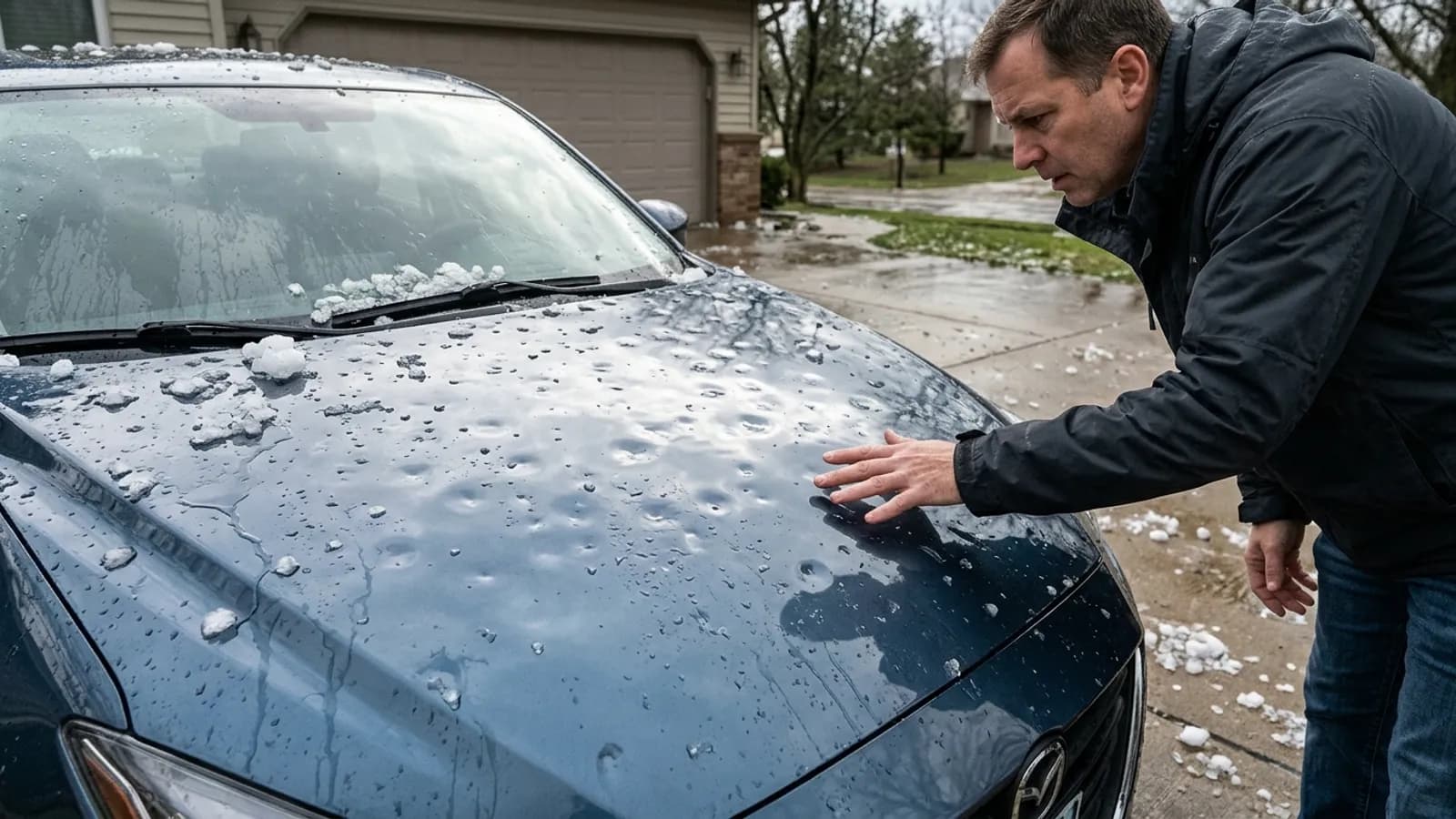
Does Car Insurance Cover Hail Damage?
Hail damage claims under comprehensive coverage — dents, broken glass, storm totals — and liability-only policies cover none of it. PDR and deductibles explained.
Read guideWhat Is Uninsured Motorist Coverage?
Uninsured motorist (UM) coverage pays your injuries when an at-fault driver has no insurance — including hit-and-run drivers — and UIM pays when limits fall short.
Read guide