
Glossary
What Is Uninsured Motorist Coverage?
Uninsured motorist (UM) coverage pays your injury damages when the at-fault driver carries no liability insurance — and, in most states, when a hit-and-run driver is never identified. It converts the other driver's missing insurance from your financial problem into your carrier's claim, up to your UM limit.
How it works
Roughly 14% of American drivers carry no insurance — higher in some states — and UM is the line built for them. The claim runs through your own policy: your carrier confirms the at-fault driver's uninsured status (a database check plus the police report), you document injuries and wage loss the way a liability claimant would, and your carrier pays to your limits. The fault still must be established — personal injury protection (PIP) pays regardless of fault; UM does not, which is why the at-fault accident determination anchors the claim.
Hit-and-run claims add a documentation bar: most carriers require a police report within 24–72 hours and, in many states, physical contact with the insured vehicle. Property damage rides separately — uninsured motorist property damage (UMPD) where offered, or your own collision coverage — while the injury claim itself runs through UM bodily injury. UIM, the companion line, pays when limits exist but run out; see underinsured motorist coverage for the exhaustion mechanics. Stacking, where states permit it, lets multi-vehicle households add UM limits across vehicles. Coordination matters at settlement: UM pays after MedPay and health insurance contribute, with your health plan's lien taking its share — the order of payment changes the net recovery.
Typical values
| Context | Typical value |
|---|---|
| Uninsured-driver rate (US) | Roughly 14%, higher in some states |
| UM/UIM premium | Commonly $30–$80 per year for meaningful limits |
| Recommended limits | Match liability: 100/300 |
| Hit-and-run police-report window | 24–72 hours on most carriers |
| States requiring UM/UIM | Roughly half; written refusal elsewhere |
Uninsured motorist vs underinsured motorist
UM pays when the at-fault driver carries no liability insurance; UIM pays when their limits are too low. The two lines ride one coverage election on most policies ("UM/UIM") and stack the same way — your limits pay the gap between your damages and the other side's recovery. The trigger mechanics differ: UM includes hit-and-runs, while UIM requires proving the at-fault driver's policy limits were exhausted by payment.
Worked example
A driver is struck by a vehicle that flees the scene; the driver is never identified. Injuries total $85,000. The same-day police report preserves the claim, and the unidentified driver is legally uninsured: the victim's UM policy pays the $85,000 within its limits. Without UM, the injury costs land on the victim's health insurance and savings — with the pain-and-suffering component unrecoverable entirely. The coverage existed precisely for the driver who cannot be found. Stacking sharpens the same protection for multi-car households: in stacking states, two vehicles each carrying 100/300 UM can combine to $200,000/$600,000 of injury coverage against exactly this scenario.
Related guides
UM belongs to the injury-coverage family — the liability lines it mirrors and the first-party medical coverages it coordinates with.
- What Is Bodily Injury Liability? — the coverage UM mirrors; why 100/300 is the floor.
- What Is a Statutory Limit? — the state minimum that uninsured drivers skip entirely.
- What Is Coordination of Benefits? — the payment order that shapes the net UM recovery.
- Does Car Insurance Cover Hit-and-Run? — the documentation bar and which coverages respond.
- Car Insurance: The Complete Guide — where UM/UIM sits in the full coverage stack.
Sources
Frequently asked questions
Is uninsured motorist coverage required in my state?
It varies: roughly half the states require UM/UIM (some allow written refusal), and the rest require carriers to offer it. Even where declinable, keeping UM/UIM at your liability limits is the standard recommendation — it pays your own injuries when the at-fault driver has nothing, for a premium commonly $30–$80 per year.
Does uninsured motorist cover a hit-and-run?
Yes, in most states — the unknown driver is treated as uninsured. The conditions are strict: a police report within the carrier's stated window (commonly 24–72 hours) and, in many states, physical contact between the hit-and-run vehicle and yours. Missing the reporting bar is the most common UM denial.
How does a UM claim work?
As a first-party claim through your own carrier: it confirms the at-fault driver's uninsured status, you submit medical records and wage documentation the way a liability claimant would, and your carrier pays up to your UM limits. The negotiation runs adversarially — your carrier defends its own payout while stepping into the uninsured driver's shoes.
Related guides
What Is Underinsured Motorist Coverage?
Underinsured motorist (UIM) coverage pays the gap when an at-fault driver's liability limits are too low for your injuries — their limits pay first, then yours.
Read guideWhat Is Bodily Injury Liability?
Bodily injury liability pays the medical bills, lost wages, and legal claims of people you injure in an at-fault crash — written as paired limits, such as 100/300.
Read guideWhat Is Medical Payments (MedPay) Coverage?
MedPay pays crash-related medical bills for you and your passengers regardless of fault — $1,000–$25,000 of limits for roughly $15–$60 per year.
Read guideWhat Is an At-Fault Accident?
An at-fault accident is a crash you are legally responsible for — expect a premium surcharge of commonly 20–40% for three years, plus an entry on your claims record.
Read guide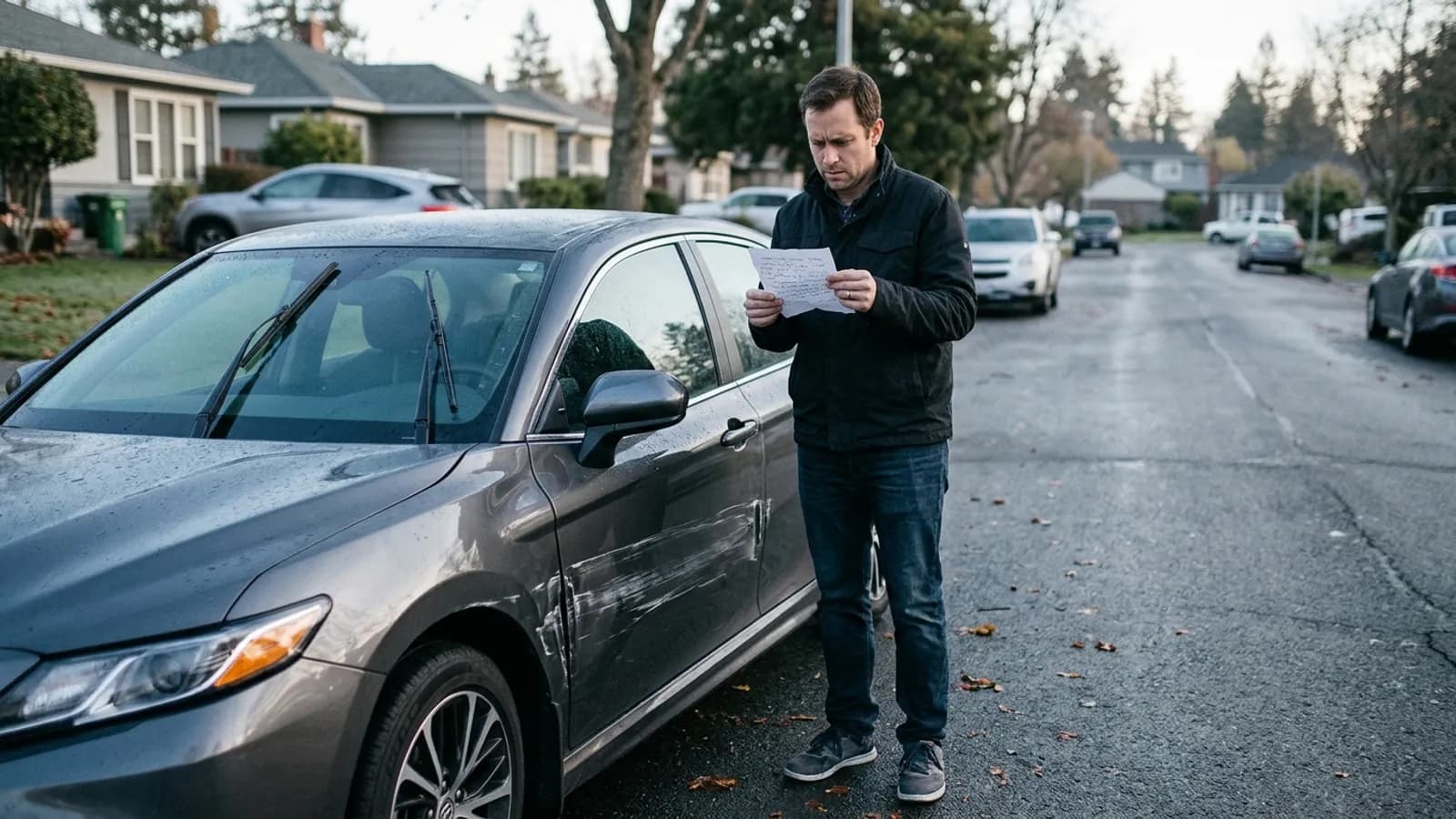
Does Car Insurance Cover Hit-and-Run?
Hit-and-run damage claims under collision and injuries under uninsured motorist — the unidentified driver counts as uninsured. The claim protocol and refund path.
Read guide← Back to the full insurance glossary
Sources
The primary sources behind the facts on this page. Last verified November 10, 2026.
- HealthCare.gov Glossary — official ACA definitions for health-coverage terms.
- Insurance Information Institute (III) — property & casualty term definitions cross-checked against policy forms.
- NAIC consumer resources — regulator-authored guides and glossaries for each line of insurance.
Rules that vary by state are verified against the state insurance department's consumer pages — find yours via the NAIC directory above.