
Does Homeowners Insurance Cover Solar Panels?
Roof-mounted solar panels you own are covered under dwelling coverage, including hail, fire, and wind damage; leased arrays and ground mounts change the analysis.
Why you can trust this guide
- Written by Daniel Reyes, AINS, former licensed P&C agent — independent insurance education publisher.
- Factual accuracy reviewed and signed off by Marcus Hale, CPCU, AINS, licensed P&C agent (Independent insurance reviewer).
- Every factual claim traces to a regulator, statute, or policy document — sources are listed at the bottom of the page.
- Last verified ; time-sensitive guides are re-checked at least twice a year. Read our editorial policy.
On this page
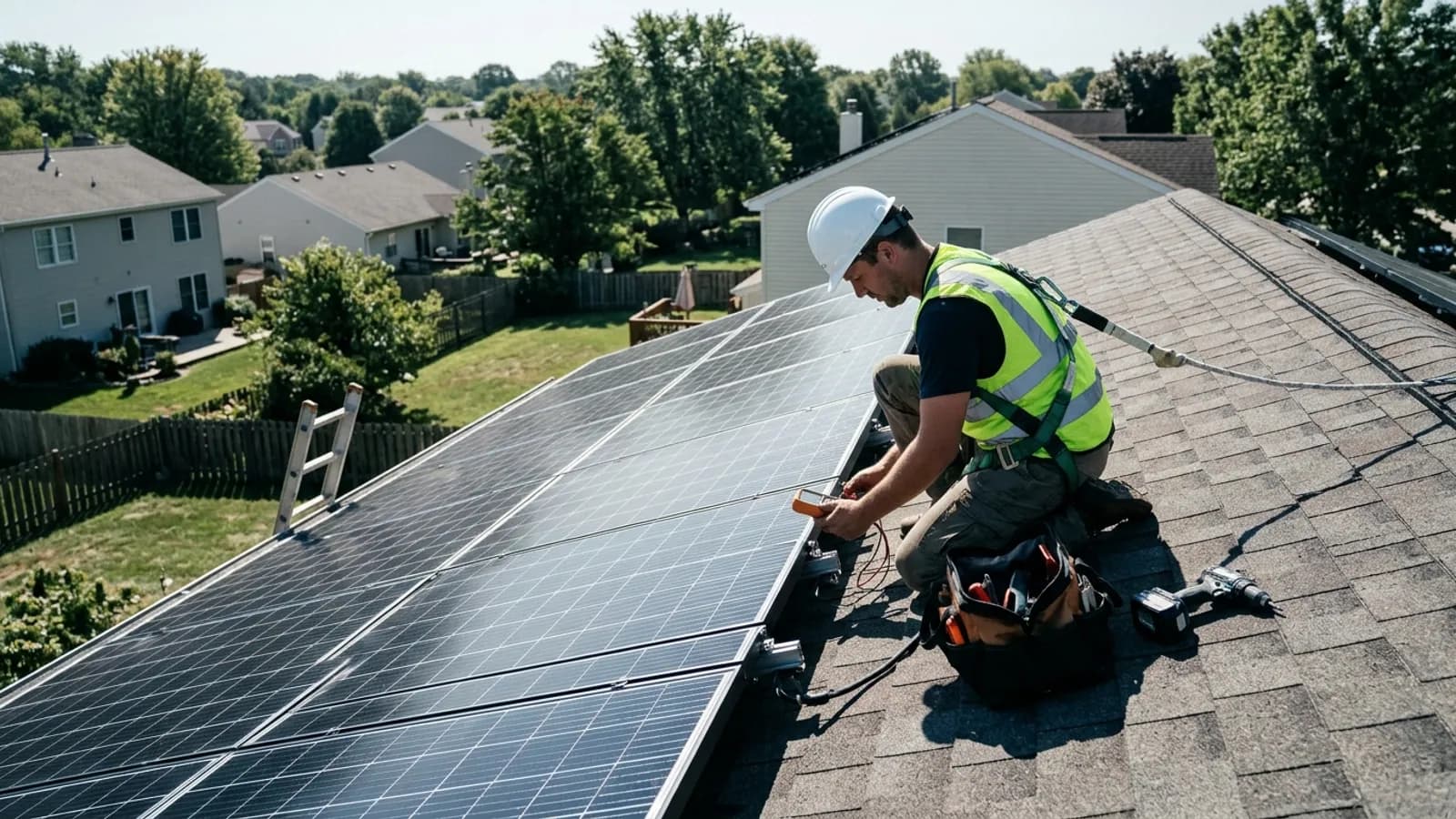
Roof-mounted solar panels you own are typically covered under dwelling coverage — hail, fire, and wind included — because they are attached to the structure. Leased arrays follow the lessor's insurance, ground-mounted arrays often fall under other structures, and carriers want the installation disclosed.
Who owns the array decides who insures it
Solar-panel coverage starts with ownership structure, and the three structures answer differently. Owned and financed — bought outright or held on a loan — the array is yours, and the homeowners policy is the right place, but dwelling coverage must be increased to include the panels' replacement value. Leased or power-purchase-agreement systems belong to the leasing company: the contract typically places the insurance duty on the lessor, and that language should be verified before assuming your policy answers for them, though your policy still answers for roof damage from a panel mounting issue in some scenarios. Financed systems deserve one extra check: the loan's insurance covenants sometimes require a named endorsement, so read the financing paperwork before assuming the base dwelling entry satisfies it. The mid-term question generates the disputes: an array installed after the policy was written is not automatically covered at its value, so the dwelling limit and the insurer's records need updating the week the system is commissioned — one endorsement call in the annual-audit habit.
The classification and the value math
Rooftop panels are generally classified as part of the dwelling; ground-mounted arrays often fall under other structures, which carries the default 10%-of-dwelling limit — a $30,000 ground array on a $400,000 dwelling policy has only $40,000 of other-structures coverage and competes with the fence, shed, and detached garage for it. The value math to run at installation: panel cost plus inverter plus mounting hardware — a typical residential system commonly runs $20,000–$35,000 before incentives — added to dwelling coverage increases the premium modestly, tracking the added insured value. Two endorsements worth asking about: replacement-cost treatment for the array specifically, and loss-of-production coverage, which some specialty carriers price for large systems. Net-metering credits are a utility relationship, not an insured value. The coverage map behind these classifications sits in the homeowners coverage guide.
| Solar scenario | Coverage path | Watch for |
|---|---|---|
| Owned roof array, hail cracks the panels | Dwelling coverage | Percentage wind/hail deductible applies first |
| Leased array damaged in a storm | Lessor's insurance | Lease terms name the responsible party |
| Ground array damaged by wind | Other structures | Default limit is 10% of dwelling, shared |
| Panels removed for a re-roof | Not covered | Maintenance cost unless tied to a covered peril |
Two numbers make the table concrete. First, the deductible interplay: a percentage wind/hail deductible of 2% on a $400,000 dwelling is $8,000, so a $30,000 array plus a $20,000 roof filed as one storm claim pays loss minus $8,000 — filing two separate claims would apply the threshold twice. Second, the shared-limit risk: the $30,000 ground array, the $8,000 fence, and the $12,000 detached garage together sit inside a $40,000 other-structures limit, and the shortfall is discovered at claim time. Run both checks at installation, and endorse the limit upward where the array is ground-mounted.
The hail and roof-work interactions
Two claim scenarios dominate panel losses. Hail: panels are engineered glass, but large hail cracks them, and the claim runs through the same wind/hail deductible as the roof — a percentage deductible on a $400,000 dwelling means the $30,000 array rides on the same $8,000 threshold as the shingles, so claim economics must be run before filing, as the hail damage guide works out. Roof replacement: panels must be removed and reinstalled to re-roof, a cost commonly quoted at $3,000–$6,000 that is not a covered loss on its own — it is a maintenance-side expense, though when the roof was damaged by a covered peril, part of the removal cost can be argued into the claim; get the roofer and the solar contractor to itemize it separately. Fire and wind follow the base policy's structure sections. California's market rules on solar and wildfire pricing sit in the California state guide. The record-keeping that pays: the commissioning invoice with equipment model and serial numbers, kept with the policy file.
Related guides
Solar-panel coverage connects to the hail and dwelling-limit pages, because the array is a dwelling-value question as much as a coverage question.
- Does Homeowners Insurance Cover Roof Leaks? — the re-roofing scenario that forces panel removal and reinstallation.
- Annual Insurance Audit Checklist — the 30-minute review that catches an array missing from dwelling coverage.
- How Much Is Homeowners Insurance? — the annual cost bands the array's added dwelling value moves.
- ACV vs Replacement Cost — the settlement basis behind replacement-cost treatment for the array.
- What Does Homeowners Insurance Cover? — the dwelling-versus-other-structures classification behind panel claims.
Sources
Frequently asked questions
Do solar panels increase my homeowners premium?
Modestly, in proportion to the added insured value: adding $25,000–$35,000 of array to dwelling coverage raises the premium by roughly the same percentage that adding any other dwelling value would. The larger factor is roof risk, because some carriers view panel roofs as harder to service and apply their own surcharge or age rules differently. Get the array added to the policy in writing at commissioning.
Are leased solar panels covered under my homeowners policy?
Usually not by you. The leasing company owns the equipment and its contract generally requires the lessor to insure it, often naming you as an additional insured. Read the lease's insurance section and confirm two points: who pays for roof damage related to the installation, and who is responsible when the system must be removed for roof repairs. Your policy still covers the home itself.
Does homeowners insurance cover power production lost while panels are down?
Standard policies do not — they pay property damage, not lost utility savings. Specialty and some high-net-worth carriers offer loss-of-production endorsements that pay the avoided savings during repair, and larger systems justify pricing one. For most residential systems the practical answer is the warranty: equipment and workmanship warranties cover the performance side while insurance covers the physical damage side.
Does homeowners insurance cover solar panel hail damage?
Owned roof-mounted panels are typically covered as dwelling, and hail is a covered peril, so cracked panels claim under the policy — through the same percentage wind/hail deductible as the roof. Panel efficiency-loss claims from micro-cracks are harder than broken glass, because the damage is measurable in output rather than appearance. Documentation and commissioning diagnostics matter.
Do ground-mounted solar panels need separate coverage?
Often yes. Rooftop panels attach to the structure and generally ride with dwelling coverage, while ground-mounted arrays frequently fall under other structures, which carries a default limit of 10% of dwelling coverage. A $30,000 ground array then competes with the fence, shed, and detached garage for that limit. Verify the classification and the limit before installation, and endorse where needed.
How we researched this guide
Home policies are forms-driven: the peril list in the form decides what gets paid, so our guides follow the policy form structure.
- Coverage explanations track the standard HO-3/HO-5 form structure — Coverage A through E — because that's the contract language adjusters apply.
- Flood facts come from FEMA's National Flood Insurance Program (floodsmart.gov), since standard home policies exclude flood.
- Regional cost ranges are built from NAIC home-owners insurance statistics, with the drivers of variation (construction, age, wind/hail exposure) named explicitly.
- Mitigation and eligibility claims cite IBHS research and state fair-plan rules where standard market access is an issue.
Where facts vary by state or insurer, we publish the range and the reason for the variation rather than a single misleading average. We do not sell insurance, take money from insurers for coverage, or publish claim amounts we cannot trace to a source.
Sources
The primary sources behind the facts on this page. Last verified November 10, 2026.
- FEMA — National Flood Insurance Program (FloodSmart) — flood coverage, which standard homeowners policies exclude.
- Insurance Institute for Business & Home Safety (IBHS) — property-loss research and mitigation standards that affect eligibility and discounts.
- U.S. Department of Housing and Urban Development (HUD) — FHA-insured property requirements and disaster assistance programs.
- NAIC — National Association of Insurance Commissioners — model regulations, consumer guides, and industry statistics.
- Find your state insurance regulator (NAIC directory) — every state insurance department — the authority for your state's rules and complaint filing.
- Insurance Information Institute (III) — industry statistics and consumer explainers we cross-check against regulator publications.
Rules that vary by state are verified against the state insurance department's consumer pages — find yours via the NAIC directory above.
Keep reading
Does Homeowners Insurance Cover Roof Leaks?
Homeowners insurance covers leaks caused by a covered peril — storm hail, wind, a fallen tree — while leaks from age, wear, or deferred maintenance are excluded.
Read guide
Annual Insurance Audit Checklist (30 Minutes)
A 30-minute annual audit: verify dwelling limits against rebuild cost, pull the CLUE report, sweep endorsements and beneficiaries, and re-shop both policies.
Read guide
How Much Is Homeowners Insurance?
Homeowners insurance costs $1,500–$3,000 per year for typical coverage, and state risk, roof age, and your deductible choices decide where you land.
Read guide
ACV vs Replacement Cost: The Claim-Payout Difference
Replacement cost pays today's price to rebuild; ACV pays that price minus depreciation. Learn which settlement basis your policy names before a claim arrives.
Read guide
What Does Homeowners Insurance Cover? (And What It Never Covers)
A standard HO-3 covers fire, wind, hail, theft, and burst pipes — and never floods, earthquakes, or gradual damage. The coverage buckets, exclusions, and fixes.
Read guideWhat Is Dwelling Coverage (Coverage A)?
Dwelling coverage (Coverage A) insures your home's structure at rebuild cost — not market value — and anchors the policy: other limits are percentages of it.
Read guide