
Car Insurance Scams: Ghost Brokers, Staged Accidents, and Rate-Evasion Tricks
The car-insurance scams that cost drivers money — ghost brokers, staged accidents, rate-evasion lies, and roadside fraud — how each works and how to verify an offer.
Why you can trust this guide
- Written by Daniel Reyes, AINS, former licensed P&C agent — independent insurance education publisher.
- Factual accuracy reviewed and signed off by Marcus Hale, CPCU, AINS, licensed P&C agent (Independent insurance reviewer).
- Every factual claim traces to a regulator, statute, or policy document — sources are listed at the bottom of the page.
- Last verified ; time-sensitive guides are re-checked at least twice a year. Read our editorial policy.
On this page
Car-insurance scams range from ghost brokers selling fake policies to organized staged-accident rings — and the victim is usually the person who thought they saved money. Each scam has a tell; here is the field guide.
Scam 1: Ghost brokers
The play: social-media "agents" sell real-looking insurance certificates at too-good prices — targeting high-risk drivers, young drivers, and non-English-speaking communities. The mechanics: doctored documents, lapsed real policies, or policies purchased with false details (the address trick).
The tell: payment to a personal account (Venmo, CashApp, crypto), no policy documents, pressure to pay "before rates rise."
The verification: state DOI license lookup for the agent and carrier, the carrier's app confirming the policy, and the payment going to the insurer — never a middleman's personal account.
Scam 2: Staged accidents
The play: organized rings cause deliberate crashes (the swoop-and-squat: a car cuts in front and brakes), stage injuries with recruited passengers, and route treatment through complicit clinics.
The defense: dashcams (the single best anti-fraud device), photograph everything at the scene, count the occupants, and report suspected staging to the NICB (1-800-TEL-NICB). The claim-side response to any crash — staged or not — is the after-accident checklist.
Scam 3: Rate evasion (the lies that void claims)
The misstatements that save premium and void claims: garaging address lies (insuring the car at grandma's rural address), fronting (parent named driver, teen actually drives — the unlisted-driver claim problem), undisclosed business use, and mileage understatements. Every one of these surfaces the same way: an investigator pulls registration data, telematics, and the motor vehicle record, and the misstatement is written down at claim time.
The mechanics of discovery: claims investigations pull registration, telematics, and scene evidence — the misstatement surfaces exactly when the claim matters. See misrepresentation.
Scam 4: The after-accident approaches
- The runner: "attorneys" and "clinics" soliciting at crash scenes or via text after a fender-bender — the staged-accident recruiting funnel.
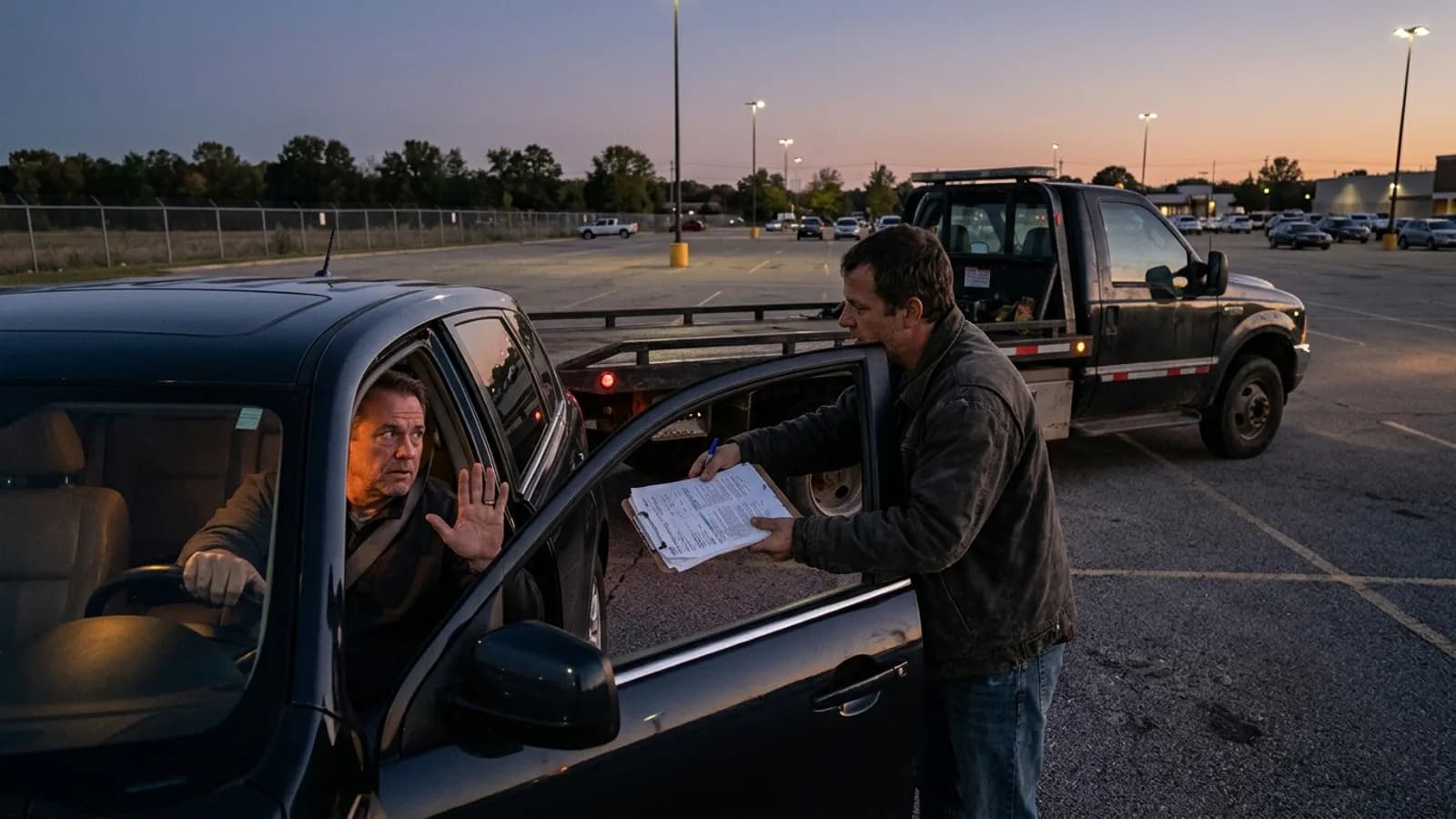
- The tow scam: unsolicited tow trucks taking the car to a bonded yard with storage fees.
The defense: choose your own attorney and shop, use the insurer's dispatch, and never sign anything roadside.
The legitimate cheap-coverage checklist (the anti-scam)
- Quote through licensed channels (state DOI lookup first).
- Pay the insurer directly.
- Verify the policy in the carrier's app before driving.
- Compare the declaration page to what was promised.
- Re-shop through switching mechanics — real savings never require unlicensed shortcuts.
The fake-policy variants beyond ghost brokers
Ghost brokers get the headlines, but the fake-insurance economy runs on four variants, each with a different tell. The cloned-agency website mirrors a real carrier's branding, quotes you, and captures card details — the tell is a domain one character off and a payment page that is not the carrier's own. The fake ID card is sold directly: a laminated proof-of-insurance card for the glovebox — the tell is that no policy number verifies in the carrier's system or app. The rate-evasion broker sells a real policy built on false data (a rural garaging address, a parent as the rated driver) — the tell is the broker asking for your real address "for paperwork only." And the social-media agent DMs quotes with a Venmo or CashApp handle — the tell is everything. Every variant ends the same way: no coverage on the day it matters, which is why verification runs through the state DOI license lookup and the carrier's own app before any payment, and why a real policy's declaration page arrives with the carrier's name, not a middleman's.
What the day a fake policy is discovered actually costs
The math makes the scam self-defeating. Worked example: the ghost broker's "policy" saved a driver $600 per year for two years — $1,200 pocketed. Then an at-fault crash: the other car's repairs and rental total $9,400, the other driver's injury treatment runs $11,000, and their attorney adds a bodily-injury demand. With no real policy, every dollar is personal, collection goes through the courts, and the driver's license and registration can be suspended for the uninsured period — plus the future premium penalty of re-entering the market as an uninsured-crash statistic, where the high-risk market is the only door. Even the no-crash days carry costs: a routine traffic stop or registration check that flags the fake card means an uninsured-driving citation and impound risk in many states. The scam's value proposition is the years it does not rain; the premium saved is never sized against the liability it leaves bare.
Reporting a suspected scam and recovering the money
Recovery is procedural, and speed decides how much comes back. The sequence: file a police report first — it establishes the fraud date every other agency wants; complain to your state insurance department's fraud unit, which licenses agents and acts on unlicensed sellers; report to the NICB, which tracks staged-accident and ghost-broker rings; then request a chargeback from the card processor or bank — card payments are commonly recoverable, and app-based payments sometimes are if disputed fast. The harder line is the knowledge question: victims who genuinely believed the policy was real have a refund path; buyers who knew the address was fake or the driver was misstated are participants in rate evasion, and no agency returns that money. For legitimate replacement shopping afterward, use licensed channels only — every legitimate savings path runs through a DOI-licensed agent or the carrier directly, and the lowering playbook lists them.
Related guides
The scams feed on the gaps between real coverage and claimed coverage — these pages close the real ones.
- Does Car Insurance Cover Other Drivers? — when permissive use covers another driver, and when it does not.
- What Is Non-Owner Car Insurance? — the between-cars liability policy that keeps a coverage record continuous.
- What to Do About a Claim Denial — why claims get denied, and the appeal path that follows.
- Car Insurance: The Complete Guide — the coverage structures, state rules, and savings levers every other page builds on.
Sources
Frequently asked questions
What is a ghost broker?
A scammer selling fake or doctored insurance policies — real-looking certificates, no actual coverage — typically marketed to high-risk drivers and non-English speakers through social media and community groups. The discovery comes at a traffic stop or a claim. Verify insurers against your state DOI's license lookup before paying anyone.
What are staged accidents?
Organized fraud: a deliberately caused crash (the swoop-and-squat), fake injuries, recruited passengers, and complicit clinics billing the insurer for treatment that never happened. Costs flow to everyone's premiums; participants face felony fraud charges. The defense: dashcams and the same-scene documentation discipline.
Is fronting (insuring the car in a parent's name) illegal?
Yes — 'fronting' is misrepresentation: the parent is the named driver while the teen actually drives. Claims get denied, policies rescinded, and both parties can face fraud exposure. The legitimate alternatives: proper teen rating, telematics, and the car-assignment strategy.
How do I verify an insurance offer is real?
Four checks: the carrier's license in your state DOI lookup, the policy documents (not just a certificate image), payment to the insurer (not a personal account or app), and the ID-card verification through the carrier's app or phone line before driving.
Can I get my money back if a ghost broker sold me a fake policy?
Often yes if you paid by card or bank transfer — request a chargeback immediately, citing fraud. File a police report and a state insurance-department complaint to support it. Cash, crypto, or app payments are rarely recoverable. Either way, buy real coverage the same day: the fake policy was never protecting you.
Do dashcams actually deter staged accidents?
They deter by making staging provable — the swoop-and-squat is visible on video, and fraud rings avoid vehicles likely to be recording. More practically, a dashcam resolves the fault dispute that staged-accident claims depend on, which is why fraud investigators call it the single best consumer anti-fraud device.
How we researched this guide
Car insurance pricing is set per driver, per ZIP code — so our guides anchor on regulator and industry statistics and explain the factors, not a fake exact price.
- Premium ranges are anchored to NAIC statewide average-expenditure data, the most complete public dataset on what drivers actually pay per state.
- State minimum-coverage requirements are checked against each state's motor-vehicle financial-responsibility statute and the state insurance department's consumer pages.
- What a coverage actually pays for is verified against policy declarations and specimen forms, not marketing copy.
- Discount and surcharge rules cite the state DOI consumer bulletin where each state regulates them differently — for example credit-based insurance scores, which most states permit but a few ban.
Where facts vary by state or insurer, we publish the range and the reason for the variation rather than a single misleading average. We do not sell insurance, take money from insurers for coverage, or publish claim amounts we cannot trace to a source.
Sources
The primary sources behind the facts on this page. Last verified November 10, 2026.
- IIHS — Insurance Institute for Highway Safety — crash-test data, vehicle loss statistics, and safety-feature research.
- NHTSA — National Highway Traffic Safety Administration — recalls, crash data, and state traffic-safety requirements.
- FMCSA — Federal Motor Carrier Safety Administration — commercial vehicle and carrier insurance requirements.
- NAIC — National Association of Insurance Commissioners — model regulations, consumer guides, and industry statistics.
- Find your state insurance regulator (NAIC directory) — every state insurance department — the authority for your state's rules and complaint filing.
- Insurance Information Institute (III) — industry statistics and consumer explainers we cross-check against regulator publications.
Rules that vary by state are verified against the state insurance department's consumer pages — find yours via the NAIC directory above.
Keep reading
Does Car Insurance Cover Other Drivers?
Car insurance follows the car: permissive use covers occasional permitted drivers, household members must be listed, and a named exclusion voids coverage.
Read guide
What Is Non-Owner Car Insurance? Who Needs It and What It Covers
Non-owner car insurance is liability that follows the driver, not the car — who needs it, what it covers, what it costs, and when it beats a standard policy.
Read guideWhat to Do About a Claim Denial
A claim denial is the insurer's refusal to pay, issued with a reason code. Fix by resubmission, internal appeal within 180 days, then independent external review.
Read guide
Car Insurance: The Complete Guide
Car insurance bundles liability, collision, comprehensive, and medical coverage — this guide explains state minimums, full coverage, and how to lower the premium.
Read guide