
Food Truck Insurance: Coverage for the Mobile Kitchen
Food truck insurance pairs commercial auto for the truck with equipment coverage for the kitchen build-out; most owner-operators pay $200–$500 per month.
Why you can trust this guide
- Written by Daniel Reyes, AINS, former licensed P&C agent — independent insurance education publisher.
- Factual accuracy reviewed and signed off by Marcus Hale, CPCU, AINS, licensed P&C agent (Independent insurance reviewer).
- Every factual claim traces to a regulator, statute, or policy document — sources are listed at the bottom of the page.
- Last verified ; time-sensitive guides are re-checked at least twice a year. Read our editorial policy.
On this page
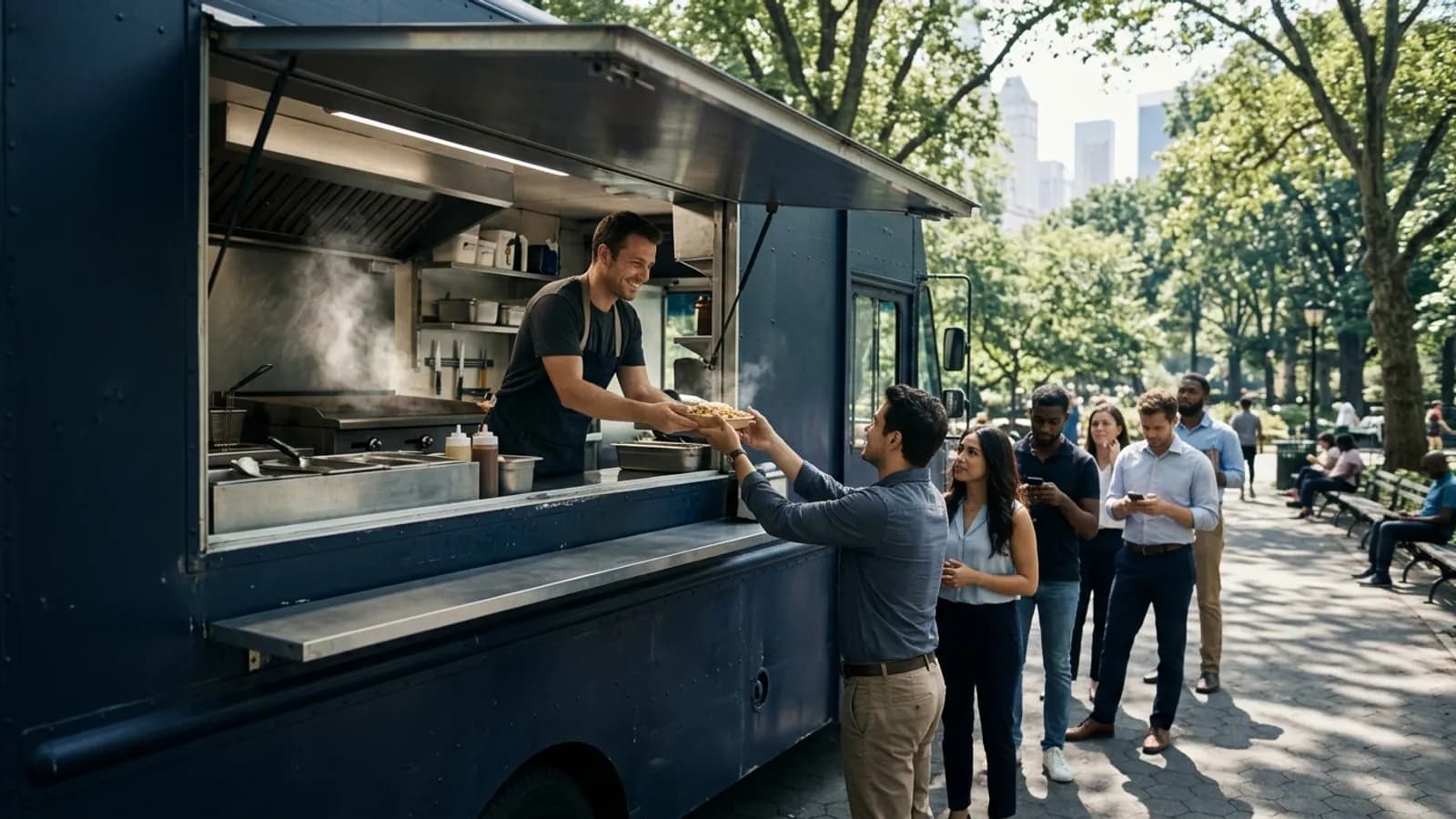
Food truck insurance is commercial auto plus a kitchen: the truck's policy carries the vehicle, and attached coverage handles the $20,000–$100,000 build-out, the customer liability, and the event paperwork. Owner-operators commonly pay $200–$500 per month for the stack.
The food truck stack
| Policy | Covers | Typical monthly cost |
|---|---|---|
| Commercial auto | The truck itself | $150–$300 |
| General liability | Customer injuries, product claims | $50–$150 |
| Equipment (inland marine) | The kitchen build-out | $30–$80 |
| Workers compensation | Staff injuries (burns, cuts) | Priced per payroll class |
| Spoilage | The refrigerated inventory | $20–$50 |
| Scale | Typical monthly cost |
|---|---|
| Solo owner-operator | $200–$350 |
| Truck plus 1–2 staff | $300–$500 |
| Multi-truck operation | Per-truck pricing plus fleet discounts |
The vehicle line is priced by the same rules as any work vehicle — the commercial auto guide covers radius, weight, and driver records — and the serving line is priced like the restaurant operation it is (see the restaurant guide).
The truck is a vehicle at nine and a kitchen at noon
A food truck lives under two policy regimes and needs both. On the road it is a commercial vehicle: commercial auto with physical damage (comprehensive and collision) priced on the truck's value — and the wrap, the graphics, and the built-out interior should be included in the stated value, not the chassis price. Parked and serving, it is a food operation: general liability for the serving line and the crowd it stands in, plus the property line for generators, fryers, and refrigeration inside the box. The gap between the two is where claims fall through: a truck rear-ended en route is the auto policy; a fryer fire at the curb is the liability and property file. Insurers that specialize in mobile food write both in one program — worth seeking out.
Commissaries, shared lots, and whose policy answers
Most jurisdictions require food trucks to service at a licensed commissary — and the commissary agreement is an insurance document in disguise. Typical terms: the truck operator must carry $1 million liability naming the commissary as additional insured, provide auto evidence for vehicles entering the lot, and indemnify the commissary for the truck's operations. Shared vending lots and pod arrangements add the same structure between truck operators. The claims logic underneath: your general liability answers your operations wherever they occur; the host's policy answers the premises; the additional-insured status and the indemnity clause decide who defends first. Collect the commissary's requirements before signing, and keep certificates current on both sides.
The mobile-specific wrinkles
- The truck is the premises — liability attaches wherever the truck parks, so locations must be reported.
- Event certificates — festivals, breweries, and office parks demand additional-insured certificates; the certificate of insurance is daily business.
- Route and state questions — crossing county and state lines changes permit and coverage requirements.
- Commissary requirements — many jurisdictions require licensed commissary kitchens, a lease with insurance implications.
Propane, generators, and the fire-inspection loop
Mobile kitchens carry their fire risk on the vehicle, and both the fire marshal and the carrier ask about it in the same language. The underwriting questions: is an ANSUL or equivalent suppression system installed over the cooking line and serviced on schedule, how is propane stored and changed, are generator fuel and exhaust managed, and is the health-department fire inspection current. Several jurisdictions require the suppression system as a permit condition; insurers increasingly treat the service tags as a condition of quoting. A truck with current suppression tags and documented propane procedure prices below an identical truck without them — and if a fryer fire ever happens, the tag is the first document the adjuster asks for.
The route calendar as an insurance document
A food truck's schedule is an insurance file in disguise, because every stop changes the exposure map. Each municipality on the route carries its own permits and health inspections — some require proof of insurance with the permit application — each festival demands its own certificate with the organizer named, and private bookings put the truck on premises the policy does not describe until reported. The operational habit: a calendar synced with the policy file — new towns reported to the carrier, certificates issued per event, private bookings added as locations. Trucks running a multi-town lunch route commonly refresh the location list quarterly; the festival season is a separate certificate cycle. The permit-and-license layer is mapped in the business insurance requirements guide.
Related guides
The mobile kitchen borrows from both the restaurant and vehicle sides of the map:
- Coffee Shop Insurance — the stationary small-kitchen sibling stack.
- Workers Comp Insurance — the staff burn-and-cut payroll rules.
- How Much Is Business Insurance? — costs by policy and business type.
- Business Insurance: The Complete Guide — the full small-business coverage map.
Sources
Frequently asked questions
How much is food truck insurance?
Commonly $200–$500 per month: commercial auto for the truck at $150–$300, liability for operations at $50–$150, workers compensation per payroll, plus equipment coverage for the kitchen build-out — $20,000–$100,000 of equipment rides in the box.
What insurance does a food truck need?
Commercial auto (the truck is the business), general liability (customer injuries at the window), equipment and inland-marine coverage (the kitchen build-out), workers compensation for staff, and event compliance — festivals demand certificates of insurance with specific limits.
Does food truck insurance cover the kitchen equipment?
Through inland-marine and equipment coverage attached to the policy — the grills, fryers, refrigeration, and generators inside the truck. Standard auto policies do not cover the contents; the equipment schedule does, so list the build-out at its real value.
Does food truck insurance cover the wrap and graphics?
Only if the stated value includes them. Physical damage pays the truck's insured value minus the deductible, so a $40,000 build on a $15,000 chassis should be valued near the total. Report wrap and equipment values when binding; the adjuster pays the policy number, and an under-stated value becomes a co-pay at the worst moment.
Is my truck covered while driving to an event?
Yes — that is the commercial auto policy's job, including liability and physical damage en route. The kitchen equipment inside is covered by the auto policy's contents terms or your property line depending on how the policy is written; verify which. What is not covered en route is your general liability — that follows the truck's operations, not the highway.
Do festivals require their own insurance from me?
Almost always: event organizers commonly require $1M general liability with the organizer named as additional insured, auto evidence for vehicles on site, and sometimes liquor or products endorsements. The certificate is usually due weeks before the event, so ask for the requirements at booking. One annual policy issuing certificates per festival handles the whole season.
How we researched this guide
Business insurance requirements are mostly statutory — workers comp is state law — so our guides separate legal requirements from prudent coverage.
- Workers-comp rules (who must carry, exemptions, monopolistic states) are verified against state statutes and NCCI classifications.
- General liability and BOP coverage mechanics are verified against standard policy forms and SBA guidance.
- Professional-liability explanations distinguish the claims-made trigger and tail options, because that's where businesses get caught.
- Industry examples use realistic claim scenarios published by insurers and courts, and we label estimates as estimates.
Where facts vary by state or insurer, we publish the range and the reason for the variation rather than a single misleading average. We do not sell insurance, take money from insurers for coverage, or publish claim amounts we cannot trace to a source.
Sources
The primary sources behind the facts on this page. Last verified November 10, 2026.
- U.S. Small Business Administration (SBA) — which policies a business legally needs and how to buy them.
- OSHA — Occupational Safety and Health Administration — workplace safety rules that drive workers-compensation obligations.
- NCCI — National Council on Compensation Insurance — workers-comp class codes and rate filings used in most states.
- NAIC — National Association of Insurance Commissioners — model regulations, consumer guides, and industry statistics.
- Find your state insurance regulator (NAIC directory) — every state insurance department — the authority for your state's rules and complaint filing.
- Insurance Information Institute (III) — industry statistics and consumer explainers we cross-check against regulator publications.
Rules that vary by state are verified against the state insurance department's consumer pages — find yours via the NAIC directory above.
Keep reading
Restaurant Insurance: Coverage, Costs, and Requirements
Restaurant insurance bundles a BOP, workers comp, liquor liability, and spoilage coverage, running $150–$350 per month fast-casual and $250–$700 full-service.
Read guide
Commercial Auto Insurance: When Your Personal Policy Stops Working
Commercial auto insurance exists because personal policies exclude business use; most small businesses pay $100–$250 per month per vehicle, and HNOA fixes the rest.
Read guide
Business Insurance: The Complete Guide
Business insurance explained: the general liability, BOP, workers comp, E&O, and commercial auto policies a small business needs — and what each costs per month.
Read guide
How Much Is Business Insurance? Costs by Policy and Business Type
Small business insurance runs $40–$100 per month for general liability and $60–$200 for a BOP, with a small employer's full stack at $150–$600 per month.
Read guide
Business Insurance Requirements: What's Legally Required (State by State)
Workers compensation, commercial auto, and license-specific coverage are the legal floor — every other business insurance requirement arrives by contract.
Read guide