
Coffee Shop Insurance: Coverage for Cafés and Roasters
Coffee shop insurance pairs a BOP built around the espresso equipment with spoilage coverage for the milk; most shops pay $80–$250 per month.
Why you can trust this guide
- Written by Daniel Reyes, AINS, former licensed P&C agent — independent insurance education publisher.
- Factual accuracy reviewed and signed off by Marcus Hale, CPCU, AINS, licensed P&C agent (Independent insurance reviewer).
- Every factual claim traces to a regulator, statute, or policy document — sources are listed at the bottom of the page.
- Last verified ; time-sensitive guides are re-checked at least twice a year. Read our editorial policy.
On this page
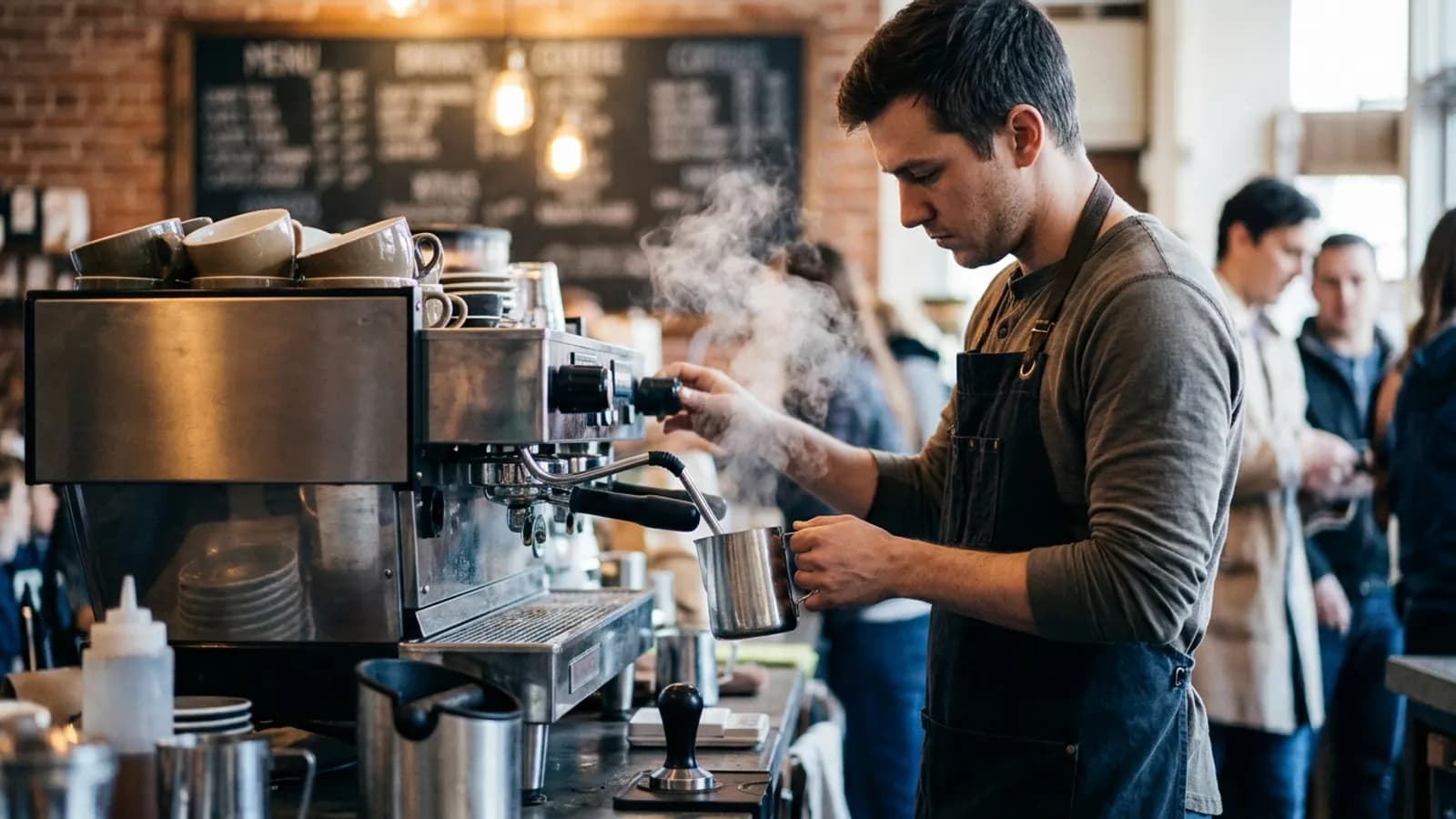
Coffee shop insurance is the café stack: the espresso machine is the asset, the hot-beverage burn is the claim, and the milk spoilage is the endorsement. The standard shop runs $80–$250 per month, with roasting operations pricing above it.
The coffee shop stack
| Policy | Covers | Typical monthly cost |
|---|---|---|
| BOP | Equipment, liability, interruption | $60–$180 |
| Workers compensation | Barista injuries (burns, slips) | Priced per payroll |
| Spoilage | Milk and refrigerated inventory | $15–$40 |
| Equipment breakdown | The boiler, the grinders | $10–$30 add-on |
| Cyber | POS and payment systems | $30–$80 |
The bundle at the top of the table is the BOP small cafés start with; the bundle's interruption line is what keeps payroll running during a forced closure, and its mechanics are the business interruption terms worth reading before the fire, not after.
Power failure, spoilage, and the chain of perils
The dairy case is the coffee shop's most claim-prone asset, and it fails in chains, not single events. A compressor seizes (equipment breakdown), the power grid drops for nine hours (utility failure), a storm snaps the line to the building (covered peril) — each chain lands in different coverage. Standard BOP property answers direct damage from fire, storm, and similar perils. Equipment breakdown coverage answers mechanical and electrical failure of the compressor, the espresso boiler, the roaster. Spoilage coverage pays the spoiled stock itself — and when the cause is an off-premises power failure, it typically needs its own endorsement, because utility-failure perils are carved out of base forms. A shop with $4,000 of perishables and a $10,000 espresso machine should price all three, not assume one covers the other.
The shop-specific claims
- The burn claim — the served-too-hot beverage; the general liability staple.
- The machine breakdown — the boiler failure that closes the shop until the repair lands.
- The spoilage event — the power outage and the milk.
- The slip-and-fall — the milk-steamed floor.
- The roaster's fire — roasting operations add a fire and product exposure of their own.
Grease, steam, and the fire-suppression connection
Coffee kitchens rarely fry, but they stack their own heat and moisture: espresso boilers, drip brewers, blenders, panini presses, and the grease film that accumulates wherever food runs. Carriers underwrite this file through questions, not guesses: is there an extinguishing system over any cooking line, is hood and equipment cleaning on a documented schedule, are outlets and cords maintained around water stations. The answers move the premium and, more importantly, decide claims — a fire that spreads from an unmaintained press invites the maintenance-record question in every adjustment. Shops that keep a dated cleaning log and annual suppression-service tags price and settle better than identical shops without the paper.
A 1,200-square-foot shop's annual budget
A neighborhood shop of about 1,200 square feet with eight seats commonly budgets the following per year: BOP (liability, property, interruption) at $1,500–$3,000 (about $125–$250 per month); equipment breakdown endorsement at $100–$300; spoilage endorsement at $100–$250; workers compensation priced on payroll — two full-time and three part-time staff commonly adds $1,000–$2,500 per year; and, where beer and wine are poured, liquor liability at $500–$1,500 per year (the serving rules live in the bar insurance guide). Total: roughly $3,000–$7,000 per year for the complete stack — about $250–$585 per month. Two line items most owners mis-size: the espresso machine (verify it is listed at replacement value, not purchase price) and business interruption (verify the indemnity period covers a rebuild timeline, not just a cleanup).
The lease clause that prices the build-out
Coffee-shop leases hide the largest insurance number in the deal: the build-out. The espresso bar's plumbing, the hood and ventilation, the electrical service, the flooring — commonly $80,000–$250,000 of tenant improvements — sit in a lease article that decides who restores them after a fire. Some leases leave restoration to the landlord; many shift it to the tenant, which converts your BOP's property limit from a furniture list into a build-out number. The certificate the landlord demands ($1M/$2M liability, additional-insured status) is the small part; the limit you choose on tenant improvements is the part that pays the claim. Read the article, price the number, and verify the interruption line covers the rebuild timeline — the lease-requirements pattern is mapped in the business insurance requirements guide, and the mobile version of the same kitchen is in the food truck guide.
The roaster's add-ons
Roasting in-house converts the café file into a light-industrial one, and three add-ons carry the difference. Fire exposure: the roaster's afterburner, the chaff collector, and the cooling tray are the ignition points, and carriers ask for interlocks, cleaning schedules, and clearances before quoting — some route the roaster to equipment breakdown with its own inspection terms. Product liability: beans sold wholesale to other cafés put your name on someone else's menu, extending the products-completed-operations exposure beyond the counter. Green-bean stock: jute and GrainPro bags stored in quantity change the property schedule — burlap burns, and warehouse-stored inventory belongs on the policy's description like any other stock. A shop roasting for itself and selling the rest by the bag prices all three; a café buying roasted beans prices none of them.
Related guides
The café stack borrows from the food-service family next door:
- Restaurant Insurance — the full kitchen stack: property, spoilage, liquor, liability.
- Cyber Insurance — the POS and payment-data line for card-taking cafés.
- Workers Comp Insurance — the barista payroll and burn-injury class codes.
- Business Insurance: The Complete Guide — the full small-business coverage map.
Sources
Frequently asked questions
How much is coffee shop insurance?
Commonly $80–$250 per month: a BOP at $60–$180 (espresso equipment drives the property value), workers compensation per payroll, spoilage for the milk inventory at $15–$40, and cyber for the POS systems. Roasting operations add fire and product-liability exposure on top.
What insurance does a coffee shop need?
A BOP (the espresso machine is the asset — $15,000–$40,000), general liability for the hot-beverage burn claims, workers compensation, spoilage for the milk, and business interruption. Roasters add product liability and equipment breakdown for the roaster itself.
Does coffee shop insurance cover the espresso machine?
Through the BOP's property coverage, and equipment-breakdown extensions cover the boiler failures. The $20,000 machine is the shop's asset number one; verify it is listed at replacement value, not purchase price, and add the breakdown endorsement.
Is the hot-coffee burn claim real?
Yes — the served-too-hot burn claim is the café's general liability staple (the McDonald's case is the archetype). Coverage pays the claim; temperature documentation and lid discipline are the defense that keeps the claim small.
Does coffee shop insurance cover food spoiled during a power outage?
Only with spoilage coverage, and only when the outage's cause is a covered peril. A failure on the utility's side of the line typically needs a specific off-premises power endorsement on top. Check both the spoilage limit against your perishable inventory and whether utility failure is included — the standard form usually excludes it.
Does coffee shop insurance cover a pop-up booth at a farmers market?
Not automatically — off-premises sales add locations the base policy does not list. Some carriers extend coverage with an endorsement; others prefer a short-term event policy per market. Festival organizers typically require your own $1M certificate naming them as additional insured either way, so ask your carrier before the first booth.
How we researched this guide
Business insurance requirements are mostly statutory — workers comp is state law — so our guides separate legal requirements from prudent coverage.
- Workers-comp rules (who must carry, exemptions, monopolistic states) are verified against state statutes and NCCI classifications.
- General liability and BOP coverage mechanics are verified against standard policy forms and SBA guidance.
- Professional-liability explanations distinguish the claims-made trigger and tail options, because that's where businesses get caught.
- Industry examples use realistic claim scenarios published by insurers and courts, and we label estimates as estimates.
Where facts vary by state or insurer, we publish the range and the reason for the variation rather than a single misleading average. We do not sell insurance, take money from insurers for coverage, or publish claim amounts we cannot trace to a source.
Sources
The primary sources behind the facts on this page. Last verified November 10, 2026.
- U.S. Small Business Administration (SBA) — which policies a business legally needs and how to buy them.
- OSHA — Occupational Safety and Health Administration — workplace safety rules that drive workers-compensation obligations.
- NCCI — National Council on Compensation Insurance — workers-comp class codes and rate filings used in most states.
- NAIC — National Association of Insurance Commissioners — model regulations, consumer guides, and industry statistics.
- Find your state insurance regulator (NAIC directory) — every state insurance department — the authority for your state's rules and complaint filing.
- Insurance Information Institute (III) — industry statistics and consumer explainers we cross-check against regulator publications.
Rules that vary by state are verified against the state insurance department's consumer pages — find yours via the NAIC directory above.
Keep reading

What Is a BOP (Businessowners Policy)? The Small-Business Bundle
A Business Owners Policy (BOP) bundles general liability, commercial property, and business interruption at a discount; most small businesses pay $50–$300 per month.
Read guide
Restaurant Insurance: Coverage, Costs, and Requirements
Restaurant insurance bundles a BOP, workers comp, liquor liability, and spoilage coverage, running $150–$350 per month fast-casual and $250–$700 full-service.
Read guide
Business Insurance: The Complete Guide
Business insurance explained: the general liability, BOP, workers comp, E&O, and commercial auto policies a small business needs — and what each costs per month.
Read guide
How Much Is Business Insurance? Costs by Policy and Business Type
Small business insurance runs $40–$100 per month for general liability and $60–$200 for a BOP, with a small employer's full stack at $150–$600 per month.
Read guideWhat Is Business Interruption Insurance?
Business interruption insurance pays a closed business's lost income and continuing expenses after covered property damage — the payroll-keeping coverage in a BOP.
Read guide