
Does Homeowners Insurance Cover Sinkholes?
Standard policies cover catastrophic ground collapse under a narrow test but exclude ordinary sinkhole damage; karst states sell endorsements separately.
Why you can trust this guide
- Written by Daniel Reyes, AINS, former licensed P&C agent — independent insurance education publisher.
- Factual accuracy reviewed and signed off by Marcus Hale, CPCU, AINS, licensed P&C agent (Independent insurance reviewer).
- Every factual claim traces to a regulator, statute, or policy document — sources are listed at the bottom of the page.
- Last verified ; time-sensitive guides are re-checked at least twice a year. Read our editorial policy.
On this page
Standard policies cover catastrophic ground collapse — a specific, narrow four-condition test — but exclude ordinary sinkhole damage. Florida, Tennessee, and other karst states require or offer sinkhole endorsements and state-backed coverage separately.
Catastrophic ground collapse: the narrow baseline
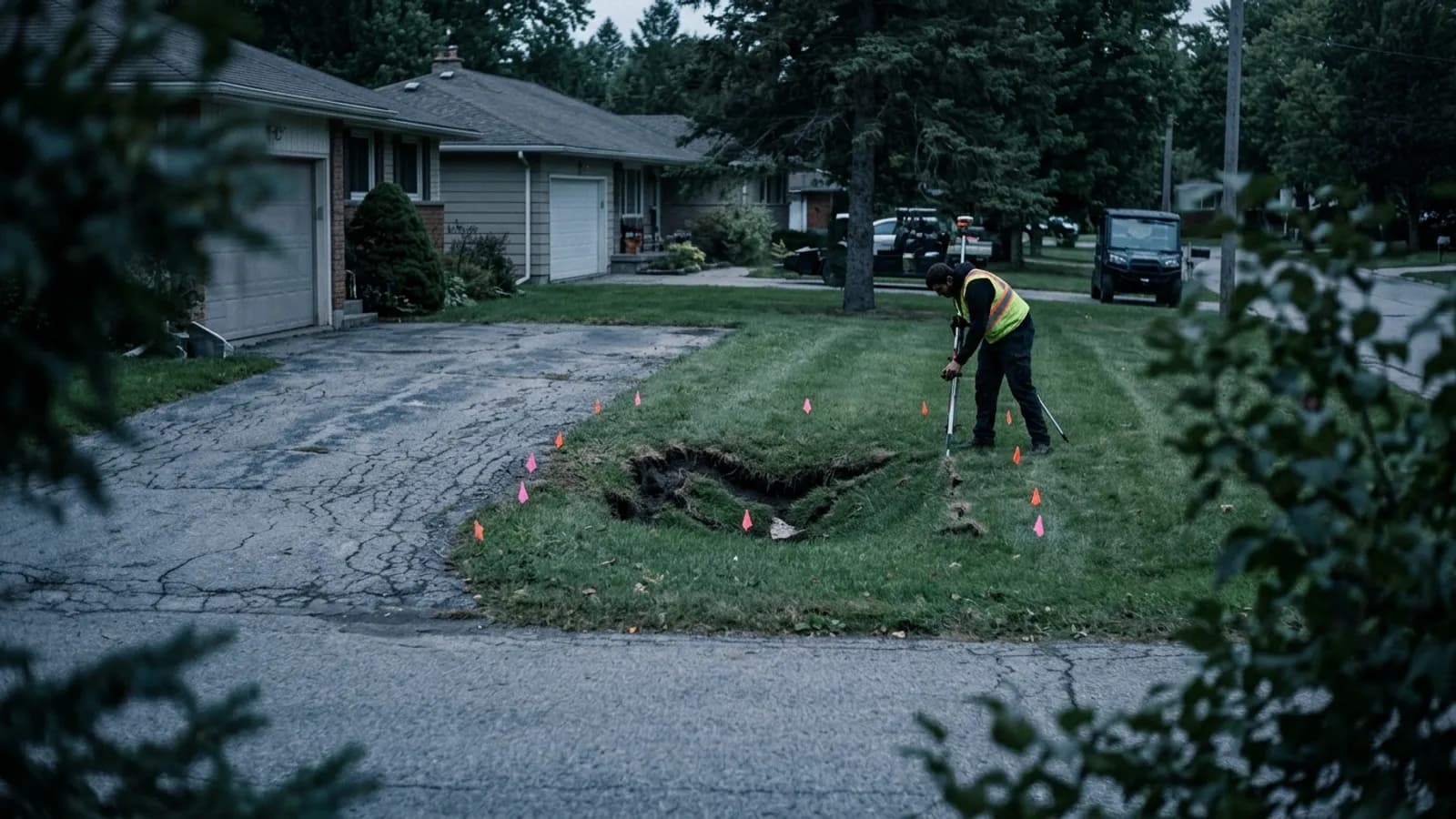
Catastrophic ground collapse coverage, required in Florida policies, typically triggers only when all four conditions are met: the ground collapses suddenly, a visible depression forms, the structure is condemned by a government agency, and the loss makes the home uninhabitable. A sinkhole that cracks the driveway, swallows part of the yard, or shifts a wall without condemning the house does not meet that baseline — which is why Florida homeowners buy the broader sinkhole endorsement when they want real protection. The same pattern explains claim dynamics elsewhere: partial, slow subsidence is the common damage pattern and the hardest to cover, while total collapse is dramatic but rare. When evaluating coverage, ask which trigger standard the policy uses — condemned-and-uninhabitable versus structural damage from verified sinkhole activity — because that single line separates token coverage from real coverage.
| Scenario | Covered? | Why |
|---|---|---|
| Sudden collapse; home condemned and uninhabitable | Yes | Catastrophic ground collapse, all four conditions met |
| Yard depression and driveway cracking, house intact | No | Earth-movement exclusion without an endorsement |
| Verified sinkhole activity cracks walls, with endorsement | Yes per endorsement | The broader trigger sold under state law |
| Ground settling over abandoned mines in coal states | Separate policy | Mine subsidence is its own coverage |
The four-condition test explains why sinkhole claims are evidence disputes before they are coverage disputes: three of the four conditions are official or observable facts — the condemnation, the visible depression, the uninhabitable status — and only the collapse mechanism requires expert testimony. That is the geotechnical report's job, and it is also why counties with mapped karst data produce faster claims: the mechanism is documented before the adjuster arrives. Homeowners in carbonate terrain should know their county's mapping status before a claim, not after.
The state-by-state map, because sinkhole coverage is regulatory
Sinkhole coverage is one of the most state-specific areas in home insurance. Florida is the structural outlier: insurers there must offer sinkhole coverage, often as a priced addition rather than automatic, and the state's building code and sinkhole disclosure rules for real-estate transactions are the most developed in the country. Tennessee requires insurers to offer sinkhole coverage by endorsement in certain counties, and the Tennessee market guide covers the local terms. Pennsylvania and Kentucky sit over carbonate geology where sinkholes occur but coverage is optional and separately priced. In most other states, sinkhole and earth-movement damage falls under the earth-movement exclusion unless a specific endorsement exists. The same exclusion family bars earthquake damage, which is why the earthquake insurance decision rides on the same exclusion text. The practical sequence for anyone in limestone country: ask the carrier which earth-movement exclusions apply, whether a sinkhole endorsement is offered and at what cost, and — before purchase — whether the property sits in a mapped karst area.
The claim process: testing, remediation, and the grouting decision
A sinkhole claim runs through a technical chain. It begins with geotechnical testing — ground-penetrating radar, soil borings, and sometimes seismograph readings — commonly costing $5,000–$15,000, which some insurers fund when a claim is plausible and some require the homeowner to fund first; Florida's process is formalized, and elsewhere it is negotiable. A confirmed sinkhole then faces a remediation decision: compaction or pressure grouting to stabilize the soil under the structure, commonly running tens of thousands of dollars, versus condemnation and rebuild in the severe cases. Two documentation points matter for any version of this claim: the testing report is the claim, because without geotechnical confirmation the earth-movement denial stands; and nearby reported sinkholes with dates, public data in Florida and Pennsylvania, are legitimate supporting evidence. The foundation-evidence side of the claim is covered in the foundation repair guide, and the Florida market context in the Florida state guide.
Related guides
Sinkhole questions connect to the foundation and exclusion pages, because earth movement is the exclusion family they all share.
- Does Homeowners Insurance Cover Foundation Repair? — the sudden-versus-gradual line and the evidence file foundation claims need.
- What Does Homeowners Insurance Cover? — where earth movement sits in the standard exclusions list.
- Flood Insurance — the water peril that undercuts karst terrain and the coverage that answers it.
- Homeowners Insurance in Tennessee — annual costs in a state where sinkhole endorsements are required offerings in certain counties.
Sources
Frequently asked questions
How do I know if my area is sinkhole-prone?
Check your state geological survey's karst maps — Florida, Pennsylvania, Tennessee, Kentucky, and parts of the Southeast publish county-level sinkhole and carbonate-rock maps, and Florida maintains an official sinkhole report database. On a specific property, the real-estate disclosure, prior sinkhole reports on the address, and a geologist's karst assessment are the evidence chain. Limestone, dolomite, and gypsum bedrock are the geological signature.
Does regular homeowners insurance cover a driveway collapse?
Generally no. Sinkhole and earth-movement damage to a driveway falls under the same earth-movement exclusion as the house itself, unless a sinkhole endorsement extends to other structures. Driveway-only collapse is also a common sign of utility-trench settlement rather than true sinkhole activity, which is why insurers ask for geotechnical evidence before paying. Check whether an endorsement, where offered, covers detached structures and paved surfaces.
Is mine subsidence the same as sinkhole coverage?
No. Mine subsidence is ground movement from abandoned underground mines, a separate coverage sold in coal states such as Pennsylvania, Ohio, Illinois, Kentucky, West Virginia, and Indiana — sometimes automatically, sometimes by endorsement. The geological mechanism differs: voided mine workings versus carbonate dissolution. Homes over former mines need mine-subsidence coverage; homes over karst need sinkhole coverage, and some properties need both.
Is sinkhole damage covered in Florida?
Catastrophic ground collapse is covered by standard Florida policies, and insurers must offer broader sinkhole coverage as a priced option under state law. The two triggers are different: collapse coverage requires a sudden, visible collapse that condemns and uninhabits the home, while the endorsement responds to verified sinkhole activity short of collapse. That distinction decides most Florida sinkhole disputes.
What is catastrophic ground collapse coverage?
A narrow standard-policy protection that typically triggers only when all four conditions are met: the ground collapses suddenly, a visible depression forms, the structure is condemned by a government agency, and the loss makes the home uninhabitable. A sinkhole that cracks a driveway, swallows part of the yard, or shifts a wall without condemning the house does not meet it. The endorsement is the broad version.
How we researched this guide
Home policies are forms-driven: the peril list in the form decides what gets paid, so our guides follow the policy form structure.
- Coverage explanations track the standard HO-3/HO-5 form structure — Coverage A through E — because that's the contract language adjusters apply.
- Flood facts come from FEMA's National Flood Insurance Program (floodsmart.gov), since standard home policies exclude flood.
- Regional cost ranges are built from NAIC home-owners insurance statistics, with the drivers of variation (construction, age, wind/hail exposure) named explicitly.
- Mitigation and eligibility claims cite IBHS research and state fair-plan rules where standard market access is an issue.
Where facts vary by state or insurer, we publish the range and the reason for the variation rather than a single misleading average. We do not sell insurance, take money from insurers for coverage, or publish claim amounts we cannot trace to a source.
Sources
The primary sources behind the facts on this page. Last verified November 10, 2026.
- FEMA — National Flood Insurance Program (FloodSmart) — flood coverage, which standard homeowners policies exclude.
- Insurance Institute for Business & Home Safety (IBHS) — property-loss research and mitigation standards that affect eligibility and discounts.
- U.S. Department of Housing and Urban Development (HUD) — FHA-insured property requirements and disaster assistance programs.
- NAIC — National Association of Insurance Commissioners — model regulations, consumer guides, and industry statistics.
- Find your state insurance regulator (NAIC directory) — every state insurance department — the authority for your state's rules and complaint filing.
- Insurance Information Institute (III) — industry statistics and consumer explainers we cross-check against regulator publications.
Rules that vary by state are verified against the state insurance department's consumer pages — find yours via the NAIC directory above.
Keep reading

Does Homeowners Insurance Cover Foundation Repair?
Homeowners insurance covers foundation repair only when a sudden covered peril causes it; settling, soil movement, and gradual leaks are excluded maintenance.
Read guide
What Does Homeowners Insurance Cover? (And What It Never Covers)
A standard HO-3 covers fire, wind, hail, theft, and burst pipes — and never floods, earthquakes, or gradual damage. The coverage buckets, exclusions, and fixes.
Read guide
Flood Insurance: What It Covers, What It Costs, and Who Needs It
Flood insurance is never part of a standard home policy. Costs per year, the 30-day waiting period, NFIP limits, and why most claims come from outside flood zones.
Read guide
Homeowners Insurance in Tennessee: Costs and What to Know (2026)
Homeowners insurance in Tennessee costs $1,700–$2,700 per year, with Middle Tennessee tornado corridors, Memphis quake risk, and severe-storm hail shaping premiums.
Read guideWhat Is an Exclusion in Insurance?
An exclusion is a peril, property type, or situation a policy does not cover — floods, earthquakes, wear and tear — marking exactly where your protection ends.
Read guide