
Glossary
What Is Diminished Value?
Diminished value is the market-value drop a vehicle suffers after accident repairs — the market pays less for a wrecked-and-repaired car than an identical never-crashed one, even when the repair is flawless. Recovery in most states runs through a third-party claim against the at-fault driver's insurer.
How it works
The repair bill fixes the car; the accident history prices it. Diminished value exists in three recognized forms: inherent (the stigma discount from the accident's existence), repair-related (substandard repairs adding to it), and additive (pre-existing damage contributing). The claim mechanics:
- The claim path is third-party — a demand against the at-fault driver's liability carrier after an at-fault accident that is not yours. First-party diminished-value claims against your own collision coverage are commonly excluded by policy language.
- The claim rides on documentation — a professional diminished-value appraisal comparing pre- and post-repair market values, the repair file, and comparable sales data.
- The vehicle must qualify — recent model years, enough value for the discount to be real (the claim strengthens above roughly $15,000 in value), and repair severity such as structural or frame damage supports larger amounts.
- The timing follows the liability claim — the same statute of limitations applies, measured in years, not months.
Settlements land where the appraisal and the comparables point; a contested claim argues repair quality and the local market's actual discount before reaching a negotiated settlement. Appraisal methodology is the contested ground: carriers still reference the 17c formula — a court-derived framework capping DV at a fraction of repair cost — while independent appraisers argue the market-comparison approach, pricing the discount from actual comparable sales of wrecked-and-repaired vehicles. The credible report is the local-market one; template online reports get discounted to near zero by claims departments.
Typical values
| Factor | Typical range |
|---|---|
| Settlement as share of repair cost | 10–30% for late-model vehicles |
| Professional appraisal | $150–$500 for the report |
| Strongest claim profile | Vehicle value above ~$15,000; frame or structural repair |
| Claim deadline | The liability claim's statute of limitations (years) |
Diminished value vs depreciation
Depreciation is the predictable value loss from age and mileage; diminished value is the extra loss caused by the accident record. A five-year-old car depreciates whether or not it was ever hit — the diminished-value claim compensates only the difference between its post-repair value and the value of an identical car with a clean history. That distinction is what the appraisal measures, and what the at-fault insurer's adjustment compares against comparables.
Worked example
A $45,000 SUV takes $18,000 of frame damage in a crash the other driver caused. The shop repairs it perfectly, but the post-repair market value drops $6,800 once the accident history reaches the vehicle report. The owner commissions a $400 diminished-value appraisal, submits the demand package to the at-fault driver's insurer, and settles at $5,200. The first-party equivalent was never available — the owner's own policy excludes diminished value — so the third-party path was the only route, and it recovered 13× the appraisal's cost.
Related guides
Diminished value is the after-claim valuation question — the total-loss and settlement mechanics it sits beside.
- What Is a Total Loss? — the valuation event at the opposite end of damage severity.
- What Is an At-Fault Accident? — the liability basis that makes the third-party claim possible.
- What Is an Insurance Settlement? — how the DV demand resolves.
- What Is Collision Coverage? — the first-party claim that excludes DV by contract.
- What to Do After a Car Accident — where the DV demand fits the claim sequence.
- Car Insurance: The Complete Guide — the full claim and coverage picture.
Sources
Frequently asked questions
Can I claim diminished value from the other driver's insurance?
Yes — in most states the at-fault driver's property-liability coverage owes the resale discount their crash left on your car, supported by a professional appraisal. First-party claims against your own insurer are commonly excluded by policy language, which makes the third-party path the viable route. Recovery is strongest for recent-model vehicles with complete repair documentation.
How much does a diminished value claim pay?
Settlements commonly land at 10–30% of the repair cost for late-model vehicles, scaled by the car's value, age, mileage, and appraisal quality. The professional appraisal runs $150–$500 and is the claim's backbone — template online reports get discounted to near zero by carriers, so the local-market appraisal is the one that pays.
Does a perfect repair eliminate diminished value?
No — the accident history alone moves the market. Vehicle history reports flag the damage regardless of repair quality, and buyers discount a wrecked-and-repaired car against an identical never-crashed one. That stigma discount is inherent diminished value, the most commonly claimed of the three recognized types.
Related guides
What Is a Total Loss?
A total loss is declared when repair costs plus salvage approach the car's actual cash value — thresholds run 70–100% — and the insurer pays ACV minus deductible.
Read guideWhat Is an At-Fault Accident?
An at-fault accident is a crash you are legally responsible for — expect a premium surcharge of commonly 20–40% for three years, plus an entry on your claims record.
Read guideWhat Is an Insurance Settlement?
A settlement is the agreed payment resolving a claim — the policy's valuation for property or a negotiated liability amount — and the release ends it.
Read guideWhat Is Collision Coverage?
Collision coverage pays to repair or replace your car after a crash with a vehicle or object, regardless of fault — minus your deductible. Lenders require it.
Read guide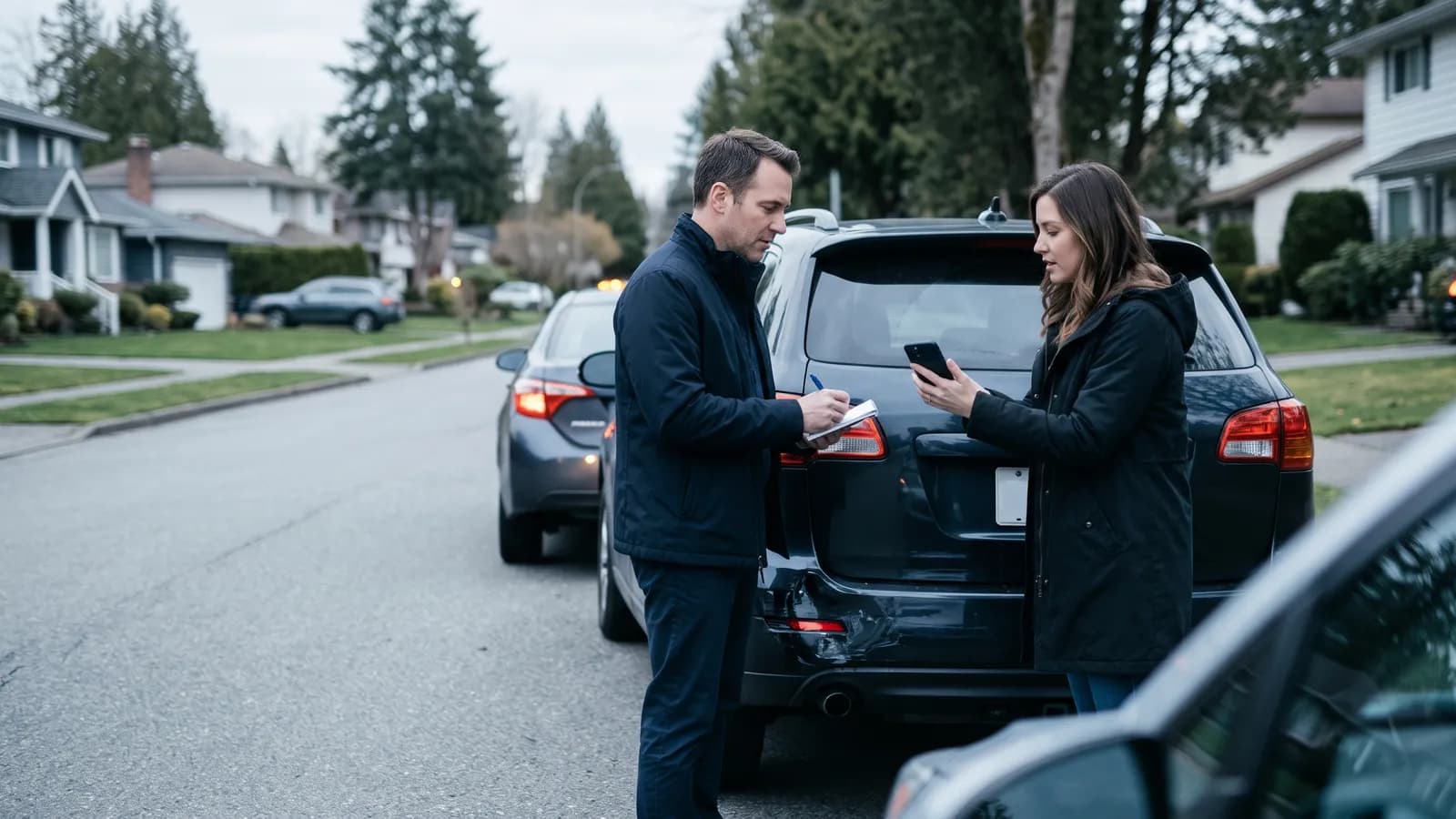
What to Do After a Car Accident: The 10-Step Claim Checklist
The post-accident sequence that protects your claim: scene safety, documentation, prompt insurer notice, the adjuster process, and the statements that cost money.
Read guide
Car Insurance: The Complete Guide
Car insurance bundles liability, collision, comprehensive, and medical coverage — this guide explains state minimums, full coverage, and how to lower the premium.
Read guide← Back to the full insurance glossary
Sources
The primary sources behind the facts on this page. Last verified November 10, 2026.
- HealthCare.gov Glossary — official ACA definitions for health-coverage terms.
- Insurance Information Institute (III) — property & casualty term definitions cross-checked against policy forms.
- NAIC consumer resources — regulator-authored guides and glossaries for each line of insurance.
Rules that vary by state are verified against the state insurance department's consumer pages — find yours via the NAIC directory above.