
First Car: Insurance Checklist for New Drivers
The first-car insurance checklist: quote before you buy, set liability at 100/300/100, stack the young-driver discounts, and build habits that price the decade.
Why you can trust this guide
- Written by Daniel Reyes, AINS, former licensed P&C agent — independent insurance education publisher.
- Factual accuracy reviewed and signed off by Marcus Hale, CPCU, AINS, licensed P&C agent (Independent insurance reviewer).
- Every factual claim traces to a regulator, statute, or policy document — sources are listed at the bottom of the page.
- Last verified ; time-sensitive guides are re-checked at least twice a year. Read our editorial policy.
On this page
The first car and first policy set the trajectory: quote before you buy, set liability at 100/300/100, stack the young-driver discounts, and build the re-shop habit that prices the next decade. The checklist below is the sequence; the budget section prices it.
The checklist
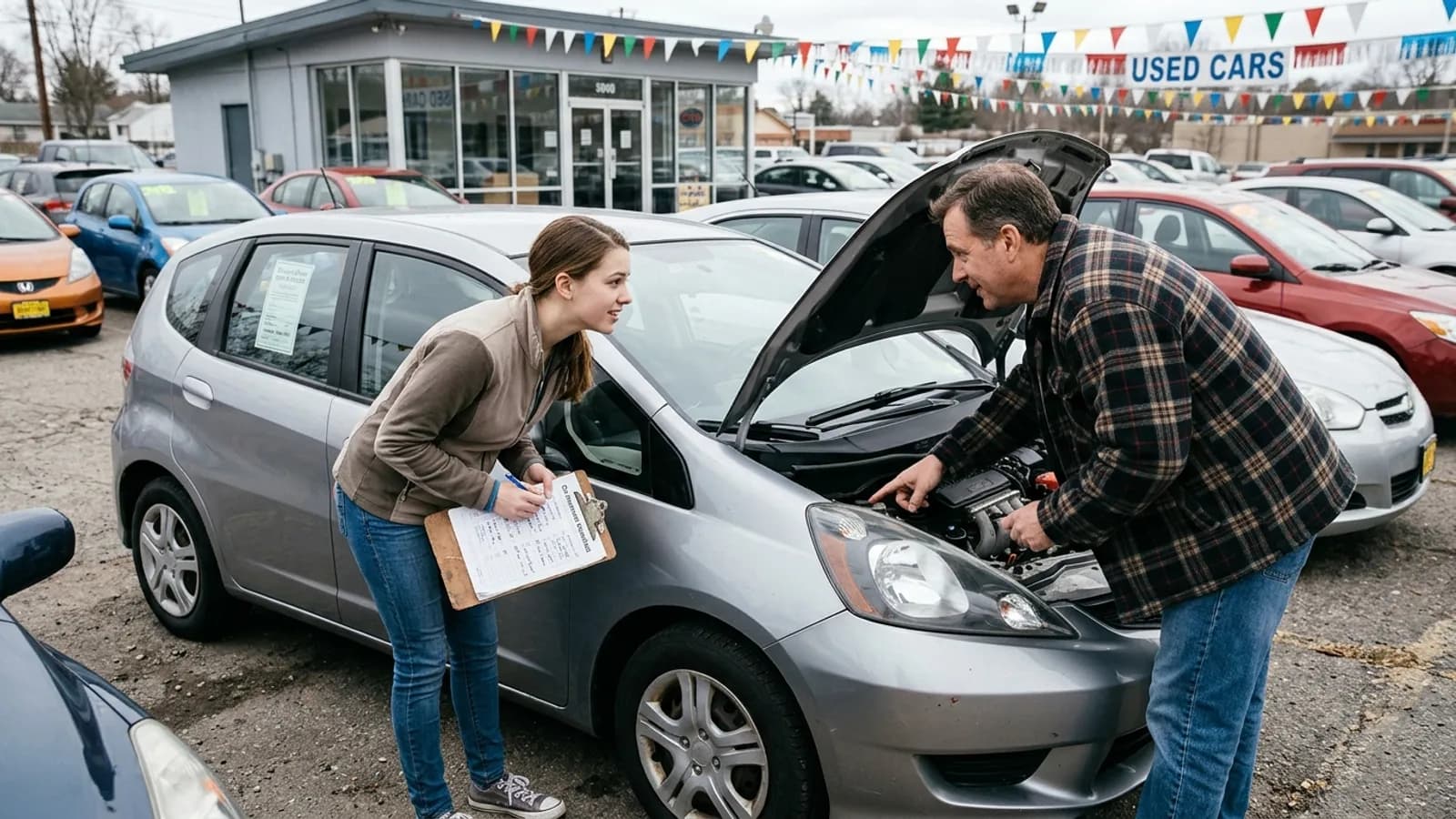
- Get quotes BEFORE buying the car — models differ by $800+ per year at identical driver profiles.
- Set liability at 100/300/100 — minimums are not protection; the upgrade costs a few dollars a month.
- Assign the oldest safe car as primary — the rating assignment decision that prices the household's exposure.
- Liability-only on old cars — the ten-times rule decides; see full coverage.
- Stack the discounts — good student, driver course, telematics.
- Take the defensive driving course — 5–15% off plus the skills.
- Enroll in telematics with real habits — the biggest young-driver savings; the mechanics are in telematics.
- Never let coverage lapse — the lapse surcharge outlives the gap by years.
- Calendar the annual re-shop — rates fall every clean year, and the market releases them faster than incumbents.
The model-penalty list for first cars
The first car's price tag is not the premium driver — the model's claim history is, and the spreads are large. Worked example: a 19-year-old quoted on a 2016 base-trim sedan versus the same year's sport-coupe version of a similar price: the sedan commonly quotes $1,400–$1,800 per year full coverage, the sport coupe $2,400–$3,200 per year — an $800–$1,400 annual penalty for horsepower and a claim record. The penalty list: performance trims (turbo and Si/ST/GTI-type badges), two-door configurations on sporty models, high-theft models (the theft-frequency tables price them everywhere), and anything with expensive crash sensors behind low bumpers. The reward list: base-trim sedans and small SUVs five to ten years old with strong crash ratings — the cheapest-to-repair cars are also the safest for new drivers, which is the rare alignment of insurance math and parenting. The quote-before-buying discipline ties to the average cost guide, and the model effect is the same one the teen-driver setup exploits with car assignment.
A first-policy budget, in dollars
The first policy is buildable, and the build has real numbers. Worked example: a 19-year-old on a $9,000 used sedan, own-name policy, clean record:
| Line | Typical annual |
|---|---|
| Liability at 100/300/100 | ~$1,150 |
| Comprehensive + collision, $1,000 deductible | ~$700 |
| Roadside + rental reimbursement | ~$60 |
| Subtotal | ~$1,910 |
| Good student discount (5–15%) | −$150 |
| Driver-training course (5–10%) | −$150 |
| Telematics, careful driving (10–20%) | −$290 |
| Effective total | ~$1,320–$1,450 per year |
Two structural notes on the build: liability at 100/300/100 is the point where the premium stops being the thing that matters — minimums save about $200 per year and expose wages for a decade; and the $1,000 deductible belongs only if the emergency fund holds it. The liability-only question — when the car is old enough to drop physical damage — is the full coverage ten-times test, and it usually says yes on a $9,000 car only if the driver can self-fund a $9,000 loss.
The first-year habits that price the next five years
The first policy's renewal trajectory is set by habits in year one, and the expensive versions are all avoidable:
- Buying the policy before comparing three carriers — the first quote is rarely the best, and young drivers see the widest quote dispersion of any age group.
- Skipping telematics — careful young drivers earn the largest usage-based discounts in the market, commonly 10–30%, and the data history compounds at renewal.
- Letting coverage lapse between cars or semesters — the continuous-coverage penalty outlives the gap by years and hits hardest on young files.
- Adding a ticket in year one — one violation on a new file prices like several on an old one.
- Staying with the first insurer past two renewals — the re-shop at each clean birthday collects step-downs the incumbent releases slowly; the lowering playbook is the annual habit.
Related guides
The first policy connects to the age curve and to the used-car purchase most first cars are.
- Car Insurance at 18: What New Adult Drivers Pay — the highest-priced age band, and the household setup that halves it.
- Buying a Used Car: Insurance Checklist — the VIN quote, title-brand checks, and ten-times rule for a used purchase.
- What Is a Deductible? — the per-claim amount you self-fund, and how it prices the premium.
- Car Insurance: The Complete Guide — the coverage structures, state rules, and savings levers every other page builds on.
Sources
Frequently asked questions
How much is insurance for a first car?
Full coverage for a young first-time driver commonly runs $1,500–$2,500 per year after discounts on a modest used sedan — and liability-only on an older car cuts it further. The model matters more than the price tag: the same driver can see $800–$1,400 per year spreads between a base sedan and the sport version.
Can I buy car insurance before I have the car?
You can get quotes with a VIN, and bind coverage the day you take ownership — dealers require proof of insurance before the drive home. For a private sale, bind before driving: the seller's policy may extend permissive use, but your own policy from minute one is the clean structure.
Should a first policy be a six-month or twelve-month term?
Twelve months locks the rate through a year of clean driving; six-month terms reprice twice a year, which is bad while the file is improving and good if it is not. For young drivers with improving records, the re-shop discipline matters more than the term — quote both at renewal either way.
Can a first car stay on a parent's policy?
Usually yes, and it is the cheapest structure — a named driver on the household policy keeps the multi-car and bundling discounts. The exceptions: the car is titled solely to the young driver, or the driver has moved out. The household setup, including car assignment, is what makes the increment affordable.
What happens if a new owner drives without insurance?
A traffic stop means a citation, possible registration suspension, and in many states an SR-22 requirement to reinstate — plus the future-rate penalty of a lapse on the record. An at-fault crash uninsured is worse: personal liability for all damage, and the uninsured-crash flag that prices every future quote.
How we researched this guide
Car insurance pricing is set per driver, per ZIP code — so our guides anchor on regulator and industry statistics and explain the factors, not a fake exact price.
- Premium ranges are anchored to NAIC statewide average-expenditure data, the most complete public dataset on what drivers actually pay per state.
- State minimum-coverage requirements are checked against each state's motor-vehicle financial-responsibility statute and the state insurance department's consumer pages.
- What a coverage actually pays for is verified against policy declarations and specimen forms, not marketing copy.
- Discount and surcharge rules cite the state DOI consumer bulletin where each state regulates them differently — for example credit-based insurance scores, which most states permit but a few ban.
Where facts vary by state or insurer, we publish the range and the reason for the variation rather than a single misleading average. We do not sell insurance, take money from insurers for coverage, or publish claim amounts we cannot trace to a source.
Sources
The primary sources behind the facts on this page. Last verified November 10, 2026.
- IIHS — Insurance Institute for Highway Safety — crash-test data, vehicle loss statistics, and safety-feature research.
- NHTSA — National Highway Traffic Safety Administration — recalls, crash data, and state traffic-safety requirements.
- FMCSA — Federal Motor Carrier Safety Administration — commercial vehicle and carrier insurance requirements.
- NAIC — National Association of Insurance Commissioners — model regulations, consumer guides, and industry statistics.
- Find your state insurance regulator (NAIC directory) — every state insurance department — the authority for your state's rules and complaint filing.
- Insurance Information Institute (III) — industry statistics and consumer explainers we cross-check against regulator publications.
Rules that vary by state are verified against the state insurance department's consumer pages — find yours via the NAIC directory above.
Keep reading
Car Insurance at 18: What New Adult Drivers Pay
Car insurance at 18 runs $3,500–$6,500 per year for solo full coverage — the parent-policy setup, car assignment, and telematics are the levers that cut it.
Read guide
Buying a Used Car: Insurance Checklist
The used-car insurance checklist: quote the VIN before buying, run the ten-times rule on comp and collision, check title brands, and configure coverage day one.
Read guideWhat Is a Deductible? (Insurance, Explained)
A deductible is what you pay out of pocket for covered losses before insurance pays — health resets it yearly; auto and home apply it per claim.
Read guide
Car Insurance: The Complete Guide
Car insurance bundles liability, collision, comprehensive, and medical coverage — this guide explains state minimums, full coverage, and how to lower the premium.
Read guide