
Landscaping Insurance: Coverage for Lawn Care and Landscaping Businesses
Landscaping insurance covers property damage, mower injuries, stolen equipment, and chemical-application claims; solo operations pay $70–$150 per month.
Why you can trust this guide
- Written by Daniel Reyes, AINS, former licensed P&C agent — independent insurance education publisher.
- Factual accuracy reviewed and signed off by Marcus Hale, CPCU, AINS, licensed P&C agent (Independent insurance reviewer).
- Every factual claim traces to a regulator, statute, or policy document — sources are listed at the bottom of the page.
- Last verified ; time-sensitive guides are re-checked at least twice a year. Read our editorial policy.
On this page
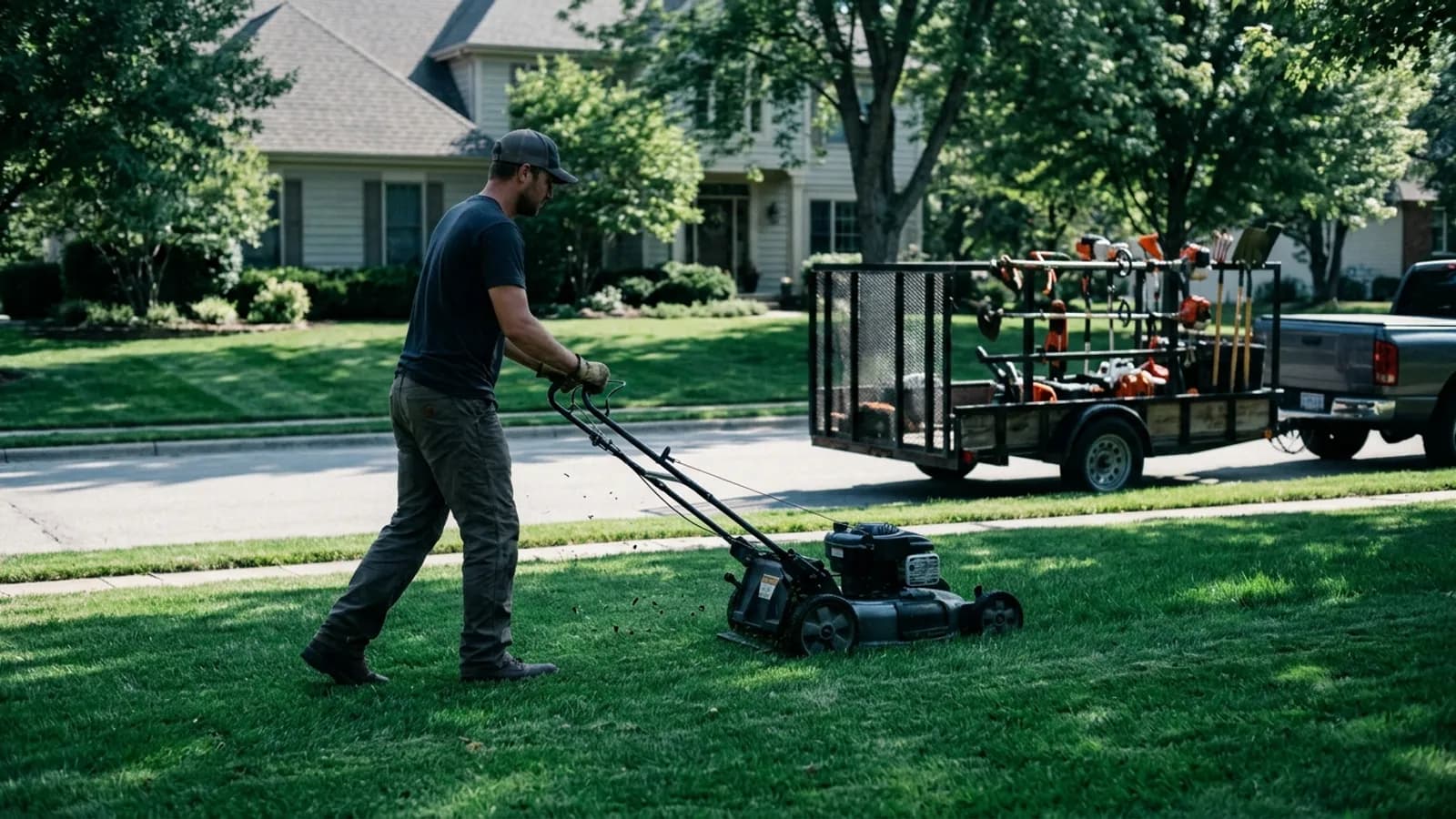
Landscaping insurance is the injury-heavy trade's stack: general liability for property damage, workers compensation for the crew, equipment coverage for the mowers and trailers, and chemical-application liability where the license requires it. Solo operations run $70–$150 per month; crews with chemicals run $200–$500 per month.
The landscaping stack
| Policy | Covers | Typical monthly cost |
|---|---|---|
| General liability | Property damage, injuries | $70–$150 |
| Workers compensation | Cuts, heat, equipment injuries | $3–$8 per $100 of payroll |
| Equipment (inland marine) | Mowers, trimmers, trailers | $20–$60 |
| Commercial auto / HNOA | Trucks, trailers, routes | $100–$200 |
| Pesticide application | Chemical damage claims | $20–$60 |
| Scale | Typical monthly cost |
|---|---|
| Solo mowing (no chemicals) | $70–$150 |
| Crew with chemicals | $200–$350 |
| Full-service (trees, hardscape) | $350–$700 |
The property-damage line is the general liability core, and the vehicle line is priced by the same fields as any work truck — radius, records, and trailers — in the commercial auto guide. Where tree work enters the picture, the pricing jumps into the construction tier; the trade-by-trade table is in the contractor guide.
The landscaping-specific claims
- The rock through the window — the general liability property-damage staple.
- The mower injury — the workers compensation staple and the safety-program target.
- The chemical burn on the lawn — the application-coverage claim.
- The stolen trailer — the equipment claim; trailers are theft magnets.
- The tree incident — tree work prices separately and can double the liability line.
Herbicide drift and the neighbor's garden
The landscaping claim with the longest tail is chemical: herbicide applied on one property damages the neighbor's vegetable beds, an applicator's overspray reaches a fish pond, a treatment misapplied to the wrong lawn kills a client's mature plantings. Standard liability forms treat chemical application through their pollution exclusions — some damages fall through, which is why licensed applicators carry either a specific chemical-application endorsement or pollution liability. The regulatory layer matters too: most states require a pesticide applicator license for commercial herbicide work, with record-keeping (products, rates, dates, wind conditions) written into the license conditions. The application log that satisfies the state inspector is the same file that defends the drift claim.
Trailers, mowers, and the equipment in transit
A landscaping operation's capital is mobile and stealable: mowers, blowers, trimmers, the enclosed trailer, the skid steer. None of it is covered by the auto policy's liability parts, and shop-only property forms do not follow it to job sites. The coverage that works is an inland marine (contractor's equipment) floater — it follows tools to properties, in trailers, and back to the shop, with theft the most common claim (unattended trailers at supply-yard stops and overnight lots). Trailer liability on the road belongs to the commercial auto policy's trailer coverage. Two loss-control habits that price into the premium: hitch locks and enclosed storage overnight, and a photographed equipment list with serial numbers — the claim is only as good as the inventory attached.
Snow contracts and the seasonal flip
The landscaping business that flips to snow removal adds a different liability regime in the same calendar. Snow-and-ice work carries slip-and-fall exposure with a timing twist: claims arrive months after the storm, when the ice condition on the day of the fall is a memory — which is why contract language (scope of service, response triggers, timing after snowfall events) and site documentation (service logs with timestamps and photos) decide the defense. Underwriting treats snow work as its own operation: carriers price it separately, sometimes in a different policy-year structure, and some require it disclosed at application rather than added mid-winter. The solo mower's policy that quietly adds snow plowing in November is the endorsement conversation that prevents the January surprise.
Crews, subs, and the payroll question
The landscaping crew is where insurance and labor law meet the premium. Crew on payroll: workers compensation prices the trade's injury profile — the class code carries mower, trimmer, and lifting exposure — and general liability re-rates on the added payroll, both audited at year end; the hire itself runs through the first-employee checklist. Crew as 1099: the audit's favorite reclassification, converting their payroll into your workers-comp base retroactively, plus the misclassification exposure that follows. Subcontracted crews (a tree company you bring in for removals): your exposure is what you inherit — verify their liability and workers-comp certificates, name them as your additional insured where the contract allows, and keep the certificates on file. The full mechanics of both transitions are in the workers comp guide.
Related guides
The landscaping stack shares its bones with the trades and the payroll pages around it:
- HVAC Insurance — the mechanical-trade sibling with the hot-work exposure.
- How Much Is Business Insurance? — costs by policy and business type.
- Certificate of Insurance — the sub-verification document crews live on.
- Business Insurance: The Complete Guide — the full small-business coverage map.
Sources
Frequently asked questions
How much is landscaping insurance?
Solo mowing operations commonly pay $70–$150 per month for general liability plus auto. Crews with workers compensation, equipment coverage, and pesticide applications pay $200–$500 per month. Tree work prices into the roofing tier — the injury-heavy specialty.
What insurance does a landscaping business need?
General liability (property damage — the rock through the window), workers compensation (the injury-heavy trade: cuts, heat, equipment), commercial auto or HNOA for trailers and routes, equipment coverage (mowers run $10,000+ each), and pesticide or herbicide application liability where chemicals are used.
Does landscaping insurance cover chemical damage to a client's lawn?
Only with pesticide or herbicide application coverage — standard general liability excludes chemical-application damage through its pollution exclusions. The over-application that burns a lawn is the category; the state applicator license pairs with the coverage, and the application log defends the claim.
Is lawn mowing equipment covered under my auto policy?
No — mowers, trimmers, and blowers need inland-marine or equipment coverage; the trailer needs its own (or attached-equipment) treatment. The auto policy's job is road liability, not the equipment's value. The stolen-trailer claim is the category, and the photographed equipment list is what gets it paid.
Does landscaping insurance cover a branch my crew cut that fell on a client's roof?
Yes — that is completed-operations damage within general liability: your work caused damage to the client's property after you left. Document the scope (what was to be removed, what the client directed) and photograph before and after. The dispute that follows is usually scope, not coverage — which the signed work order answers.
Do I need pesticide applicator coverage for basic weed treatment?
If the state requires an applicator license for commercial herbicide work — which most do beyond homeowner-grade products — the insurance question follows: chemical application sits against general liability's pollution exclusions, so licensed applicators carry a chemical-application endorsement or pollution liability. Verify both with the state agriculture department and your carrier; the two requirements travel together.
How we researched this guide
Business insurance requirements are mostly statutory — workers comp is state law — so our guides separate legal requirements from prudent coverage.
- Workers-comp rules (who must carry, exemptions, monopolistic states) are verified against state statutes and NCCI classifications.
- General liability and BOP coverage mechanics are verified against standard policy forms and SBA guidance.
- Professional-liability explanations distinguish the claims-made trigger and tail options, because that's where businesses get caught.
- Industry examples use realistic claim scenarios published by insurers and courts, and we label estimates as estimates.
Where facts vary by state or insurer, we publish the range and the reason for the variation rather than a single misleading average. We do not sell insurance, take money from insurers for coverage, or publish claim amounts we cannot trace to a source.
Sources
The primary sources behind the facts on this page. Last verified November 10, 2026.
- U.S. Small Business Administration (SBA) — which policies a business legally needs and how to buy them.
- OSHA — Occupational Safety and Health Administration — workplace safety rules that drive workers-compensation obligations.
- NCCI — National Council on Compensation Insurance — workers-comp class codes and rate filings used in most states.
- NAIC — National Association of Insurance Commissioners — model regulations, consumer guides, and industry statistics.
- Find your state insurance regulator (NAIC directory) — every state insurance department — the authority for your state's rules and complaint filing.
- Insurance Information Institute (III) — industry statistics and consumer explainers we cross-check against regulator publications.
Rules that vary by state are verified against the state insurance department's consumer pages — find yours via the NAIC directory above.
Keep reading

Contractor Insurance: What Coverage You Need and What It Costs
Contractor insurance is a stack: general liability as the base, workers compensation on the first hire, tools, auto, and trade-driven pricing from $100 per month.
Read guide
Business Insurance: The Complete Guide
Business insurance explained: the general liability, BOP, workers comp, E&O, and commercial auto policies a small business needs — and what each costs per month.
Read guide
Workers Comp Insurance: Requirements, Costs, and the Rules Employers Miss
Workers compensation insurance is required in nearly every state; class codes and experience modifiers price a typical small employer at $40–$150 per month.
Read guide
How Much Is Business Insurance? Costs by Policy and Business Type
Small business insurance runs $40–$100 per month for general liability and $60–$200 for a BOP, with a small employer's full stack at $150–$600 per month.
Read guide
Commercial Auto Insurance: When Your Personal Policy Stops Working
Commercial auto insurance exists because personal policies exclude business use; most small businesses pay $100–$250 per month per vehicle, and HNOA fixes the rest.
Read guide