
HVAC Insurance: Coverage for Heating and Air Contractors
HVAC insurance pairs general liability and completed-work coverage with workers compensation, vans, and the refrigerant question; expect $150–$400 per month solo.
Why you can trust this guide
- Written by Daniel Reyes, AINS, former licensed P&C agent — independent insurance education publisher.
- Factual accuracy reviewed and signed off by Marcus Hale, CPCU, AINS, licensed P&C agent (Independent insurance reviewer).
- Every factual claim traces to a regulator, statute, or policy document — sources are listed at the bottom of the page.
- Last verified ; time-sensitive guides are re-checked at least twice a year. Read our editorial policy.
On this page
HVAC insurance is the licensed-trade stack: general liability with completed-work coverage, workers compensation for the injury profile, the service-van auto policy, and the refrigerant-adjacent pollution question. Licensed solo operators commonly pay $150–$400 per month; crews scale above that.
The HVAC stack
| Policy | Covers | Typical monthly cost |
|---|---|---|
| General liability | Property damage, completed work | $90–$200 |
| Workers compensation | The trade's injury profile | $2–$6 per $100 of payroll |
| Commercial auto | Service vans | $150–$250 per vehicle |
| Equipment / tools | Diagnostic tools, refrigerant equipment | $20–$50 |
| E&O | Design-build system-sizing claims | $40–$100 |
The liability line carries the trade's signature exposure — completed work failing months after the invoice — and its mechanics are the general liability completed-operations terms. The class code assigned to each technician's duties drives the workers-comp line, and the van line follows the commercial auto pricing fields: radius, driver records, and body type.
The HVAC-specific claims
- The completed-work failure — the installation that damages the client's property months later.
- The refrigerant release — the pollution-exclusion question.
- The van theft — the $15,000 of tools and inventory in the van.
- The sizing dispute — the design claim that lands in E&O territory.
- The rooftop fire — the torch-work claim that separates HVAC from the lighter service trades.
The license-coverage pairing
State HVAC licenses require general liability minimums and, with employees, workers compensation — the license and the coverage renew together, and unlicensed operators pay surcharges or get declined outright, which is why the license-coverage pairing is the trade's real gatekeeper. EPA Section 608 certification governs refrigerant work; it is a certification, not insurance, but carriers ask about it at quoting because it maps to the release exposure.
Torches, rooftops, and the hot-work question
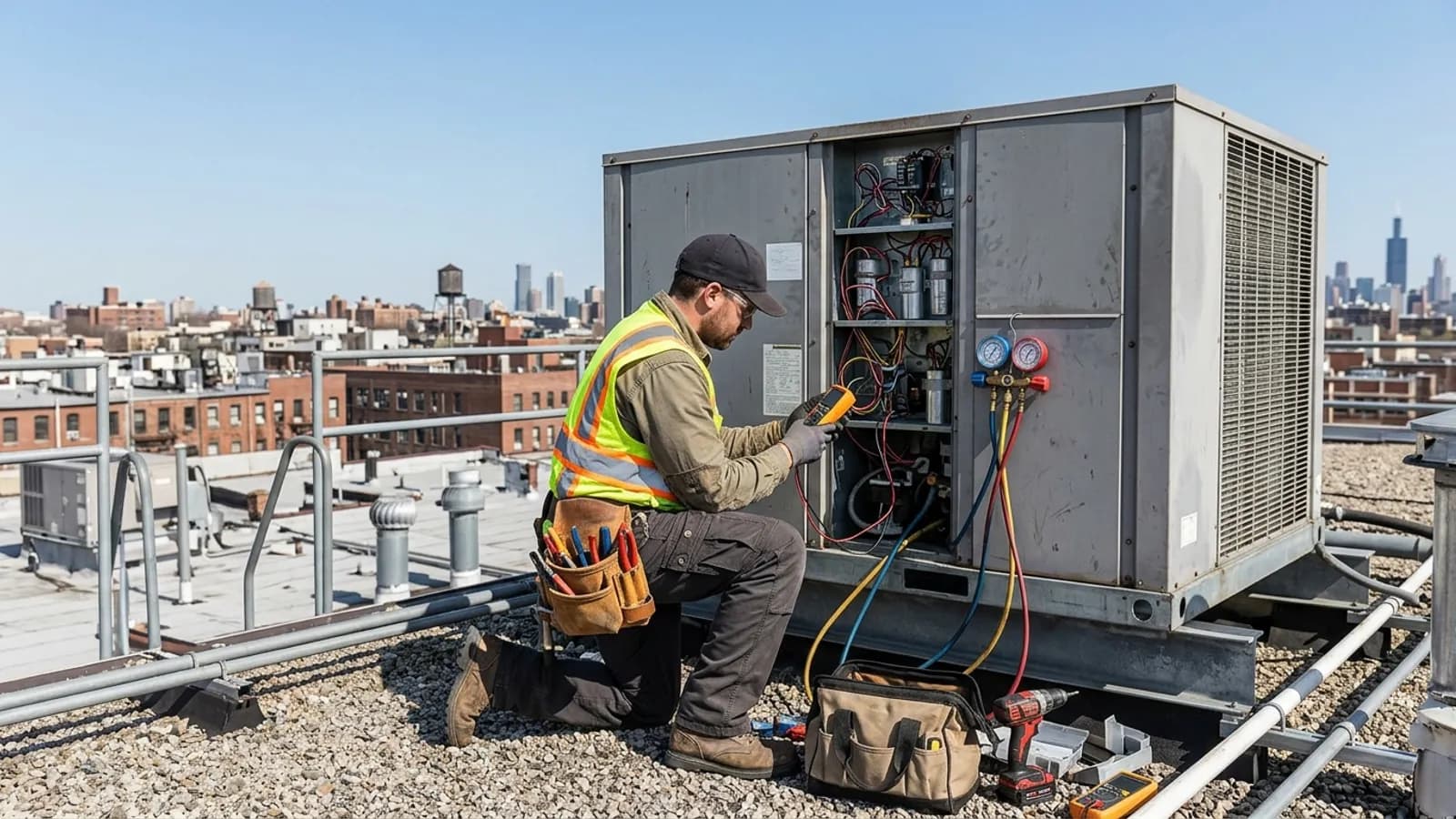
HVAC carries a fire exposure most service trades do not: brazing and torch work on rooftops and in mechanical rooms, next to combustible roof assemblies, insulation, and attic stock. A spark that smolders unseen becomes the building fire claim that names your company. Underwriters ask about it directly — hot-work permits, fire-watch procedures after torch work, extinguisher placement — and liability forms apply their own fire exclusions and conditions around it. The operational standard is borrowed from the roofing trade: a permit per hot-work session, a fire watch for the period after the torch goes out (commonly 30–60 minutes), and documentation. The procedure costs minutes per job; the uncovered fire claim it prevents is the six-figure kind.
The completed-installation clock
The HVAC claim that fires most often starts months after the invoice: the installation that leaks in February, the condensate line that ruined a ceiling, the electrical work that failed inspection. Completed-operations coverage answers damage your finished work causes to others' property — the ruined ceiling, the flooded floor — while the failed component itself (your work product) is a warranty and repair matter, not an insurance payout. Two timing facts shape the exposure: property damage from faulty installation surfaces months to years later, and many states' statutes of repose run six to twelve years for construction-related work. Keep completed-operations coverage continuous, and photograph every install before the walls close — the hidden-work photo is the claim's best evidence.
A licensed two-truck operator's annual spend
A licensed HVAC shop with two service trucks and three technicians commonly budgets per year: general liability at $1M/$2M for $1,200–$3,000 (about $100–$250 per month, with completed-operations limits per contract requirements); workers compensation — a mechanical-trades class code, commonly $2,000–$5,000 at three-tech payroll; commercial auto at $1,500–$3,000 per truck (about $125–$250 per month per vehicle); a tools and equipment floater at $200–$600; and, where commercial contracts demand it, higher completed-operations limits or a $1M umbrella policy at $400–$1,000. Total: roughly $6,000–$12,000 per year — about $500–$1,000 per month. The two levers that move it most are claims history (the experience modifier and the loss runs) and license status.
The service-agreement angle
The maintenance contract is HVAC's quiet insurance asset. A service agreement does three things the claim file rewards: it schedules the inspections whose records prove diligence (the condensate line flushed quarterly, the electrical connections torqued and logged), it documents the customer's acceptance of recommended repairs (the declined-repair note that defeats the "you should have caught it" claim), and it standardizes scope — the agreement defines what a visit includes, the same fence an engagement letter builds for professional-services claims. Underwriters read the agreement count at quoting: shops with a maintenance base price below one-off operators, because recurring inspected systems fail less and claim less. The design-build sizing claims the agreements do not cover are the E&O line, and the trade stack this page borrows from is mapped in the contractor guide.
Related guides
The HVAC stack is the contractor family's mechanical-trade case:
- Workers Comp Insurance — the tech payroll and audit mechanics.
- Landscaping Insurance — the outdoor-trade sibling with the chemical line.
- How Much Is Business Insurance? — costs by policy and business type.
- Business Insurance: The Complete Guide — the full small-business coverage map.
Sources
Frequently asked questions
How much is HVAC contractor insurance?
Licensed solo operators commonly pay $150–$400 per month for general liability plus auto. Crews pay $300–$600 per month, adding workers compensation. The license requirement pairs with liability minimums, and refrigerant handling adds EPA 608 certification to the compliance file.
What insurance does an HVAC contractor need?
General liability (property damage and completed-work claims), workers compensation (the trade's injury profile), commercial auto for the service vans, equipment and tool coverage, and completed-work liability — the installation that fails next season. E&O applies to design-build system-sizing work.
Does HVAC insurance cover a faulty installation that fails later?
Completed-work liability covers property damage from the installation; the system-performance claims — it does not cool properly — sit in professional liability (E&O) territory. The distinction between damage and dissatisfaction is the claim's fork, and the service agreement's scope language draws it.
Does HVAC insurance cover refrigerant released into the air?
Mostly no — pollution exclusions in standard liability forms bar releases of contaminants, and refrigerant venting is exactly that. Limited pollution endorsements exist for sudden and gradual releases; contractors doing significant refrigerant work price pollution liability separately. EPA recovery-equipment compliance is the operational answer — and it is also the underwriting question.
Does HVAC insurance cover the unit I installed if it fails?
No — damage to your own work product is excluded from general liability; that is a warranty and repair cost. What GL does cover is the damage your failed work causes elsewhere: the ceiling the condensate line ruined, the floor the leak reached. Builder's risk or an installation floater covers the unit itself during the installation window.
Are seasonal or part-time techs covered under my policy?
Yes for workers compensation when on payroll — employment status, not hours, drives coverage in mandated states. General liability covers their acts within the scope of the business. The audit trap is the seasonal tech paid as 1099: audits reclassify them as employees, adding their payroll to your workers-comp base retroactively. Payroll honesty is the whole answer.
How we researched this guide
Business insurance requirements are mostly statutory — workers comp is state law — so our guides separate legal requirements from prudent coverage.
- Workers-comp rules (who must carry, exemptions, monopolistic states) are verified against state statutes and NCCI classifications.
- General liability and BOP coverage mechanics are verified against standard policy forms and SBA guidance.
- Professional-liability explanations distinguish the claims-made trigger and tail options, because that's where businesses get caught.
- Industry examples use realistic claim scenarios published by insurers and courts, and we label estimates as estimates.
Where facts vary by state or insurer, we publish the range and the reason for the variation rather than a single misleading average. We do not sell insurance, take money from insurers for coverage, or publish claim amounts we cannot trace to a source.
Sources
The primary sources behind the facts on this page. Last verified November 10, 2026.
- U.S. Small Business Administration (SBA) — which policies a business legally needs and how to buy them.
- OSHA — Occupational Safety and Health Administration — workplace safety rules that drive workers-compensation obligations.
- NCCI — National Council on Compensation Insurance — workers-comp class codes and rate filings used in most states.
- NAIC — National Association of Insurance Commissioners — model regulations, consumer guides, and industry statistics.
- Find your state insurance regulator (NAIC directory) — every state insurance department — the authority for your state's rules and complaint filing.
- Insurance Information Institute (III) — industry statistics and consumer explainers we cross-check against regulator publications.
Rules that vary by state are verified against the state insurance department's consumer pages — find yours via the NAIC directory above.
Keep reading

Contractor Insurance: What Coverage You Need and What It Costs
Contractor insurance is a stack: general liability as the base, workers compensation on the first hire, tools, auto, and trade-driven pricing from $100 per month.
Read guide
Business Insurance: The Complete Guide
Business insurance explained: the general liability, BOP, workers comp, E&O, and commercial auto policies a small business needs — and what each costs per month.
Read guide
How Much Is Business Insurance? Costs by Policy and Business Type
Small business insurance runs $40–$100 per month for general liability and $60–$200 for a BOP, with a small employer's full stack at $150–$600 per month.
Read guide
Commercial Auto Insurance: When Your Personal Policy Stops Working
Commercial auto insurance exists because personal policies exclude business use; most small businesses pay $100–$250 per month per vehicle, and HNOA fixes the rest.
Read guideWhat Are Workers Comp Class Codes?
Class codes are the occupational categories pricing workers comp — each job maps to a rate per $100 of payroll, from clerical ($0.20–$0.50) to roofing ($8–$20+).
Read guide