
Glossary
First-Party vs Third-Party Claims
A first-party claim is the policyholder's claim against their own policy — the collision claim, the homeowner's fire claim, the health claim. A third-party claim is someone else's claim against your liability coverage. The distinction sets the rulebook: your contract governs the first, tort law and the other carrier govern the second.
How it works
The first-party claim exercises the coverages named on your declarations page — collision, comprehensive, dwelling, personal property — each with its own deductible and valuation basis. The policy's conditions govern the process: prompt notice, cooperation, mitigation of further damage, proof-of-loss requirements on larger claims, and examinations under oath in disputed cases. Payment goes to you or, on financed property, jointly to the lienholder. Valuation splits the check too: actual cash value deducts depreciation and replacement cost does not, so the same first-party claim pays differently on the two bases — the election made at purchase decides the settlement. The carrier's conduct is reviewable through the state insurance department, and bad-faith statutes attach because the carrier owes contractual duties to its own insured.
The third-party claim flips the machinery: an external claimant files against your liability coverage, must prove your fault, pays no deductible, and deals with your carrier's defense. Your duties as the insured are cooperation and notice — the claim is not yours to negotiate.
Two first-party protections have no third-party equivalent. The appraisal clause lets the policyholder invoke a three-member valuation panel when the carrier's number looks low, and bad-faith statutes give the insured a direct remedy against its own carrier's unreasonable conduct. Both exist because the first-party contract is a two-party promise.
Typical values
| Attribute | First-party claim | Third-party claim |
|---|---|---|
| Filed with | Your own carrier | The at-fault party's carrier |
| Deductible | Applied | None to the claimant |
| Governing rules | Your policy's conditions | Liability law and the other policy |
| Renewal effect | Possible surcharge, 3–5 years | Points against you, priced at renewal |
First-party claim vs third-party claim
The confusion costs money at the accident scene. Filing first-party gets your repair paid now, minus your deductible, and your carrier pursues the other carrier through subrogation to recover it. Waiting on the third-party route avoids the deductible but runs on the other carrier's timeline — and stalls entirely when fault is disputed. A claim denial on the first-party path is reviewable under your own state's bad-faith rules; a third-party delay has no such lever for you.
Worked example
A hailstorm dents your roof and the neighbor's parked car. Your roof claim is first-party: your dwelling coverage pays, minus your deductible, under your policy's conditions. The neighbor's car claim is also first-party — filed by the neighbor against their own comprehensive coverage, because hail is nobody's fault. Two policies, two first-party claims, one storm. Had your tree fallen on the neighbor's fence instead, the same neighbor would file third-party against your liability coverage and prove your negligence.
Related guides
The claim type decides the process, and the neighboring pages — the third-party mirror, the subrogation that follows payment, the denial path — complete the map.
- Public Adjusters — the first-party-claim specialist the third-party side never hires.
- Proof of Loss — the sworn filing larger first-party claims require.
- Settlement — how the payment closes the claim.
- After a Car Accident — choosing the filing route at the scene.
- Home Insurance Claims — the property-claim process end to end.
Sources
Frequently asked questions
Do I pay a deductible on a first-party claim?
Yes. First-party property coverages apply the deductible stated on your declarations page, per claim unless the policy says otherwise. Liability-type payments carry no deductible because the carrier pays a third party on your behalf. Waiver endorsements on some policies drop the deductible for glass or specified losses.
Can a first-party claim raise my insurance premium?
It can. Carriers rate the claim's type, size, and your prior record at renewal. Not-at-fault claims raise premiums in some states and stay neutral in others, and at-fault property claims commonly surcharge for three to five years. Small claims below a few hundred dollars often cost more in surcharges than they pay.
What is an examination under oath?
A sworn, transcribed interview the carrier may require in disputed first-party claims — a policy condition in most property policies. Refusing commonly voids the claim, so attend, with counsel if the questions are serious. It is the first-party duty third-party claimants never face.
What is the difference between first-party and third-party claims?
A first-party claim runs against your own policy, follows your policy's conditions, and pays minus your deductible. A third-party claim runs against someone else's liability coverage — the claimant must prove fault, pays no deductible, and negotiates with the other carrier instead of following its contract.
Related guides
What Is a Third-Party Claim?
A third-party claim is a demand filed against someone else's liability insurance — the other driver's injury claim, or a guest's fall at your home.
Read guideWho Is a Claimant?
A claimant is anyone making an insurance claim — the policyholder on first-party claims or the injured third party on liability claims.
Read guideWhat Is Subrogation?
Subrogation is your insurer's right to recover its claim payment from the party at fault — paying you first, then pursuing the responsible side's insurer.
Read guideWhat to Do About a Claim Denial
A claim denial is the insurer's refusal to pay, issued with a reason code. Fix by resubmission, internal appeal within 180 days, then independent external review.
Read guide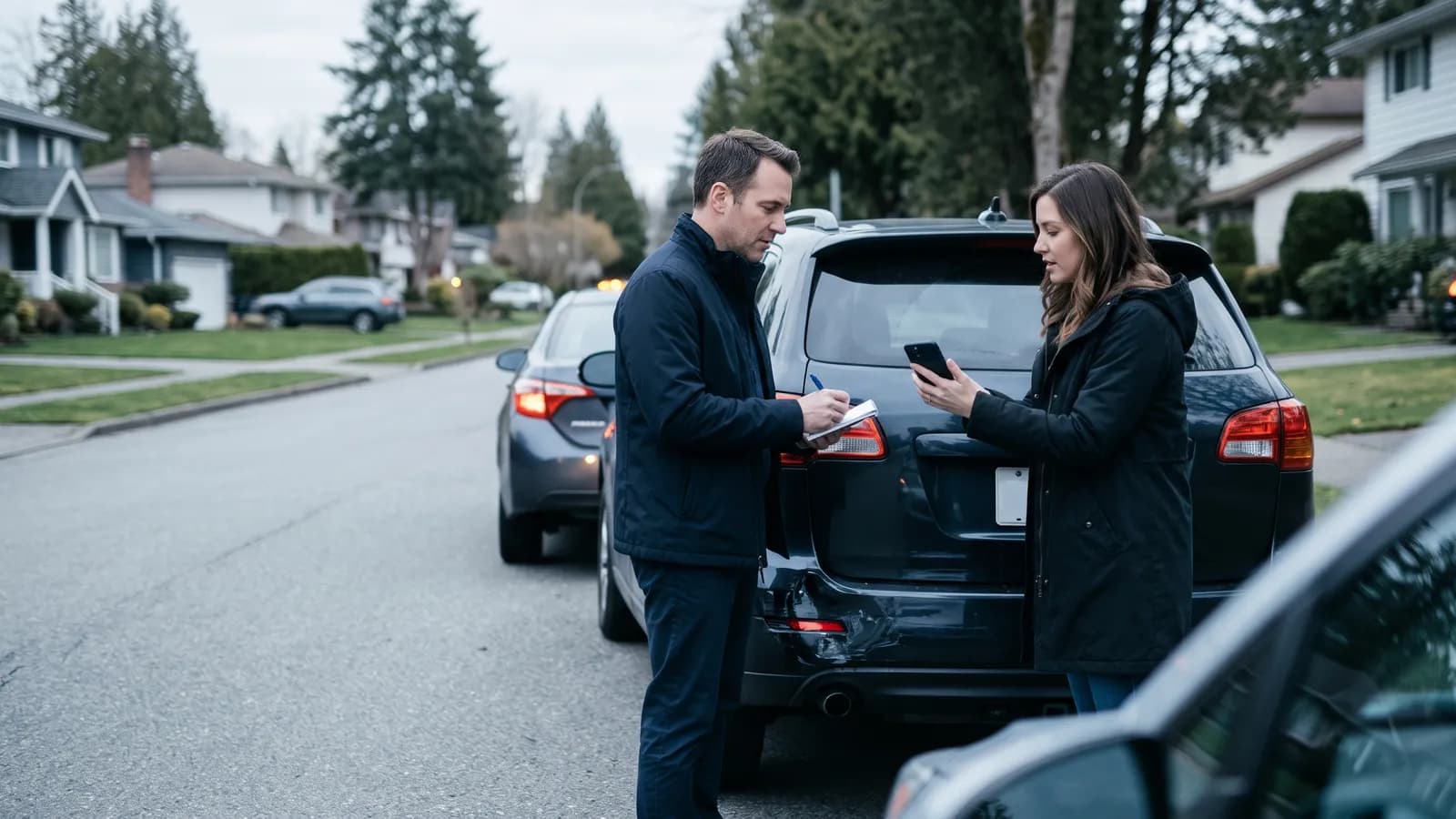
What to Do After a Car Accident: The 10-Step Claim Checklist
The post-accident sequence that protects your claim: scene safety, documentation, prompt insurer notice, the adjuster process, and the statements that cost money.
Read guide
The Home Insurance Claim Process: From Damage to Settlement
How a homeowners claim actually works: mitigation, documentation before cleanup, the adjuster visit, the two-check payout, supplements, and common mistakes.
Read guide← Back to the full insurance glossary
Sources
The primary sources behind the facts on this page. Last verified November 10, 2026.
- HealthCare.gov Glossary — official ACA definitions for health-coverage terms.
- Insurance Information Institute (III) — property & casualty term definitions cross-checked against policy forms.
- NAIC consumer resources — regulator-authored guides and glossaries for each line of insurance.
Rules that vary by state are verified against the state insurance department's consumer pages — find yours via the NAIC directory above.