
Does Car Insurance Cover Interstate Travel?
Car insurance covers all 50 states and typically Canada — most policies raise liability limits to meet the state where a crash happens. Mexico is excluded.
Why you can trust this guide
- Written by Daniel Reyes, AINS, former licensed P&C agent — independent insurance education publisher.
- Factual accuracy reviewed and signed off by Marcus Hale, CPCU, AINS, licensed P&C agent (Independent insurance reviewer).
- Every factual claim traces to a regulator, statute, or policy document — sources are listed at the bottom of the page.
- Last verified ; time-sensitive guides are re-checked at least twice a year. Read our editorial policy.
On this page
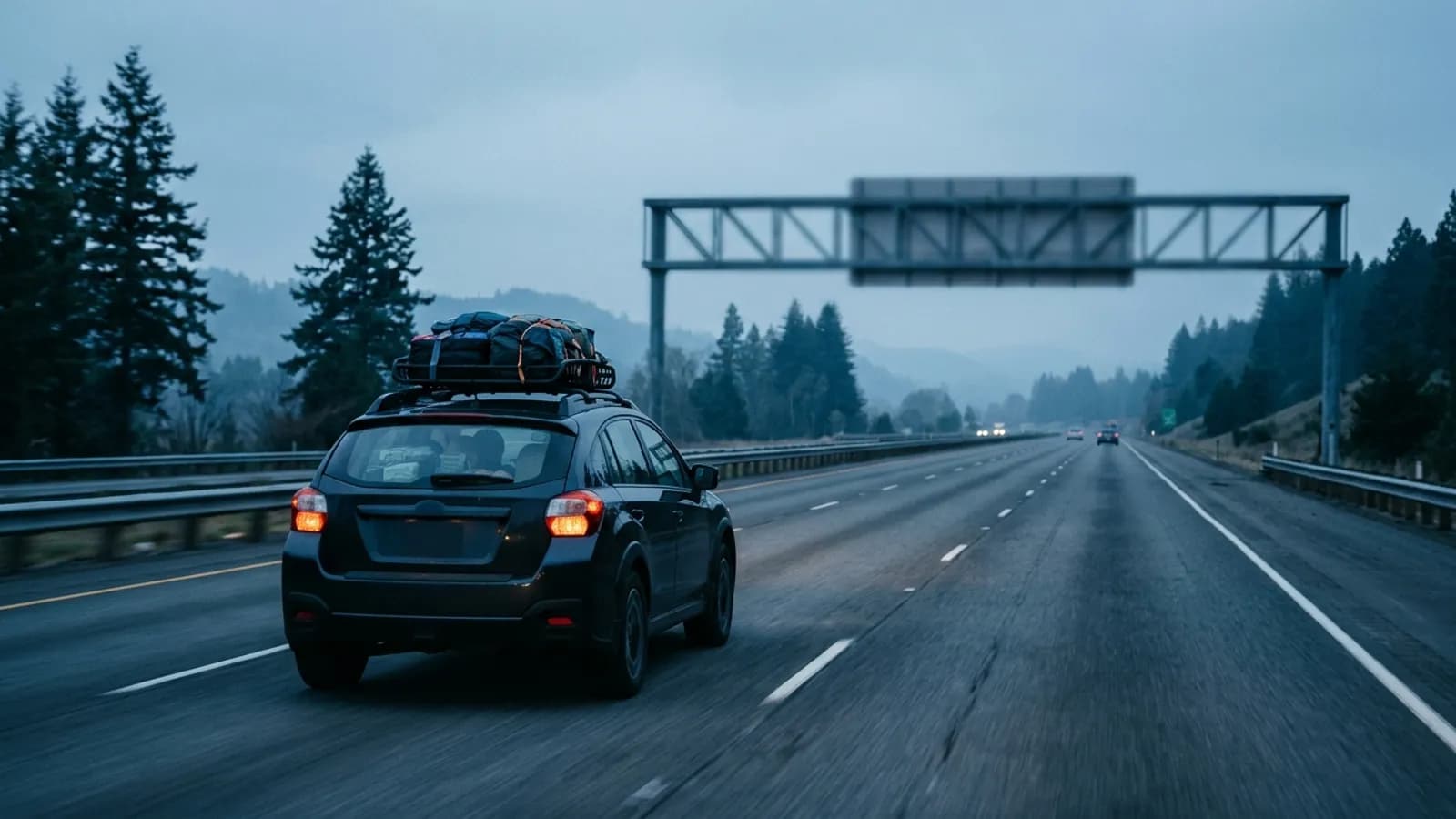
Yes — U.S. auto policies cover all 50 states, and typically Canada; the home state's policy applies wherever the car is driven in the country. Most policies automatically raise liability limits to meet the state where a crash happens. Mexico is the standing exclusion, and a relocation is different from a trip: the garaging address must update.
The limits-extension clause, in plain language
Crossing a state line does not change the policy — but the state where a crash happens can change the liability exposure, and most policies handle it automatically. The mechanic: many policies contain a clause that raises liability limits to meet the minimum requirements of the state where an accident occurs, so a driver carrying 25/50 from a lower-minimum state who crashes in a 30/60 state gets the higher minimum applied.
It is a floor-raiser, not an upgrade: the clause protects the carrier's compliance, not the driver's assets — a $300,000 injury bill still outruns a raised minimum. The same logic runs the other way for coverages declined at home: a no-fault state's PIP requirement applies to residents, not visitors, so a traveler from an at-fault state does not gain PIP by crossing a line. The no-fault rules themselves are the no-fault insurance glossary entry.
Vacation versus relocation: the garaging-address line
The policy travels with vacations; it does not travel with residency. The line is the garaging address — where the car lives overnight most of the year. Vacation: a two-week trip, a college semester with the car still garaged at home, a snowbird winter — coverage applies everywhere in the U.S., because nothing about the risk changed. Relocation: establishing residency in a new state means the garaging address updates within weeks, because rates price to the address and an out-of-state address on a policy is a rate-evasion pattern insurers police.
The gray cases: college students — many carriers allow the home address while the student remains a resident-dependent; military reassignments — special rules apply, per the military deployment guide; and extended work assignments past a few months, where most carriers want the address updated. The full move sequence is the moving-states checklist, and the policy's geographic reach is formally called the coverage territory.
| Scenario | Covered? | Why | | | --- | --- | | Road trip through five states | Yes — all 50 states | Coverage territory spans the country | | Crash in a higher-minimum state | Yes — limits raise automatically | Policy limits-extension clause | | Spring-break drive into Mexico | No | Mexico excluded; Mexican policy legally required | | Drive into Canada | Typically yes | U.S. policies extend; proof card sometimes requested | | Moved to a new state, policy unchanged | At risk | Garaging-address misrepresentation; claim-time discovery | | Semester at college, car garaged at home | Yes | Resident-student exception |
Road-trip claim logistics in another state
A crash 900 miles from home follows the same claim mechanics with different logistics. The local police department takes the report, and its report number matters locally. Roadside assistance dispatches through the carrier's national network. The claim opens with the home insurer exactly as it would at home.
The differences that matter: the other state's fault rules apply to liability — an at-fault-state driver crashing in a no-fault state meets PIP rules and injury thresholds they have never read. Repair shops and rental-car logistics run locally. The total-loss valuation uses the crash state's market, which can differ from the home market on trucks and specialty vehicles. The rental-car layer on a trip is priced in the rental car coverage guide.
Quick answer: does car insurance cover interstate travel?
Yes — your policy follows the car across state lines, and in most policies the coverage automatically rises to meet the minimum requirements of the state you are driving in.
- Temporary travel needs nothing — vacations, road trips, and cross-border commutes run on the home policy.
- Coverage adjusts to the driving state: a minimums-only driver from a low-minimum state is temporarily raised to a stricter state's floor in most policy forms.
- Moving is different from traveling — a new home state means re-registration and a new policy within that state's windows; the old policy does not extend residency.
- Canada is generally covered; Mexico is not — most policies exclude travel beyond the near-border zone, and Mexican insurance is a separate purchase.
The trap: assuming a low-coverage home policy is fine for a cross-country drive. It usually is — because the form lifts the minimums — but the interstate travel guide covers the exceptions, and the state guides carry each state's floor.
What interstate coverage costs, priced
Nothing extra — the benefit ships with the policy. The repricing comes only with the move: registering in a new state re-rates the policy to that state's rules, credit environment, and density, which can move the premium 20–50% either direction. The moving-states checklist sequences the switch; the trip itself prices at zero.
Related guides
The neighboring work is the move that changes the policy, the no-fault rules a traveler meets, and the rental layer of the same trip.
- What Is Personal Injury Protection (PIP)? — the no-fault coverage a traveler does not gain by crossing a line.
- What Is Territorial Rating? — how the garaging address prices the policy.
- Adding a Teen Driver — the resident-student rules behind the college gray case.
- What Is Liability Insurance? — the coverage the limits-extension clause raises.
- Car Insurance: The Complete Guide — the hub for state rules and coverage structures.
Sources
Frequently asked questions
Does my car insurance follow me on a road trip through several states?
Yes — U.S. policies cover all 50 states, and most automatically raise liability limits to meet the minimums of the state where an accident happens. The coverage levels travel unchanged, and the garaging address only needs updating for an actual move, not a visit.
Is my car covered driving into Mexico for the day?
No — Mexico is the standing exclusion on U.S. auto policies, and Mexican law requires liability insurance from a Mexican insurer. Tourist policies are sold per-day or per-trip at the border and online; the U.S. policy pays nothing on the Mexican side of the line.
Does my car insurance work in Canada?
Typically yes — U.S. policies extend to Canada, and a proof-of-insurance card is sometimes requested at the border. Canada is the exception that proves the rule: the United States and Canada sit inside the coverage territory, while Mexico requires its own liability policy by law.
Do I need to update my insurance when I move states?
Yes — within weeks of establishing residency. The garaging address reprices the policy and the new state's requirements apply. An out-of-state address left on a policy is a rate-evasion pattern insurers police, and claim-time discovery is the expensive version: the claim pays, then the policy collapses around it.
What if I crash in a state with higher minimums than mine?
Most policies automatically raise the liability limits to meet the state's minimums where the crash happens — a policy provision that protects compliance, not assets. A $300,000 injury bill still outruns a raised minimum, which is why carrying higher limits than the home state requires is the real answer.
Do I need extra coverage for winter or mountain driving on a trip?
No separate coverage is needed — comprehensive and collision apply to weather and crash damage wherever it happens. What matters is the deductible before the trip: a $1,000 deductible on a slide-into-the-ditch claim is cash from the emergency fund, wherever the ditch is.
How we researched this guide
Car insurance pricing is set per driver, per ZIP code — so our guides anchor on regulator and industry statistics and explain the factors, not a fake exact price.
- Premium ranges are anchored to NAIC statewide average-expenditure data, the most complete public dataset on what drivers actually pay per state.
- State minimum-coverage requirements are checked against each state's motor-vehicle financial-responsibility statute and the state insurance department's consumer pages.
- What a coverage actually pays for is verified against policy declarations and specimen forms, not marketing copy.
- Discount and surcharge rules cite the state DOI consumer bulletin where each state regulates them differently — for example credit-based insurance scores, which most states permit but a few ban.
Where facts vary by state or insurer, we publish the range and the reason for the variation rather than a single misleading average. We do not sell insurance, take money from insurers for coverage, or publish claim amounts we cannot trace to a source.
Sources
The primary sources behind the facts on this page. Last verified November 17, 2026.
- IIHS — Insurance Institute for Highway Safety — crash-test data, vehicle loss statistics, and safety-feature research.
- NHTSA — National Highway Traffic Safety Administration — recalls, crash data, and state traffic-safety requirements.
- FMCSA — Federal Motor Carrier Safety Administration — commercial vehicle and carrier insurance requirements.
- NAIC — National Association of Insurance Commissioners — model regulations, consumer guides, and industry statistics.
- Find your state insurance regulator (NAIC directory) — every state insurance department — the authority for your state's rules and complaint filing.
- Insurance Information Institute (III) — industry statistics and consumer explainers we cross-check against regulator publications.
Rules that vary by state are verified against the state insurance department's consumer pages — find yours via the NAIC directory above.
Keep reading

Moving States: Insurance Checklist
The moving-states insurance checklist: update the garaging address first, meet the new state's minimums, re-shop the market, and use the 60-day health window.
Read guide
Deployed Military: Car Insurance Rules, SCRA, and Storage Options
Deployment insurance rules: the SCRA 6% cap on pre-service premiums, stored-vehicle options, power-of-attorney logistics, and the maintain-or-suspend decision.
Read guide
Does Car Insurance Cover Rental Cars?
Most auto policies extend liability and often comprehensive and collision to U.S. rental cars at your own limits — loss-of-use fees and foreign rentals are the gaps.
Read guideWhat Is No-Fault Insurance?
No-fault insurance is a car insurance system where your own PIP coverage pays crash medical bills regardless of fault, with lawsuits limited to serious injuries.
Read guideWhat Is a Coverage Territory?
Coverage territory is the clause defining where a policy applies — US auto policies cover the US and Canada but exclude Mexico; property follows the location.
Read guide