
Barbershop Insurance: Coverage for Barbers and Shops
Barbershop insurance splits by seat: booth renters buy liability plus tools coverage, shop owners add a BOP — $25–$65 solo, $85–$250 per month for shops.
Why you can trust this guide
- Written by Daniel Reyes, AINS, former licensed P&C agent — independent insurance education publisher.
- Factual accuracy reviewed and signed off by Marcus Hale, CPCU, AINS, licensed P&C agent (Independent insurance reviewer).
- Every factual claim traces to a regulator, statute, or policy document — sources are listed at the bottom of the page.
- Last verified ; time-sensitive guides are re-checked at least twice a year. Read our editorial policy.
On this page
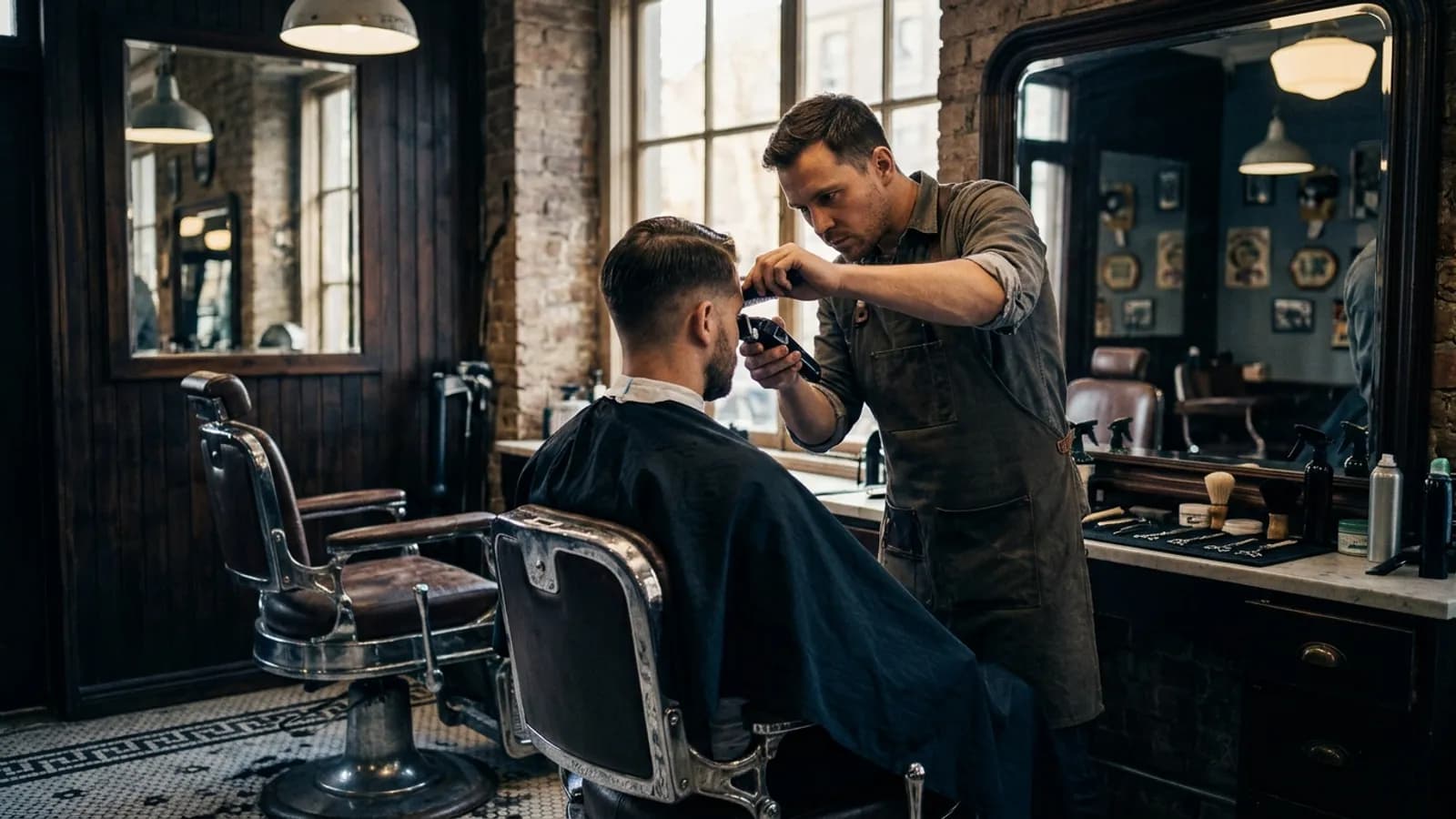
Barbershop insurance is the salon-family stack with razor claims at the center: a BOP for shop owners, individual liability for booth-renter barbers, and professional liability for the nicks, cuts, and infections that define the trade.
The three positions in the shop
Coverage follows the seat, not the building. The shop owner carries the premises; the booth renter carries the chair they rent; the commission barber works under the owner's policy. Each position answers a different certificate request, and the recurring dispute — who pays when a client sues both — resolves by policy, not by argument.
| Model | Coverage | Typical monthly cost |
|---|---|---|
| Shop owner | BOP + workers comp + professional liability | $85–$250 |
| Booth-renter barber | Individual liability + tools | $25–$65 |
| Commission barber | Covered under the shop's policy (verify) | Often included |
A booth renter — licensed, renting a chair, building their own clientele — commonly pays $300–$800 per year ($25–$65 per month) for personal general liability plus professional coverage, and brings their own certificate to the shop owner. The shop owner, carrying the premises and hosting or employing the renters, commonly pays $1,000–$3,000 per year ($85–$250 per month) for the building-side package. Both certificates on file, exchanged both ways, is the arrangement that holds up when a client sues everyone in the room: the renter's policy answers for the renter's services, the owner's answers for the premises. The liability mechanics behind both are in the general liability guide.
The razor and chemical claims: professional liability territory
Most barbershop claims are not falls — they are service outcomes: a nick that got infected, a relaxer left too long, a hot-towel treatment that scalded. These are professional-liability claims, the same category other service professions buy as errors and omissions (E&O), and they are either included in the shop's package or endorsed with a specific professional limit. The defense is built at the chair: patch tests before chemical services, signed consent forms for sensitive treatments, product labels and batch records, and a sanitation log showing tools sterilized between clients. Carriers price shops with written protocols below shops without them, and adjusters resolve disputed claims on exactly that paper.
The sanitation defense
The razor and infection claims defend on documentation: disinfection logs, single-use blade policies, and state-board compliance records. The sanitation protocol is both the license requirement and the claim defense — the two functions share the same binder. Shops that keep a dated log price better at renewal and settle faster at claim time.
Tools, chairs, and the property line
A barbershop's real balance sheet is small and stealable: clippers, trimmers, shears, razors, sterilizers, chairs, mirrors, and the reception terminal. Commercial property coverage inside a shop policy pays for fire, theft, and storm damage to that list, and the distinction that matters is how items are listed — a scheduled endorsement records each high-value piece with its own limit, while unscheduled contents coverage applies one blanket limit to everything. Both routes work; the schedule is worth the paperwork once the kit passes a few thousand dollars. Photograph the equipment and keep receipts with the policy file, because the claim is only as good as the list attached to it.
From one chair to a shop: the transition stack
The move from booth renter to shop owner rewrites the insurance file. Your personal liability and professional coverage stay — they answer your services — but the premises adds a landlord-facing stack: a BOP covering property, liability, and interruption for the shop itself, with limits sized to the build-out you fund. The moment barbers join as employees rather than renters, workers compensation insurance becomes a legal requirement and the shop's payroll enters the workers-comp rating system — the hire itself runs through the first-employee checklist. Two habits carry forward unchanged from the renter days: certificates exchanged both ways with everyone working in the space, and the sanitation log. The shop's premium is priced on its documentation as much as its square footage.
The state-board layer and the commission question
Two compliance notes ride alongside the policies. First, the state barber board links insurance to licensure in several states — proof of liability coverage at license renewal, sanitation inspections that double as claim evidence, and apprenticeship ratios that determine whether an apprentice is an employee or a trainee under the shop's supervision. Calendar the board renewal beside the policy renewal; the two expirations rarely align, and a lapsed certificate surfaces at the worst of the two. Second, the commission arrangement — the barber who splits chair revenue instead of renting — blurs the booth-renter line. Commission barbers usually ride the shop's policy, but verify the policy's insured wording says so; a commission barber treated as a booth renter by the carrier is an uninsured professional the day the claim names both.
Related guides
Barbershops share their risk family with salons and the broader small-business stack:
- Salon and Barber Insurance — the salon-side version: chemical services, stations, and booth renters.
- Workers Comp Insurance — what the first employed barber triggers, state by state.
- How Much Is Business Insurance? — costs by policy and business type.
- Business Insurance: The Complete Guide — the full small-business coverage map.
Sources
Frequently asked questions
How much is barbershop insurance?
Individual barbers pay $25–$65 per month for liability plus tools coverage. Shop owners pay $85–$250 per month for a BOP, workers compensation, and professional liability. The razor-claim exposure — nicks, cuts, infections — is the professional-liability core.
What insurance does a barbershop need?
Shop owners: a BOP (stations, general liability, interruption), workers compensation for employed barbers, professional liability (razor injuries, infection claims), and tools coverage. Booth-renter barbers: individual liability plus their own tools — the shop's certificate requirement applies either way.
Does barbershop insurance cover razor injuries?
Professional liability covers the nick-that-got-infected claim — the service-injury category. Coverage pays defense and settlement costs, and the decisive documents are your sanitation log, single-use-blade records, and the client's intake form, which is why shops with written sanitation protocols resolve these claims faster and cheaper.
Do barbers need their own insurance in a booth-rental shop?
Yes — the shop's policy covers the shop; each booth renter carries individual liability (the shop lease requires it) plus their own tools coverage. The state barber board's license-linked requirements add the compliance layer on top.
Does barbershop insurance cover slip-and-fall claims from clients?
Yes — premises liability inside the shop's general liability pays for client injuries on the property, including wet-floor and walkway falls. Medical payments coverage typically handles smaller claims quickly. Keep walkways clear and document cleanups; the incident report written the same day is the claim's best evidence.
Are apprentice barbers covered under my shop policy?
If an apprentice is on payroll, general liability typically covers acts within their scope and workers compensation insurance becomes a legal requirement in nearly every state. Unpaid or 1099 arrangements are weaker: verify your policy treats them as insureds or workers for the shop's operations, or have them carry their own certificate.
How we researched this guide
Business insurance requirements are mostly statutory — workers comp is state law — so our guides separate legal requirements from prudent coverage.
- Workers-comp rules (who must carry, exemptions, monopolistic states) are verified against state statutes and NCCI classifications.
- General liability and BOP coverage mechanics are verified against standard policy forms and SBA guidance.
- Professional-liability explanations distinguish the claims-made trigger and tail options, because that's where businesses get caught.
- Industry examples use realistic claim scenarios published by insurers and courts, and we label estimates as estimates.
Where facts vary by state or insurer, we publish the range and the reason for the variation rather than a single misleading average. We do not sell insurance, take money from insurers for coverage, or publish claim amounts we cannot trace to a source.
Sources
The primary sources behind the facts on this page. Last verified November 10, 2026.
- U.S. Small Business Administration (SBA) — which policies a business legally needs and how to buy them.
- OSHA — Occupational Safety and Health Administration — workplace safety rules that drive workers-compensation obligations.
- NCCI — National Council on Compensation Insurance — workers-comp class codes and rate filings used in most states.
- NAIC — National Association of Insurance Commissioners — model regulations, consumer guides, and industry statistics.
- Find your state insurance regulator (NAIC directory) — every state insurance department — the authority for your state's rules and complaint filing.
- Insurance Information Institute (III) — industry statistics and consumer explainers we cross-check against regulator publications.
Rules that vary by state are verified against the state insurance department's consumer pages — find yours via the NAIC directory above.
Keep reading

Salon and Barber Insurance: Coverage for Stylists and Shops
Salon insurance splits by model — shop owners carry a BOP, workers comp, and professional liability; booth renters carry their own liability from $25–$75 per month.
Read guide
Workers Comp Insurance: Requirements, Costs, and the Rules Employers Miss
Workers compensation insurance is required in nearly every state; class codes and experience modifiers price a typical small employer at $40–$150 per month.
Read guide
Business Insurance: The Complete Guide
Business insurance explained: the general liability, BOP, workers comp, E&O, and commercial auto policies a small business needs — and what each costs per month.
Read guide
How Much Is Business Insurance? Costs by Policy and Business Type
Small business insurance runs $40–$100 per month for general liability and $60–$200 for a BOP, with a small employer's full stack at $150–$600 per month.
Read guide
What Is General Liability Insurance? Coverage and Costs
General liability insurance pays third-party injury and property damage claims; small businesses pay $40–$100 per month for the standard $1M/$2M limits.
Read guide